FULL STORY — PART 2
I called my father back immediately. It went straight to voicemail. I drove to his assisted-living facility that same evening, desperate for answers, but the nursing staff told me he had locked his door and refused to see anyone, claiming he wasn’t feeling well.
For three agonizing days, I lived in a state of suspended animation. I couldn’t eat. I couldn’t sleep. Every time I looked in the mirror, I wondered if there was someone else out in the world wearing my exact face, sharing my exact blood. Was it a sister? A brother? Had they died at birth? If they had died, why hide it from me? And if they had lived… where were they?
On the morning of the fourth day, my cell phone vibrated on the kitchen counter. It was my father.
I answered on the first ring, my heart hammering against my ribs. “Dad?”
“Listen to me carefully,” he said. His voice sounded hollow, stripped of all its usual warmth. He sounded like a man who had not slept in days. “There’s a safe deposit box at the bank on Elm Street. The key is taped under the third drawer of your mother’s desk. Go there before you ask me anything else.”
Before I could say another word, he ended the call.
I drove straight back to my childhood home. I walked into the small alcove off the living room where my mother’s heavy oak roll-top desk had sat for forty years. I pulled out the chair, crouched down, and reached my hand beneath the bottom panel of the third drawer. My fingers brushed against the dry, brittle edge of old masking tape.
I peeled the tape away. A small brass bank key fell into my palm.
Twenty minutes later, I walked through the heavy glass doors of the First National Bank on Elm Street. The branch manager, a woman I had known for years, checked my mother’s death certificate and my identification, her expression sympathetic. She escorted me into the vault, unlocked Box 412, and left me alone in a private viewing room with a long metal container.
My hands shook as I lifted the lid.
There was no money inside. There was no jewelry. Instead, the box was filled with paper. Sitting right on top was an original, yellowed birth certificate issued by the state of Pennsylvania.
I read the typewritten names. *Baby Girl Henderson.* And directly beneath it: *Baby Boy Henderson.*
I traced my brother’s name with a trembling finger. He had survived. He was real.
Beneath the birth certificate was a thick stack of sealed envelopes. They were birthday cards. There were sixty-two of them in total, all addressed in my mother’s handwriting to a man named David. The final item in the box was an old legal file from a private adoption agency in Philadelphia.
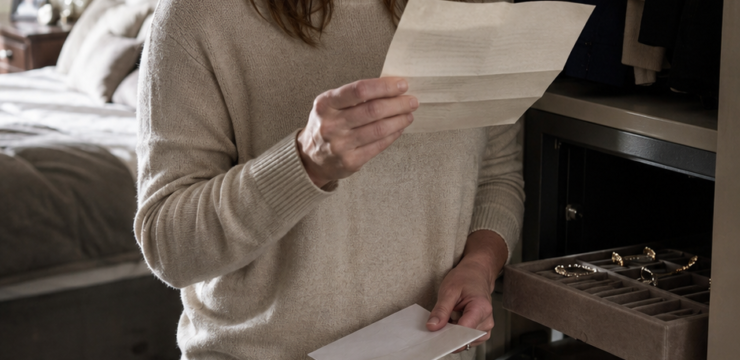
I opened the file, reading the surrender documents signed by my father. The ink was dark, the signatures harsh and final. But it was the handwritten letter tucked in the back of the file, written by my mother to her unborn son, that finally broke me.
FULL STORY — PART 3
I sat in the quiet, sterile room of the bank, the tears falling freely onto the old legal papers.
My mother’s letter laid bare a truth that completely rewrote the history of my family. In the winter of 1964, my parents were drowning in debt. My father had just lost his job at the steel mill, and they were facing foreclosure on their small apartment. When my mother went into labor and the doctors delivered not one, but two babies, my father panicked.
The adoption agency file revealed that my brother had been born with a severe, correctable heart murmur that required immediate, expensive surgery. The hospital informed my parents that they could not leave with the boy unless they could prove they had the financial means to care for his medical needs.
Terrified of losing everything, and driven by a misguided sense of masculine pride that refused to accept charity, my father made a unilateral decision. He signed the surrender papers without my mother’s consent while she was heavily sedated from the difficult birth. He arranged for the agency to take my brother and place him with a wealthy family in Philadelphia who could afford the surgery.
*He told me it was the only way to save your life,* my mother had written in her final letter to the son she lost. *He told me we would lose both of you if we didn’t give you up. I was weak. I was scared. And I let him do it. I have lived every day of my life in a prison of my own making, loving a daughter I kept, and mourning a son I betrayed.*
I packed the contents of the box into my bag and drove straight to my father’s apartment.
When he opened the door, he didn’t look at me. He just walked over to his small armchair and sat down, staring at the floor. I dropped the heavy stack of sixty-two unmailed birthday cards onto the coffee table in front of him.
“You stole my brother,” I said, my voice trembling with a rage I had never felt before. “You made her give away her child, and you forced her to mourn in secret for sixty years.”
My father buried his face in his hands, his shoulders shaking with frail, ancient sobs. “I thought I was saving us,” he wept. “We had ten dollars to our name. The doctors said he would die without the surgery. I couldn’t pay for it. I thought… I thought if she had you, she would eventually forget the pain.”
“You don’t forget your own child,” I said fiercely. “And you didn’t save us. You broke her heart, and you broke our family from the inside out.”
I didn’t yell. I didn’t throw things. The tragedy of the situation was too deep, too permanent for simple anger. I looked at the broken old man sitting in the chair, realizing that his pride and fear had cost him the one thing he was trying to protect.
“Did she ever find him?” I asked quietly, pointing to the cards.
My father nodded slowly, wiping his face. “Twenty years ago. She hired a private investigator. She knew where he was, what he did for a living, but she was too ashamed to ever make contact. The agency file… his real information is in there.”
ENDING
It took me three weeks to gather the courage to make the phone call.
When David answered the phone, his voice sounded so much like my father’s it took my breath away. He was living in upstate New York, working as a high school science teacher. He had grown up in a loving, affluent home. He always knew he was adopted, and his heart condition had been perfectly repaired when he was an infant. But he had never known he was a twin.
We met for the first time on a rainy Sunday afternoon at a quiet diner halfway between our homes.
When I walked through the doors and saw him sitting in a corner booth, time seemed to stand still. He had my mother’s soft green eyes and my father’s jawline. We sat across from each other, two halves of a whole that had been separated for six decades, and talked until the diner closed. I gave him the sixty-two birthday cards our mother had written for him. I watched as this grown man wept, finally understanding that he had never been unwanted or forgotten.
My relationship with my father remains fractured. I make sure his medical needs are met, and I visit him once a week to ensure he is safe, but the warm, naive affection I once held for him is gone. The weight of his lie is too heavy to carry comfortably.
But out of that profound betrayal, a new family was born. David and his wife joined me for Thanksgiving this year. We stood together in the cemetery on the anniversary of our mother’s death, placing two identical bouquets of blue hydrangeas on her grave.
As I stood beside the brother I never knew I had, I finally understood the depth of my mother’s silent apology. She couldn’t give us a life together, but in the end, she left the breadcrumbs for me to find him. It took sixty-two years, but we finally brought him home.