FULL STORY — PART 1
The quiet inside Mama’s house had always felt heavy, like a dust-covered blanket folded over thirty years of unspoken rules. When she passed away in January at ninety-one, I moved into her small, drafty home to sort through a lifetime of accumulated silence. Mama had kept everything. Her generation didn’t throw away string, rubber bands, or memories. In the bottom of the pantry closet, tucked behind faded flour sacks and mason jars of yellowed egg money records, I found an old metal coffee can. Inside sat ration books from the war, receipts for coal delivered in nineteen-forty-something, and a thick packet of birthday cards.
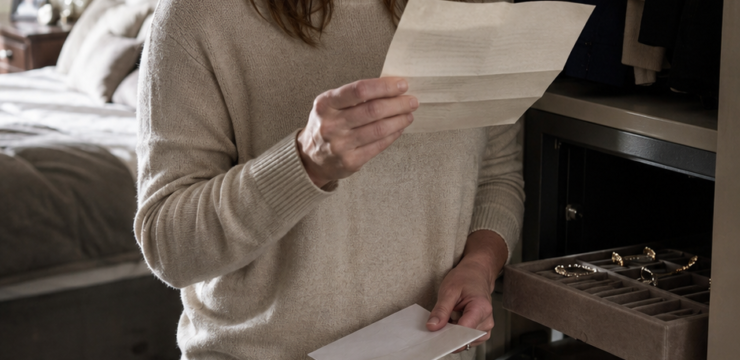
Most of them were ordinary. But near the bottom rested a single, small envelope with a faded blue postage stamp. The ink on the front was neat, written in Mama’s own sharp cursive hand before her knuckles had turned gnarled with arthritis.
*To my son on his seventh birthday.*
My breath caught in my throat. I turned the envelope over. It was stamped, mailed in November of 1965, and marked *RETURN TO SENDER* in bold red postal ink. The flap had never been opened.
I sat down on the cold linoleum floor of the cellar, the single overhead bulb humming softly above my head, and stared at the date. Mama had always told me that my brother, little David, had died as a baby in the bitter winter of 1958, long before I was born. She never took us to a cemetery, and you didn’t question Mama about things best left buried. But standing there in the damp dark, I did the arithmetic about nine times on my fingers. If he died as an infant in 1958, how could he be turning seven in 1965?
The return address printed on the corner of the envelope wasn’t our town. It was a small rural township nearly four hours north, tucked up near the state line where the pine trees grow thick and the winters bite hard.
I didn’t call anyone. I didn’t sleep that night. By eight o’clock the following morning, I had tossed my winter coat into the passenger seat of my sedan, shoved the unopened envelope into my handbag, and pointed the car north toward a secret Mama had buried for half a century.
FULL STORY — PART 2
The drive north took me through miles of desolate two-lane highway where the bare timber forests pressed close against the asphalt. By early afternoon, the GPS guided me into a sleepy, forgotten hamlet consisting of a rusted grain elevator, a shuttered hardware store, and rows of modest wooden houses with peeling paint. The return address on the 1965 envelope led me to a weathered, single-story house sitting at the end of a gravel lane, surrounded by tall pine trees that blocked out the pale winter sun.
My heart hammered against my ribs like a trapped bird as I turned my car into the narrow gravel drive and parked near an old pickup truck. For a moment, I sat paralyzed behind the steering wheel, the unopened envelope burning a hole in my bag. What was I even doing here? Was I walking into a ghost story built on a clerical error, or was I about to shatter whatever quiet life remained in this forgotten corner of the world?
Before I could reach for the door handle, the front door of the house creaked open.
An older man stepped out onto the wooden porch before I even had a chance to knock. He was seventy-some years old, tall, broad-shouldered, and wearing a faded flannel work shirt. But it wasn’t his height or his age that made my breath hitch—it was the way he moved. The slight hitch in his left stride, the heavy-footed way he walked down the porch steps to sweep pine needles off the bottom board, was identical to the way my uncle used to walk, and the way my own reflection caught me in the mirror when I was tired.
He stopped midway down the steps, resting his weathered hands on the broom handle, and stared at my out-of-state license plates with cautious curiosity.
“Can I help you, ma’am?” he asked, his voice deep, gravelly, and entirely unfamiliar, yet carrying an echo that made the hairs on my arms stand on end.
I opened my car door, my legs trembling slightly as my boots crunched against the gravel. I pulled the worn envelope from my purse and held it out toward him like a shield.
“I’m looking for the people who lived here back in sixty-five,” I said, my voice shaking despite my best efforts to steady it. “And… I think my mother was supposed to send this to you.”
FULL STORY — PART 3
The man lowered the broom slowly, his dark eyes narrowing as he focused on the small, yellowed envelope in my hand. He didn’t reach for it immediately. Instead, his gaze traveled up from the paper to my face, lingering on the shape of my jaw and the color of my eyes with a sudden, piercing intensity.
“Where did you get that?” he asked, his voice dropping into a harsh, guarded whisper.
“In my mother’s pantry,” I replied, stepping closer. “She passed away last month. Her name was Clara Henderson. She always told me she lost her firstborn boy in the winter of fifty-eight. But this letter… it’s dated nineteen-sixty-five. Addressed to her son on his seventh birthday. And it was returned to sender.”
The color drained entirely from the man’s weathered face. He gripped the wooden broom handle so tightly his knuckles turned chalk-white. He looked down at the envelope again, reading the faded handwriting that he must not have seen in over half a century.
“Clara…” he murmured, the name tasting strange and heavy on his tongue. He let out a long, ragged breath that misted in the cold air. “She didn’t lose me in fifty-eight, ma’am. Not the way she told you. My father took me after the separation. He packed me up in the middle of the night and brought me up here to live with his sister before the courts could sort it out. Clara spent years trying to find us, but by the time she tracked this address down…” He pointed a calloused finger at the red postal stamp. “We had already moved two miles down the road to my aunt’s farm. The post office returned it because she didn’t know our new box number.”
I stared at him, the sprawling puzzle of my family’s history sliding violently into place. “She never told me,” I whispered, tears blurring my vision. “She just… pretended you were gone. She locked the door on her own grief and built a lifetime around a lie.”
He looked at me with a profound, quiet sorrow, the defensive wall around him crumbling into dust. He set the broom against the porch railing, stepped down the remaining steps, and closed the distance between us.
“She wasn’t the only one who lived with a ghost,” he said softly, his voice thick with emotion. “I grew up wondering why my mother never came for me. And now… sixty-eight years later, you walk up my driveway carrying a letter that was forty years too late.”
ENDING
We didn’t go inside right away. We stood out there in the freezing northern wind for over an hour, talking about the decades we had both missed, tracing the missing branches of a family tree that Mama had pruned away with her own stubborn pride. He wasn’t a stranger anymore; he was my flesh and blood, a living brother I had never known existed, carrying the exact same quiet resilience that had defined our mother’s generation.
When I finally drove back down that gravel lane as dusk settled over the pine trees, the heavy, dusty silence that had weighed down Mama’s house for my entire life was gone. The unopened birthday card sat safely on the passenger seat between us—no longer a symbol of loss and bitter secrecy, but the bridge that finally brought us home. Mama had tried to bury the past in an old coffee can, but some truths refuse to stay in the dark. And though it took a lifetime to find him, I finally knew who my brother was.