PART 2:
My pulse quickened. The silence in the garage suddenly felt heavy, broken only by the steady drum of spring rain hitting the corrugated metal roof. I grabbed a stubby screwdriver from my workbench, leaned down, and began backing out the screws. They resisted at first, squeaking in protest against rusted threads, but one by one they gave way. When the fourth screw came free, I lifted the steel tray out and set it aside.
The moment I saw what had been sealed beneath it, I stopped breathing.
There were no more uniforms. Instead, the entire base of the footlocker was filled with a collection of personal items that belonged in a police evidence locker rather than a soldier’s kit. There was a leather-bound journal with water-stained pages, a handful of undeveloped 35mm film canisters, a stack of newspaper clippings yellowed with age, and, resting right on top, a small, polished silver pocket watch with its crystal cracked clean down the center. I picked up the watch and turned it over. Inscribed on the back in delicate cursive were the initials *E.J.M.* and a date: *October 14, 1968*.
I carefully opened the journal. The handwriting inside was frantic, cramped, and written in fading blue ink. The first few pages detailed routine motor pool assignments from an army base in Georgia, but as I flipped further, the tone shifted dramatically. Entries from late 1968 described a mounting terror. The writer—who signed his entries only as ‘Eddie’—talked about a cover-up, a missing civilian woman named Evelyn Miller, and a military truck that had been driven off a logging road into a ravine near a training installation. And then, a name leaped off the page that made my blood run cold.
*Arthur Vance.*
My grandfather. Arthur Vance, who had passed away when I was ten—a quiet, stoic man who had spent his post-military life working as a plant manager in Springfield and never spoke a word about his service. According to the journal, my grandfather hadn’t just been stationed with Eddie; he had been the last person seen with Evelyn Miller before she vanished from a diner four miles outside the base gates fifty-eight years ago.
I pulled out the newspaper clippings. The headlines stared back at me in bold, accusatory black print: *LOCAL WOMAN MISSING NEAR FORT KNOX — POLICE SUSPECT FOUL PLAY.* Below it, a grainy photograph showed a young woman with dark hair and a bright, hopeful smile. The date on the paper was October 18, 1968. I sorted through the remaining items until my fingers brushed against a thick, manila envelope tucked beneath the film canisters. Inside was a certified copy of a police report from the Dayton Police Department, dated 1994—long after the original investigation had gone cold. Someone had reopened the case decades later, and the handwritten notes scrawled in the margins indicated that investigators had suspected a military cover-up all along, but had lacked the physical evidence to tie my grandfather to the missing person’s car, which had never been found.
I sat back on my heels on the cold concrete floor, the open footlocker between my legs, realizing that the grandfather I thought I knew had carried a dark, decades-old secret to his grave. And now, by pure chance, that secret had been dumped into my lap for one hundred and forty dollars.
PART 3:
The realization settled over me like a physical weight. For three days, I kept the footlocker hidden in the trunk of my car, unable to sleep, staring at the ceiling while the journal’s entries played through my mind. I wrestled with what to do. Should I burn the contents and pretend I never found them? Should I take them to the local authorities and drag our family name through the mud for a crime committed half a century ago? Or was there a family still out there, fifty-eight years later, wondering what happened to Evelyn Miller?
On the fourth morning, I made my decision. I drove down to the Dayton public library and spent hours cross-referencing old obituary archives and missing persons follow-ups. I discovered that Evelyn Miller had a younger sister, Clara, who would now be in her eighties, living in a quiet retirement community just north of Springfield. She had spent her entire life placing memorial notices in the local paper every October, searching for answers that never came.
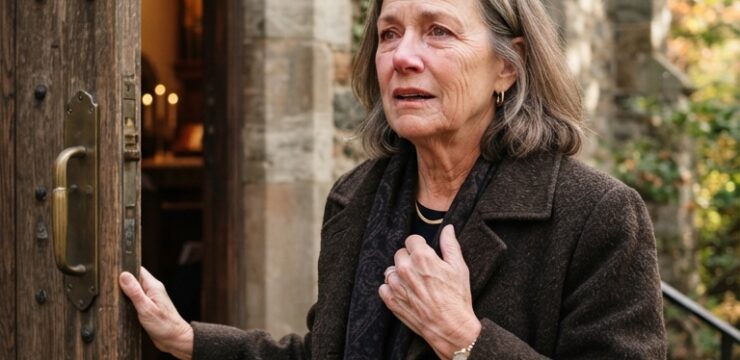
I didn’t go to the police first. Instead, I drove out to Clara’s residence on a quiet Tuesday afternoon, the heavy manila envelope tucked securely under my arm. When an elderly woman with silver hair and kind, tired eyes opened the door of her apartment, I introduced myself as Arthur Vance’s grandson.
The color drained from her face, and for a terrifying second, I thought she was going to slam the door in my face. But as I pulled the silver pocket watch from my pocket and held it out, her hands began to tremble.
“That was her watch,” Clara whispered, her voice cracking as tears welled in her eyes. “She wore it every single day. Where… where did you find this?”
I invited myself in—or rather, she pulled me inside—and I laid out everything: the footlocker, the journal, the police reports, and the photographs. We sat at her small laminate kitchen table for three hours. I watched the decades of grief, anger, and unanswered questions wash over her face as she read Eddie’s frantic journal entries detailing how my grandfather had panicked, hid the car in a disused quarry drainage tunnel, and swore Eddie to secrecy under threat of a court-martial. It wasn’t a neat story, and it didn’t redeem my grandfather. It laid bare a cowardly, devastating truth that had haunted Eddie until his own dying day—driving him to lock the evidence away in a military footlocker and abandon it in a storage unit where he hoped it would never see the light of day.
When Clara finished reading the final page of the journal, she let out a long, shuddering breath that seemed to expel half a century of ghosts. She reached across the table and placed her frail hand over mine.
“Thank you,” she choked out, wiping a tear from her cheek. “You didn’t have to bring this to me. You could have walked away. But my sister finally gets to come home.”
ENDING:
Two weeks after my visit with Clara, we met with a retired detective who agreed to review the new evidence. Using the coordinates detailed in Eddie’s journal—specifically mentioning an old limestone quarry near the county line—authorities brought in specialized search teams. Three days later, local news stations flashed reports that the rusted chassis of a 1965 Chevrolet Corvair had been pulled from a flooded sinkhole, bringing closure to one of the region’s oldest missing persons cold cases.
The fallout within my own extended family was immediate and severe when the truth came out. My aunts and uncles refused to speak to me for months, accusing me of dragging our family name through the mud for the sake of curiosity. They argued that since my grandfather was dead, the past should have stayed buried. But whenever the doubt crept in, I thought of Clara standing by her kitchen window, finally holding her sister’s silver pocket watch after fifty-eight years of empty Christmases and silent Octobers.
The garage in Beavercreek is quiet again now. The footlocker is gone, handed over to the state bureau of criminal investigation along with its damning contents. My life went back to normal on the surface, but I can never look at my family tree the same way again. I learned that history isn’t just what we write on headstones or whisper at Thanksgiving dinner; sometimes, it’s waiting in a forgotten metal box in a Dayton storage unit, traded away for loose change, just waiting for someone brave enough to open the lid.