PART 1
My mother gave my brother power of attorney after her stroke because he lived closer.
I lived forty-five minutes south in Peru, working full-time at the county water board, while Nathan lived four blocks away from Mom’s senior apartment complex in Marion. When Mom had her mild ischemic stroke eighteen months ago, she lost some strength in her right hand and got flustered trying to balance her checkbook. Nathan stepped right up at the kitchen table.
“I can walk over every Tuesday after work, Claire,” Nathan told me while Mom was still resting in her recliner. “I will pay the utility bills, manage her pharmacy orders, and balance the ledger. You have the long commute and your own household. Let me handle the day-to-day paperwork.”
I trusted him. He was forty-two, married to his second wife, Vanessa, and had worked for fourteen years as a shift supervisor at the corrugated box plant. He was our mother’s only son, and he had never given me a reason to doubt him.
Then, around the middle of last winter, Mom started mentioning money every time I came up for Sunday visits.
She was seventy-six. She received a steady monthly pension from thirty years as an administrative clerk at the public library, plus her Social Security, bringing in a little over $3,100 every month.
Her rent at Meadow Creek was subsidized, capping her basic living expenses at $1,200. There should have been plenty left over for small comforts.
Instead, I noticed her winter boots had cracked soles taped together with black electrical tape.
“Mom, why haven’t you replaced these?” I asked, kneeling by her closet door in January. “You’re going to slip on the walkway.”
“Nathan says things are very tight right now, Claire,” Mom whispered, her hands clasped in her lap. “He said the physical therapy co-pays from last summer are still being billed, and the supplemental insurance refused two of my heart prescriptions. He asked me to hold off on getting my hair cut at the salon down the hall, too.”
I called Nathan that evening from my car.
“Nathan, why is Mom walking around in taped boots?” I asked. “Her income is three thousand a month. Where is her pension going?”
“Medical bills, Claire,” Nathan said, sounding exhausted and short-tempered. “The hospital cardiology group had an out-of-network charge from her hospital stay that we’re paying down at three hundred dollars a month. Plus her blood thinners jumped to two hundred and twenty a refill. I’m doing the best I can to stretch it. You only see her on Sundays. You don’t see the pharmacy receipts.”
I believed him. I felt guilty for questioning him, so I went to the department store the next day, bought Mom a pair of warm, nonslip winter boots out of my own pocket, and paid forty dollars in cash to the building’s salon so she could get her hair washed and set.
I probably would have kept quiet forever if not for a system glitch on a Thursday afternoon in late March.
Years ago, before Mom’s stroke, I had helped her set up her online profile at First Community Credit Union, and my old work email had been entered on the secondary notification line.
Nathan had changed the primary mailing address to his own house, but whoever updated the security settings at the branch forgot to scrub the secondary alert contact.
At 2:14 PM, a transaction notification popped up in my inbox.
It was an outgoing electronic wire transfer from Mom’s primary checking account for exactly $9,800.
The recipient on the notification was not a cardiology clinic, a pharmacy warehouse, or a hospital billing department.
The money had been wired directly to Lakeview Marine & Powersports in Syracuse.
Nathan didn’t own a boat. Nathan drove an eight-year-old pickup truck and had never set foot on a lake in his life.
His wife, Vanessa, did. Vanessa’s family owned a summer trailer on Lake Wawasee, and for two years, Vanessa had been posting pictures on social media about wanting a new pontoon boat for the family lot.
I printed the wire confirmation, packed the rest of Mom’s old bank tax statements from my home desk into a folder, and drove straight to Marion.
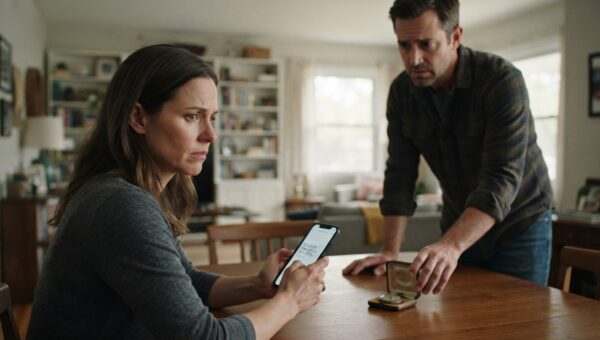
Mom was sitting in her floral armchair, watching a game show with the volume turned low. When I laid the printed wire confirmation on the coffee table beside her glasses case, she picked it up and held it two inches from her eyes.
“What is Lakeview Marine?” Mom asked, her brow furrowing. “Claire, is this an advertisement?”
“It’s nine thousand eight hundred dollars taken out of your checking account this morning, Mom,” I said. “Did you authorize Nathan to send this money?”
Mom’s face went completely still. She looked at the date, then at the account balance printed below it: $412.
“I never signed any of this,” Mom said, her voice shaking. “Nathan told me on Tuesday that I only had eighty dollars left in checking. He said I couldn’t buy my ginger ale this week.”
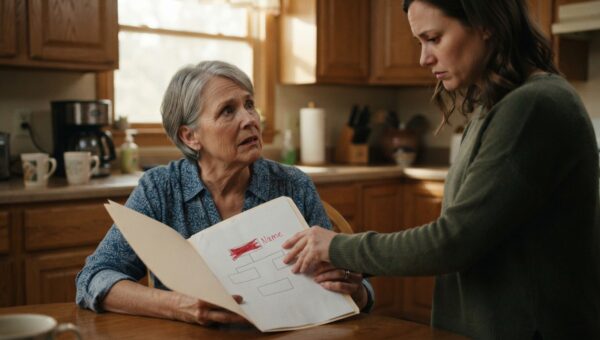
She pushed herself up from the chair with her good arm, walked slowly across the carpet to the small cherry side table, and pulled open the bottom drawer. She took out a stapled packet of legal paper in a blue cardboard jacket and handed it to me.
“This is the paper Nathan brought me from the courthouse last year,” she said. “He told me it was the general power of attorney.”
I flipped to the final page.
Under the statutory durable financial power of attorney clause was Mom’s signature: *Evelyn Miller.*
The letters were clean, smooth, and upright.
Mom had suffered her stroke on September 4th. The document was dated September 18th. By September 18th, Mom couldn’t hold a pen without her hand trembling so badly the letters looked like jagged barbed wire.
The signature at the bottom looked completely wrong. It was the firm, confident signature Mom used to have ten years ago, not the ragged scrawl she used now.
Below her name was the official stamp and seal of a local mobile notary public named Brenda Cole.
I took out my phone, snapped a clear photograph of the signature and the notary seal, and found Brenda Cole’s registered office number through the state secretary of state directory. I texted the image to the business mobile number listed on her site, accompanied by Mom’s name and the date.
Five minutes later, while I was still standing in Mom’s small kitchen, my phone rang.
The woman on the line spoke quickly, her voice sharp and anxious: “Mrs. Miller? I am looking at the document you just sent me. That is my notary stamp, but I did not notarize that document. My journal from September 2024 has no record of Evelyn Miller. That stamp was stolen from my office desk eighteen months ago.”
PART 2
Brenda Cole did not hang up. She stayed on the phone with me for nearly twenty minutes, pulling her old office logs and explaining what had happened in the autumn of 2024.
“I ran a small title and mobile notary service out of the professional building on 4th Street,” Brenda said, her keyboard clicking rapidly in the background. “On September twenty-first of that year, my office was broken into over a weekend. A lockbox was pried open, and three notary embossers were taken, along with my state seal stamp. I filed a formal police report with the Marion City Police on Monday morning, surrendered my old commission number, and received a newly issued commission from the state.”
She read the commission expiration date printed inside the stamp on the photo I had sent.
“That stamp was voided by the state on September twenty-second, 2024,” Brenda said firmly. “Whoever stamped that document used a reported stolen seal. And I certainly never met your mother.”
I wrote down the police report number Brenda gave me on the back of the wire transfer receipt.
“Who broke into your building, Brenda?” I asked. “Did they ever catch anyone?”
“No,” Brenda replied. “The front door had been jimmied, but there were no security cameras in the hallway back then. The police figured it was someone looking for petty cash or prescription pads from the dental clinic next door.”
The dental clinic next door.
Vanessa, Nathan’s wife, had worked as an office receptionist and billing clerk for that exact dental clinic for six years. Her office shared the second-floor restrooms and the rear service exit with Brenda Cole’s suite.
I sat down on Mom’s sofa. The room felt uncomfortably quiet.
Nathan hadn’t just taken over Mom’s bills out of convenience. He and Vanessa had fabricated a fraudulent legal document using a stolen notary seal from Vanessa’s workplace, had it filed with Mom’s bank, and used it to grant Nathan complete, unsupervised access to every single dollar Mom had accumulated.
Mom sat in her floral chair with her hands folded over her chest, watching me write down the numbers.
“Claire,” Mom whispered. “Did Nathan do something bad?”
“Yes, Mom,” I said, looking directly into her tired eyes. “He did.”
“I don’t want him in jail,” she said, her voice cracking with that terrible, instinctive maternal panic that never really goes away, no matter how old the child is or what they have done. “He’s my boy. He has two little girls.”
“He stole nine thousand eight hundred dollars from you this morning to buy a boat for Vanessa,” I told her gently. “He let you walk around in cracked shoes while he drained your life savings. We have to stop him, Mom. If we don’t, you will be evicted from this apartment by summer.”
I helped Mom put on her coat, took her purse, and drove her to the main branch of First Community Credit Union on Adams Street.
We didn’t see a teller. I asked for the branch manager, Mr. Henderson, an older gentleman who had managed the credit union for over twenty years and knew Mom by sight from her years at the library. We sat in his glass-walled office with the door closed.
I laid the documents on his desk: the Lakeview Marine wire confirmation, the forged power-of-attorney form, the police report number from Brenda Cole, and Mom’s original signature card from 2012.
Mr. Henderson put on his reading glasses and pulled up Mom’s account history on his computer terminal. As he scrolled through the electronic transactions, his expression hardened.
“Mrs. Miller,” Mr. Henderson said quietly, turning to my mother. “This power of attorney was presented to our branch on October second, 2024, by your son, Nathan. Because it bore a state notary seal and appeared facially valid under our intake guidelines at the time, our clerk accepted it and added Nathan as your legal attorney-in-fact.”
He turned the screen toward me.
Over the last seventeen months, Nathan had not just sent $9,800 to a boat dealer.
There were monthly recurring transfers of $850 sent to a personal credit card in Vanessa’s name. There were cash withdrawals of $400 every other Friday at the drive-through ATM. There were direct payments to an auto loan company for a late-model sport utility vehicle.
In total, since Mom’s stroke in September 2024, Nathan had siphoned $36,400 out of her accounts.
Mom’s once-comfortable reserve of $38,000, which she had saved over decades to cover long-term nursing assistance if her health failed, was reduced to exactly $412.18.
Mr. Henderson didn’t hesitate. He immediately placed an administrative fraud freeze on the checking and savings accounts, revoked Nathan’s online credentials, and drafted an internal affidavit of forgery for Mom to execute on the spot with her shaky, authentic hand.
Then he picked up his desk phone.
“I am contacting our regional fraud investigations department,” Mr. Henderson said. “And because Lakeview Marine is a participating commercial partner with our credit union network, that nine-thousand-eight-hundred-dollar wire transfer sent this morning has not fully settled into their merchant account yet. It is in forty-eight-hour escrow hold pending final clearance tomorrow at noon.”
He tapped a key on his board. “I am placing a stop-payment and recall on that wire right now.”
PART 3
We left the bank at four o’clock.
I took Mom home, made sure her deadbolt was locked, and told her not to open the door for anyone. Then I drove the four blocks to Nathan’s house on Maple Street.
Nathan’s truck was parked in the driveway beside Vanessa’s white SUV. Behind the SUV sat an empty boat trailer with brand-new chrome wheels and temporary dealer tags, parked on the lawn near their front porch.
I didn’t knock politely. I walked onto the porch and hammered my fist against the wooden storm door.
Vanessa opened it. She was thirty-eight, wearing leggings and an oversized college sweatshirt, holding a glass of iced tea. When she saw me, her friendly expression tightened into something guarded.
“Claire? What are you doing here on a Thursday?”
“Where is Nathan?” I asked, stepping right past her into the living room without waiting for an invitation.
Nathan walked out of the kitchen with a sandwich on a paper plate. He looked surprised, then annoyed.
“Claire, what’s the rush?” he said, setting his plate on the end table. “We were just about to sit down.”
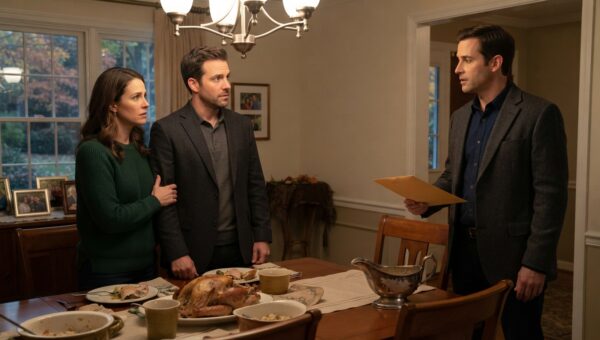
I took the copies of the bank statements, the wire recall notice Mr. Henderson had given me, and the photograph of Brenda Cole’s stolen notary seal, and tossed them squarely onto the glass coffee table between their matching leather recliners.
The papers slid across the glass, fanning out under the lamp.
Nathan looked down. His eyes caught the bold black letters: *LAKEVIEW MARINE & POWERSPORTS — WIRE RECALL PENDING.*
Vanessa set her tea glass on the kitchen counter with a sharp rap. “What is that?”
“The bank stopped the nine thousand eight hundred dollars, Vanessa,” I said. My voice was low, flat, and completely steady. “The boat dealer isn’t getting paid tomorrow. And the credit union fraud division has opened an investigation into the thirty-six thousand four hundred dollars you two have taken out of Mom’s accounts since her stroke.”
Nathan’s face lost all its color. He looked from the papers to me, his mouth opening slightly, but nothing came out.
“Claire, wait a minute,” Nathan stammered, holding up his hands. “You don’t understand how the medical bills worked. I had to shift money between accounts to keep her balance clear. I was going to replace that wire with our tax return next month.”
“Stop talking, Nathan,” I said. “Mom never signed that power of attorney. You brought a forged document into First Community Credit Union with a notary seal that was stolen from Brenda Cole’s office two days after Mom had her stroke.”
I turned my head and looked directly at Vanessa.
Vanessa had backed up against the kitchen doorway, her arms wrapped tightly around her waist. Her lips were pressed into a thin, bloodless line.
“Brenda’s office was broken into on September twenty-first, Vanessa,” I said. “Right next door to the dental clinic where you keep the appointment ledger. The police report is on that table. The state voided that seal eighteen months ago.”
“I didn’t break into anything!” Vanessa shouted, her voice jumping an octave into pure panic. “Nathan, tell her! We didn’t do anything illegal! You have power of attorney! Your mother told you to take care of everything!”
“Mom told him to pay her utility bills!” I shouted back, stepping toward them. “She didn’t tell you to buy an eight-hundred-and-fifty-dollar a month wardrobe on her pension! She didn’t tell you to buy a boat trailer while she walked around in taped shoes and drank tap water because she couldn’t afford a five-dollar case of soda!”
Nathan sank into his recliner, putting his head in his hands.
“Claire, please,” Nathan whispered into his palms. “The girls… if the police get involved, I’ll lose my supervisor spot at the plant. Vanessa will lose her clinic job. We’ll lose the house.”
“You should have thought about your daughters before you robbed an old woman in a senior apartment,” I said. “Mom has four hundred and twelve dollars left to her name because of you. She worked thirty years at the library to save that money so she wouldn’t have to depend on state welfare.”
Vanessa stepped forward, her eyes wet with angry, defensive tears. “What do you want, Claire? You want us to beg? We don’t have thirty-six thousand dollars in cash sitting in an envelope. We spent it. We have bills, too. Life is expensive.”
“You have that empty boat trailer on your lawn,” I told her. “You have your white SUV. And Nathan has his pension rollover from his first job.”
I pulled out the legal demand letter Mr. Henderson had drafted alongside the bank’s fraud investigator.
“Here are the terms,” I said, pointing at the paper. “Nathan signs a formal revocation of his power of attorney today. I take over as Mom’s sole legal conservator through probate court on Monday morning. Lakeview Marine gets their trailer back tomorrow morning, and the deposit they took on that boat goes straight back to Mom’s account.”
Nathan looked up, his eyes rimmed in red. “And the rest? The twenty-six thousand?”
“You will execute a formal promissory note secured against your house equity,” I said. “Five hundred dollars a month, paid directly into Mom’s trust account on the first of every month, until every single dollar of the thirty-six thousand four hundred is repaid. With five percent interest.”
Vanessa shook her head frantically. “Five hundred a month? We can’t afford that! That’s our grocery budget!”
“Then you can explain your grocery budget to the Grant County prosecutor,” I replied, picking up my purse. “Because Brenda Cole is already waiting for the detective’s call about her stolen seal. You have until nine o’clock tomorrow morning to sign the papers at Mr. Henderson’s desk. If you aren’t there, the bank forwards the file to the county sheriff.”
I turned around, walked out the front door, and shut the storm door behind me without looking back.
ENDING
Nathan was standing on the sidewalk outside First Community Credit Union at eight-forty-five the next morning, wearing his work jacket, with his hands jammed into his pockets.
Vanessa was not with him.
He didn’t look at me when I pulled up to the curb. We walked into Mr. Henderson’s office together in complete silence. Over the next forty minutes, Nathan signed every single line the bank attorney put in front of him: the formal surrender of all fiduciary authority, the affidavit acknowledging the fraudulent procurement of the 2024 power of attorney, and the recorded promissory lien against his Maple Street home for $26,600.
The $9,800 wire to Lakeview Marine was successfully reversed by noon. The boat dealer took back the trailer from Nathan’s lawn that afternoon, refunded the holding deposit, and canceled the purchase order.
Because full civil restitution was established and secured by a recorded lien, and because Mom specifically requested that her son not be sent to prison, the bank’s internal legal counsel agreed not to push for immediate criminal indictment, provided the monthly payments were made without default.
Mom’s account was restored to safety.
On Monday, the county probate court granted me temporary emergency guardianship over Mom’s estate, which was finalized into permanent conservatorship six weeks later. Every statement now comes to my home in Peru, and every withdrawal requires two-factor verification through my personal device.
The family we had before that Thursday is gone.
Nathan sends his five-hundred-dollar cashier’s check on the first of every month like clockwork. The envelope has his name on the return label, but there is never a note inside. He does not come to Meadow Creek on Tuesdays anymore. He did not come to Easter dinner, and when Mom turned seventy-seven in June, his daughters sent a handmade card in the mail, but Nathan did not call.
Mom still asks about him sometimes on Sunday afternoons. She will look toward the window when she hears a truck engine on the street, her eyes lingering on the parking lot for a few seconds before she turns back to her puzzle. She knows what he did, and she knows why he cannot manage her money, but thirty years of raising a son cannot be erased by an audit ledger.
I don’t bring up his name, and I don’t talk about Vanessa.
Last Saturday, I drove up to Marion early. The morning was clear and cool, with the autumn leaves just beginning to turn yellow along the bypass.
I took Mom down the boulevard to the shoe shop near the square. We spent forty minutes trying on different styles until she found a pair of soft black leather walking shoes with sturdy rubber soles and easy Velcro straps that she could fasten with her left hand.
I paid the clerk sixty-five dollars from Mom’s restored checking card, took the box under my arm, and walked her out to the sidewalk.
Mom took my arm, stepped down off the curb onto the solid concrete, and smiled down at her feet.
“These don’t pinch at all, Claire,” she said, her voice clear and untroubled in the morning air.
“They’re yours, Mom,” I told her, opening the car door. “They’re completely yours.”