PART 1
The hospital waiting room was where I thought I would be on a Tuesday morning in October. I had my overnight bag packed by the front door for three weeks. It had two changes of clothes, a knit yellow blanket I spent four months finishing, and a camera with fresh batteries.
Then my son, David, called at five in the morning. His voice was hushed, rushed, and flat.
He told me Rachel had gone into labor, but she had specifically asked that nobody come to the hospital. Not her family, not me. He said she was overwhelmed, in terrible pain, and did not want visitors under any circumstances.
“Mom, please just respect her wishes,” he told me over the hum of hospital machinery. “You know how anxious she gets. If you show up, it will only cause friction between her and me. I will call you when we are home and settled.”
I sat on the edge of my bed with my hand resting on the yellow blanket. It hurt, more than I wanted to admit to myself. I had known Rachel for four years, and while she was a quiet, private girl, we had always gotten along just fine. We traded soup recipes and worked together in her small garden bed every spring. But childbirth is personal, and young mothers carry stress in ways I figured I had forgotten.
I told myself not to be selfish. I did not want to be the overbearing mother-in-law who stomps over boundaries on the most vulnerable day of a woman’s life.
So I stayed home. I washed my kitchen cabinets. I pulled weeds until my knees ached. On Wednesday, David sent a single picture of my grandson, Leo, swaddled in white flannel. Underneath, he texted: “Exhausted. We need space. Please do not call or drop by.”
I respected that. I swallowed my grief, told my friends at church that the new parents needed quiet bonding time, and waited.
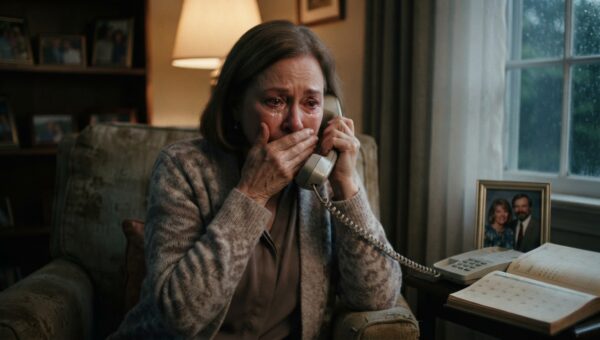
On Friday morning, three days after Leo was born, my landline rang. I picked it up, expecting David.
It was Rachel. Her voice was cracked, raw, and trembling with exhaustion, but underneath it was an anger that cut right through the line.
“Why didn’t you come?” she asked. There was no greeting. Just that blunt, ragged question.
I gripped the kitchen counter. “Rachel, honey? David told me you asked for absolute privacy. He said you were too overwhelmed for visitors.”
The silence on the other end lasted so long I thought the call had dropped. When she spoke again, her breath caught in a dry sob.
“I waited two days for you,” Rachel whispered. “David told me he called you three times from the labor room. He said you told him you were too busy with your garden club, that you didn’t care to sit in a hospital room, and that you would see the baby whenever it was convenient for you.”
The air went clean out of my lungs. “Rachel, I swear to God on my life, that is not true. I had my bag packed by the front door. He told me you didn’t want me there.”
“He is at the grocery store right now,” she said, her voice shaking violently. “Get in your car. Come here right now.”
I did not put on a coat. I grabbed my purse and car keys, left the front door unlocked, and drove the twelve minutes to their house with my hands shaking on the steering wheel.
Rachel opened the door holding Leo against her shoulder. Her face was pale, with purple shadows under her eyes and dried tear tracks down her cheeks. She looked at me, saw my face, and stepped back to let me in. We did not even hug. The sheer shock hanging between us was too thick.
“Look at the kitchen table,” she said, nodding toward the back room.
I walked in. On the round wooden table, right next to a pile of unopened mail and baby bottles, lay a standard yellow legal pad. It was covered in David’s handwriting, neat and precise, just like he had been taught in school.
Down the left side of the page were eleven separate dates, stretching all the way back to mid-April. Beside each date was a notation of an excuse.
“Told Mom Rachel has severe morning sickness.”
“Told Rachel Mom went to Atlantic City with church.”
“Canceled Sunday dinner. Told Mom Rachel’s mother was visiting.”
“Told Rachel Mom refused to host baby shower.”
Eleven dates. Eleven deliberate lies told to both of us to keep us from speaking directly, to make sure neither of us ever picked up the phone to verify the story.
At the bottom of the page, underlined twice in heavy blue ink, was a single sentence:
“Keep them separated until after Mom signs.”
My knees felt weak. I held onto the back of a kitchen chair to steady myself. “Rachel, what in heaven’s name is this? What am I supposed to sign?”
Rachel did not answer right away. She walked over to the built-in desk near the pantry, opened the deep bottom drawer, and pulled out a heavy manila folder. She dropped it on the table right over the yellow notepad.
Inside was a professionally prepared legal packet. My name, Evelyn Carter, was typed across the top, followed by the exact parcel number and street address of the three-bedroom colonial home my late husband, Thomas, and I had purchased forty-one years ago. The house was fully paid off. It was the only real asset I had left in this world.
I flipped the page. It was a quitclaim deed, transferring full ownership of my home to David for the legal consideration of ten dollars. Attached behind it was a private equity bridge loan agreement for two hundred and eighty thousand dollars, already filled out with David’s signature, listing my home as the sole collateral.
PART 2
The paperwork felt cold under my fingers. I read the clauses twice, my eyes blurring on the legal terms. It was a quitclaim deed transferring my deed entirely to David, and the loan agreement behind it was through an unregulated private lender with an interest rate of twelve percent. The terms stated that if monthly payments of nearly three thousand dollars were missed for sixty consecutive days, the lender could immediately initiate non-judicial foreclosure.
“Where did you find this?” I asked Rachel.
“He left his briefcase unlocked yesterday when he went to pick up prescriptions,” she said, shifting the baby in her arms. Leo made a tiny snuffling sound against her chest. “He told me three months ago that you were planning to give us your house as an early inheritance so we could sell it, buy a larger place with an in-law suite, and all live together. He said you were so proud of him, but that you wanted it kept a secret until after the baby arrived because you didn’t want your sisters interfering.”
“I never had a conversation like that with him,” I said. My voice sounded hollow in the quiet kitchen. “Not once. Not a single word.”
“I know that now,” Rachel said quietly. She looked exhausted, but her eyes were steady. “When he came back from the pharmacy yesterday, he had a notary coming to your house this evening. He told me he was going to bring you soup, let you see Leo for twenty minutes, and have you sign ‘trust updates’ while you were holding the baby. That was when I started digging through his desk.”
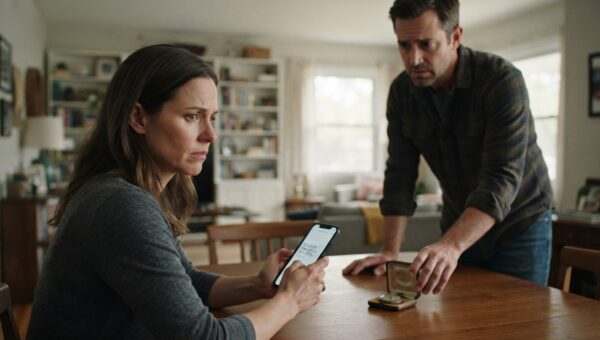
She pulled out her phone and set it on the table. On the screen was a screenshot of a business bank account balance. It showed a negative balance of fourteen thousand dollars. Underneath it was a string of text messages between David and an unknown number, arguing about past-due commercial lease payments and personal guarantees on a failed logistics consulting firm he had started two years ago.
David had told me his business was thriving. He wore tailored suits to Sunday dinners, drove a leased luxury sedan, and constantly talked about expanding his corporate accounts. In reality, he was drowning. He had taken out merchant cash advances, depleted his and Rachel’s savings, and was weeks away from complete financial ruin. He needed my unencumbered house to secure a cash-out loan to pay off his aggressive creditors, and he knew I would never agree to mortgage my only shelter to clean up his bad investments.
Before I could speak, we heard the sound of tires rolling over the gravel driveway outside.
Rachel grabbed my wrist. “He’s back.”
The front door opened with a rattle of keys. We heard grocery bags rustling as David walked through the hallway.
“Rach?” he called out cheerfully. “They were out of the organic formula, but I got the regular kind, and I picked up some deli sandwiches for—”
He stopped dead in the kitchen doorway. The paper grocery bag slipped from his arm, and two cans of soup rolled across the linoleum, stopping against the refrigerator.
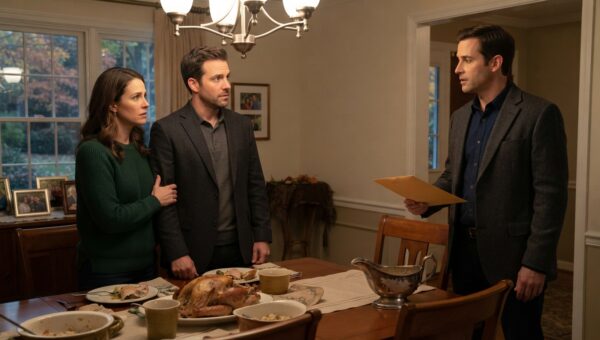
David’s eyes darted from me to Rachel, then down to the yellow legal pad and the manila folder spread open across the table. The color drained from his face until his skin looked like wet paper.
“Mom,” he said, taking half a step backward toward the hall. “What are you doing here? Rachel is supposed to be resting.”
“Rachel called me, David,” I said. I did not raise my voice. I stayed seated in the chair, looking directly at him. “She asked me why I didn’t come to the hospital. She wanted to know why I had told you that I didn’t care about my grandson.”
David swallowed hard. He looked at his wife, but Rachel turned her face away, staring down at the infant in her arms.
“That was a misunderstanding,” David stammered, raising his hands palms-out. “Things were chaotic, Mom. Rach was in labor for twenty-six hours. I got confused. I was trying to protect both of you from stress.”
“You weren’t protecting anyone,” I said, tapping my finger on the yellow pad. “You had eleven dates written down. You spent six months manufacturing arguments between two women who cared about each other, just to make sure we never compared notes.”
He looked at the pad, and for a second, a flicker of panic crossed his eyes, quickly replaced by defensive anger.
“You don’t understand the pressure I’ve been under,” he said, his voice rising. “I built a business, Mom! It hit a rough patch because clients delayed their contracts. I needed working capital for ninety days. Just ninety days! If I don’t clear those bridge loans, they will sue me personally. They will freeze our accounts and take this house. You have a four-bedroom house sitting there with no mortgage. You live alone! What do you need all that equity for when your own son is about to go under?”
“You were going to trick me into signing a quitclaim deed while I held my grandson for the first time,” I said. “You were going to let a private lender take my home when your business inevitably went belly up.”
“I would have made the payments!” he shouted.
“With what, David?” Rachel interrupted, her voice cutting through his like cold steel. “With the negative fourteen thousand in your account? Or the money you took from our joint savings that was supposed to pay our mortgage while I took unpaid maternity leave?”
David froze. The lie had run out of road.
PART 3
David looked between the two of us, realization finally setting in that there was no narrative left to spin. He sank down onto a stool at the counter, buried his face in his hands, and began to cry. It was not the crying of a man who felt remorse for what he had done to his family; it was the frantic, trapped sobbing of a man who had been caught red-handed.
“I was going to fix it,” he mumbled into his hands. “I had a big logistics contract closing in November. Once that money came in, I was going to transfer the deed right back to you, Mom. You never would have even known the difference. I swear to you, I was trying to save our family.”
“You weren’t trying to save our family, David,” I said, picking up the deed and the loan agreement from the table. “You were using me as an insurance policy for your own reckless pride. And you were willing to destroy my relationship with Rachel and my grandson to keep your secret safe.”
I folded the yellow legal pad in half and placed it inside the manila folder with the deed.
“Give me those,” David said suddenly, looking up, his eyes rimmed in red. “Those are private documents. You have no right to take them.”
“If you touch this folder, David, I will call the police right now and report attempted fraud and elder financial abuse,” I said, looking him dead in the eye. “And then I will call the title company and the private lender listed on this loan and inform them that this paperwork was prepared without the property owner’s consent or knowledge.”
He didn’t move. He sat entirely still on that stool, breathing heavily, watching me slip the folder into my large leather purse.
I stood up and walked over to Rachel. She was trembling slightly, holding baby Leo against her shoulder. For the first time in three days, I looked closely at my grandson. He had a dusting of dark hair and tiny, perfect fingers curled against his mother’s shirt.
“May I?” I asked softly.
Rachel nodded, tears slipping silently down her cheeks. She carefully transferred the baby into my arms.
Holding that little boy, feeling the warm weight of him against my chest, broke the knot of ice that had settled in my stomach since five o’clock Tuesday morning. He was completely innocent in all of this. He didn’t know about bank accounts, deeds, or lies. He just needed safety, and his father was steering the entire family toward a cliff.
“Rachel,” I said, keeping my voice calm and low so as not to startle the baby. “You and Leo are coming home with me today.”
“She is my wife!” David yelled, standing up so fast the stool scraped against the floor. “You cannot take my wife and son out of my house!”
“David, look around you,” Rachel said, turning to him with an icy certainty I had never seen in her before. “You haven’t paid the utility bill this month. You lied to me about my mother-in-law. You tried to steal her house while I was in labor. You have until tonight to figure out where you are sleeping, because I am not staying under this roof with you.”
David looked at Rachel, then at me holding the baby, and the fight drained out of him. He walked out of the kitchen, down the hallway, and slammed the front door shut behind him. A moment later, his car engine roared to life in the driveway, and he sped down the street.
Rachel sat down at the table and let out a long, ragged breath. “I don’t even have diapers packed,” she said, covering her face with her hands.
“We will pack them right now,” I told her gently. “Take your time. We have all the time in the world.”
ENDING
That afternoon, I brought Rachel and baby Leo back to my house. The yellow blanket I had knit was waiting right there on the entryway bench where I had left it. I wrapped Leo in it and laid him in the antique bassinet that had once belonged to David thirty years ago.
The next morning, I took the manila folder directly to my attorney, Arthur Vance, who had handled my husband’s estate. Arthur went through the documents, his expression growing grimmer with every page. He immediately filed a formal notice with the county recorder’s office to place a fraud alert on my property title, ensuring that no deed transfers or liens could be processed without in-person verification and an affidavit from me. He also drafted a formal cease-and-desist letter to the private lending company named in David’s packet.
Two weeks later, Rachel retained her own counsel. The financial discovery revealed that David had hidden over ninety thousand dollars in personal and business debt, including high-interest credit lines taken out in both of their names. Rachel filed for legal separation and full temporary custody of Leo.
David tried to call me several times during those first few weeks. When I refused to answer, he sent long, rambling text messages accusing me of turning his wife against him and destroying his family over what he called “a business strategy gone wrong.” He refused to acknowledge the manipulation, the eleven fabricated excuses, or the fact that he was prepared to risk my shelter to cover his bad decisions. Eventually, on Arthur’s advice, I blocked his number and directed all communication through our respective attorneys.
David ended up filing for Chapter 7 bankruptcy in late November. The consulting firm was dissolved, and his leased car was repossessed. He moved into a small one-bedroom rental apartment forty miles away near the state line and took a mid-level salaried position at a shipping warehouse. The court granted him supervised visitation with Leo every other Saturday, which takes place at a family services center in town.
Rachel and Leo stayed with me through the winter. Together, we slowly untangled the financial mess David had left behind. Rachel returned to her job as an accountant in February, working hybrid hours from my dining room table while I watched Leo during her client calls. In the evenings, after Leo went down to sleep, Rachel and I would sit in the living room with cups of tea, talking about her plans, her budget, and the kind of life she wanted to build for her son.
By the following summer, Rachel had saved enough to qualify for a modest townhouse three streets away from mine. We still plant the vegetable garden together every May, and Leo spends every Tuesday and Thursday afternoon playing on the living room rug where his mother once brought him for safety.
Sometimes, when I look out the kitchen window at the flower beds, the memory of that yellow legal pad hits me with a sharp, familiar pang. It is a terrible thing to realize that your own child could view you not as a mother, but as a line of equity waiting to be tapped. But whenever I hold my grandson’s hand as we walk down the driveway to look at the mail, I know that telling the truth preserved what really mattered. My home is still mine, my grandson is safe, and the family that remained was built on honesty rather than a lie.