I got it wrong for a long time, thinking that distance was just what happened when a girl grew up, got married, and let her own life swallow her whole. Chloe and I used to talk every single day. We shared every small detail of our routines, from what we were having for supper to the funny things the neighborhood dogs did down the road. Then she married Ethan, moved an hour down the highway to that subdivision with the identical brick frontages, and the phone calls started getting shorter. First they turned into every other day, then once a week, and eventually into those flat, polite little check-ins that felt more like duty than love. I tried not to take it personally. I told myself she was busy building a home with her husband and learning how to be a proper wife. But the silence had weight to it, settling into the corners of my house like dust on the mantelpiece.
Last year, she forgot my birthday entirely. Not a card, not a ring, not even a quick voice note while she sat in her car in some parking lot. I spent that whole Tuesday evening sitting by the landline like a fool, staring at the little green display on the microwave and telling myself she was just buried under work at the design firm. This year was worse, because it came with proof. My phone lit up on the kitchen counter at 10:14 in the morning with a notification that made my stomach drop. Two words on the screen: Happy birthday. I sat right there at the Formica table and cried into a paper napkin until my eyes burned. It wasn’t just the brevity of it. It was the absolute lack of my daughter’s voice behind the letters.
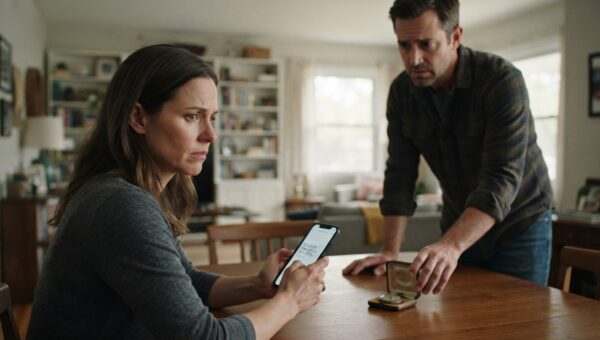
A week after that pathetic text message, the kitchen phone rang again at an hour when nobody ever called unless something had broken. It was 4:42 in the afternoon. I wiped my hands on my apron and picked up the receiver, expecting a telemarketer or the pharmacy telling me my blood pressure refills were ready. Instead, a man’s voice came through the static, rushed and shaking in a way that made my chest tighten.
“Please don’t tell her I called,” Ethan said.
I didn’t even say hello. I just gripped the plastic receiver until my knuckles turned white. “Ethan? What’s wrong? Is Chloe hurt?”
“She’s not hurt in an accident,” he said, his breath coming short and fast on the other end of the line. “I mean, she is, but not like that. Look, I shouldn’t be doing this. She’ll kill me if she finds out I went behind her back. But you need to know what’s been going on.”
I heard a car door shut in the background of his call, like he had fled out to the driveway just to talk to me without her hearing. “Ethan, start at the beginning. What are you talking about?”
“Has she been talking to you much lately?” he asked.
“No,” I snapped, the old hurt flaring up hot and fast. “She sends a two-word text once a year and calls that staying in touch. What is going on with my daughter?”
“She’s been seeing a specialist in the city for four months,” Ethan said, the words tumbling out of him like he was opening a jammed valve. “Neurology and somatic stress clinics. She takes the train twice a week on Tuesdays and pretends she’s working late on client accounts. She’s shaking so bad in her sleep some nights she wakes me up, and she forgets where she parked her car, and she refuses to tell her own family because she thinks she has to carry it all by herself.”
I just stood there in the quiet kitchen, the hum of the refrigerator suddenly sounding like a freight train in my ears. “A neurologist? Ethan, why would she need a neurologist? She’s thirty-two years old.”
“I don’t know the half of it,” he whispered, his voice dropping an octave like he was afraid someone was standing right behind him in the driveway. “The doctor thinks the problem started when she was a child, and she says you’re the only person who can confirm what happened in the summer of…”
He didn’t get to finish the year. The line clicked dead with a sharp tone, followed by the dial tone droning in my ear.
Three days later, I was sitting up in the attic with a flashlight and a pair of gardening gloves, dragging down heavy cardboard boxes I hadn’t opened since we moved into this house twelve years ago. The air up there smelled like dry insulation and old paper, thick enough to make me cough into my sleeve. I dragged the boxes over to the drop-down stair opening where the late afternoon light cut through the dust motes. My knees popped as I knelt down on the plywood floor and sliced the packing tape with an old kitchen knife.
I didn’t even know what I was looking for until I saw the spine of the blue binder peeking out beneath a stack of high school yearbooks and old tax returns. It was Chloe’s keepsake book from the summer she turned ten. That was the summer I had to have the major kidney surgery down in the state capital, the one where I spent three weeks flat on my back in a sterile room while my sister Clara took Chloe up to that old timber frame cottage by the lake in northern Wisconsin. I remembered Clara telling me Chloe had been a little quiet when she came back home, but kids adjust, don’t they? I had been too weak and sick to press her on it, and by autumn we were back into the frantic rhythm of school buses and soccer practice, and the quietness just seemed like a normal phase.
I flipped open the blue binder right there on the attic floor. The pages were stuck together slightly with age, giving off a faint smell of dried lake reeds and old newsprint. Clipped to the inside cover was a yellowed receipt from a small-town community clinic in Woodruff, dated July 14th. Underneath it was a polaroid of Chloe sitting on a wooden dock with her feet dangling over the dark water, holding a smooth grey stone in her lap. Her face in the photo wasn’t smiling. Her eyes were wide and staring off past the edge of the camera, fixed on something just out of frame, looking entirely too old for a child of ten.
I pulled out my phone and dialed Ethan’s number directly, not caring anymore if Chloe found out. He picked up on the second ring, sounding breathless.
“I found the clinic receipt,” I said without preamble, my voice shaking. “Woodruff Community Health. July fourteen. Clara brought her there while I was in surgery. Ethan, what did the specialist say about that summer?”
“Dr. Aris thinks she witnessed something or was part of an accident up there that scared her so bad her developing brain literally walled off the memory to keep her functioning,” Ethan said, his voice hard with worry. “And now that she’s under the stress of career changes and buying the house, her nervous system is rebelling. She’s having somatic paralysis episodes, Mom. Her body remembers the terror even if her conscious mind locked the door on it. But Dr. Aris can’t build a treatment plan without knowing the exact medical or environmental trigger from those three weeks. And Chloe won’t talk about it because she’s terrified of what she’ll find out.”
“She’s not alone anymore,” I said, and for the first time in years, I felt a hard, cold resolve settle deep into my chest. “Give me the doctor’s address in the city. I’m coming down.”
Two days later, I parked my old sedan three blocks away from a grey brick medical building downtown, my purse clutched so tight under my arm my fingers went numb. I didn’t call Chloe. I didn’t ask for permission. I walked straight through the heavy glass double doors and told the receptionist my name, holding out the old blue binder and the clinic receipt like a passport. Dr. Aris wasn’t what I expected. She was younger than I pictured, with sharp eyes behind wire-rimmed glasses and a quiet, steady way of listening that made me feel like I was back in a college classroom.
“Her nervous system is demanding an integration it was too young to process back then,” Dr. Aris told me across a polished oak desk, looking at the faded polaroid of Chloe on the lake dock. “When children experience acute physical shock or witness a medical emergency without an adult to help them metabolize the fear, the brain builds a vault. Decades later, major life milestones like marriage or moving away act as a second wave of stress, knocking on that vault until the body starts breaking down. She needs the historical truth, Mrs. Miller. Not guesses. She needs to know what really happened at that lake cottage so her brain can finally stop fighting itself.”
I spent the next hour walking Dr. Aris through everything I could dredge up from that long-ago summer. I told her about Clara calling to say Chloe had wandered off into the timberline behind the boat house and had been found hours later shivering under a fallen pine, soaked to the skin and completely mute for two days. Clara had brushed it off as a simple case of woods-fright, telling me kids get turned around in the brush all the time. But looking at the dates now, and listening to the way Ethan described Chloe’s current tremors, I knew my sister had missed something crucial out of her own panic.
By the time I drove out to Chloe’s subdivision in the late afternoon, my hands were shaking on the steering wheel. I didn’t call ahead. I pulled right up behind Ethan’s crossover in their neat gravel driveway, grabbed the blue binder from the passenger seat, and walked up the front steps without hesitating.
The front door swung open before I could even lift my hand to knock. Ethan stood there in the entryway, his face pale and drawn, holding a mug of cold coffee. He looked past me toward my car like he expected a squad car to pull up behind me.
“You shouldn’t have come,” he whispered, stepping back to let me in. “She’s in the kitchen. She had a bad spell this morning. Her left arm wouldn’t stop shaking for two hours.”
“She’s my daughter, Ethan,” I said, walking past him down the narrow hallway toward the back of the house. “And I’m done staying away.”
The kitchen was spotless, all white tile and stainless steel, but it felt cold, like a room nobody actually cooked in anymore. Chloe was sitting at the breakfast bar with her back to me, her shoulders hunched under a grey cardigan that looked two sizes too big for her. She had a mug between her hands, staring down at the dark surface of the coffee like she was trying to read tea leaves.
When my boots creaked on the tile, she didn’t turn around right away. She just stiffened, her fingers tightening around the ceramic mug until her knuckles went stark white.
“Ethan, I told you I didn’t want any lunch,” she said, her voice thin and raspy, stripped of all the bright confidence she used to have when she lived down the street from me. “I just want to sit here until the numbness in my fingers goes away.”
I didn’t say anything. I just walked around the island and set the battered, sun-faded blue binder right down on the counter beside her coffee mug, right on top of her trembling hands.
Chloe flinched back like the book had teeth. She looked down at the faded label on the front cover, her breath catching in her throat with a sharp, ugly sound.
“What is this?” she whispered, her eyes flying up to meet mine for the first time in over a year. There was no anger in her face now, only a raw, terrified exhaustion that made my heart ache right down to the bone. “Where did you get this?”
“Your husband called me, Chloe,” I said softly, pulling out the bar stool across from her and sitting down so I was right at her eye level. “And I went up to the attic. And then I went to see your doctor downtown.”
She stared at me, her chest rising and falling in shallow, jagged gasps. “You talked to Dr. Aris? You went behind my back?”
“Just like you went behind everyone’s back for four months,” I said, not letting her look away from me. “Carrying all of this by yourself because you thought you had to be strong enough to swallow your own past.”
“I don’t know what you’re talking about,” she lied, her voice breaking on the last word as a tear finally spilled over her lower lid and tracked down her cheek. “There’s nothing in that book. It’s just old pictures from when Aunt Clara watched me while you were in surgery.”
“Is it?” I reached out and slowly flipped the binder open to the page with the polaroid of her sitting on the dock, right beside the clinic receipt from Woodruff. “Clara told me you just got lost in the woods. But Dr. Aris says your body has been screaming for twenty-two years because you didn’t get lost in the woods, Chloe. You found something down by the boathouse that summer, didn’t you? Something you made yourself promise never to tell a soul about.”
Chloe’s hands started to shake so hard she had to let go of the coffee mug entirely, sloshing dark liquid across the white counter. She didn’t look at the spill. She just stared down at the photograph of herself at ten years old, her lower lip trembling uncontrollably as the wall she had built around her own mind for two decades finally cracked wide open.
“I didn’t mean to look,” she sobbed, the sound tearing out of her chest in a ragged gasp that brought Ethan rushing into the kitchen behind us. “I was just following the old dock path down to the water to find my skipping stone, and I saw… I saw Clara out by the old boathouse with the neighbor man, and she was crying so hard she couldn’t breathe, and then she looked right at me and told me if I ever told anybody what I saw, you would get sicker in the hospital and never come home.”
The silence in the kitchen dropped down around us like lead. Ethan stopped dead in the doorway, his hand braced against the doorframe, while the truth of that long-ago summer hung in the air between us, small and ugly and devastatingly simple. A terrified ten-year-old child, told that her mother’s life hung on her keeping a secret she was far too young to understand, had locked the memory away in a dark room and swallowed the key.
Chloe covered her face with both hands, her shoulders shaking with dry, racking sobs that sounded like they were pulling her apart from the inside out. “I thought it was my fault,” she cried into her palms. “I thought if I remembered it, you would die. And every time my life got good down here with Ethan, my body just remembered how scared I was standing on that dock, waiting for you not to come home from the hospital.”
I didn’t say a single word of comfort about how everything would be fine. I didn’t tell her not to cry. I just leaned across the kitchen counter, reached out through her shaking hands, and pulled her toward me until her face was buried against my shoulder.
A worn, leather-bound photo album rested open on Chloe’s kitchen table between us, its pages turned to a sun-faded picture of a ten-year-old girl smiling by a lake, while my hand rested gently over her trembling fingers.