PART 1
We came home from a four-day anniversary trip to a garage sale in our driveway, and it was our own stuff on the folding tables.
My mother-in-law, Martha, had offered to housesit to water the ferns and feed our beagle, Buster. Instead, she had spent all day Saturday dragging things out of my house and selling what she called my clutter to passing strangers.
When we pulled our sedan up to the curb at five o’clock on Sunday afternoon, there was still a neon poster board taped to our mailbox with the words HUGE BLOWOUT written in black marker.
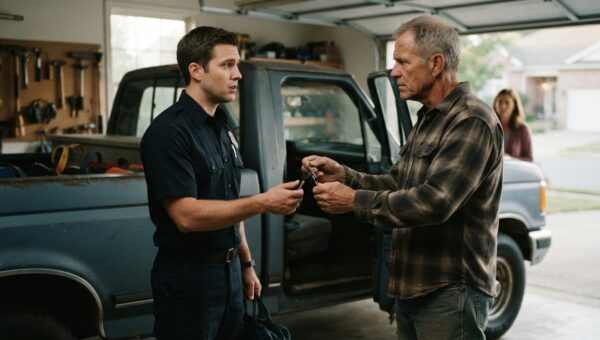
Martha was sitting in a folding lawn chair on our porch with an empty Tupperware container and a metal cash box in her lap.
“Well, look who made it back,” she said, fanning herself with a paper plate. She gave a self-satisfied smile and patted the metal box. “You two can thank me later. I made $340 today clearing out all that stagnant energy in the front rooms. You had so much junk collecting dust that you couldn’t even see the baseboards.”
My husband, Greg, stood by the car door, looking at the driveway with his mouth hanging open. “Mom, what did you do?”
“I helped,” she said, her voice turning sharp and defensive. “A woman your age shouldn’t be hoarding forty years of knickknacks, Sarah. Someone had to take charge.”
I walked through the open garage and straight into my house.
The living room looked looted. My reading chair, a winged armchair upholstered in sage velvet where I had sat every morning for fifteen years to drink my tea, was missing from the corner by the front window. The hallway closet was half-bare. Two plastic storage tubs I had clearly labeled KEEP in bold red marker on the lids were completely gone from the guest room.
And then I walked into the sunroom.
The corner table was empty. My late mother’s vintage black Singer sewing machine, the heavy steel 1952 model in the drop-leaf oak cabinet that she had used to sew my school dresses and my wedding veil, was nowhere to be found.
I walked out to the porch where Martha was counting her five-dollar bills. My hands were shaking, but I did not scream.
Screaming at Martha never worked. She had spent thirty years using other people’s anger as proof that she was the martyr who was just trying to do good.
“Where is my mother’s sewing machine, Martha?” I asked, keeping my voice as steady as I could.
Martha waved her hand toward the street. “That heavy iron thing? Nobody sews on those dinosaurs anymore, Sarah. It took up half the sunroom. Some nice girl stopped by in a hatchback and took it off my hands.”
Our next-door neighbor, Mrs. Gable, was standing near the hedge watching the whole thing. She caught my eye, shook her head, and called out across the lawn.
“Eight dollars, Sarah,” Mrs. Gable said, her voice tight with disapproval. “I came over and told her it was yours, but she took eight dollars for it and helped the girl slide it into the trunk.”
Eight dollars for the machine my mother had touched every week until the day she died.
Martha looked down at her cash box, snapped the latch shut, and handed me the wad of bills. “Well, you have $340 in your hand now. You can buy yourself something modern.”
I looked at the wrinkled bills. I didn’t yell. I went straight to work.
PART 2
I didn’t unpack our suitcases from the car. I left Greg standing in the kitchen trying to reason with his mother while she complained about how ungrateful young people were.
I took my tablet to the kitchen table, opened our local community Facebook groups, fired up the neighborhood app, and typed out a short, simple post:
“Sentimental error. My mother-in-law held an unauthorized yard sale at 414 Maple Street on Saturday while we were out of town. I am looking for my green velvet reading chair, two clear plastic tubs marked KEEP, and a 1952 Singer sewing machine in an oak cabinet. Buyback offered: double whatever you paid, no questions asked.”
Within twenty minutes, notifications started pinging on my screen.
People on our street had seen the sale and thought Greg and I were downsizing. By eight o’clock that evening, an older man named Carl who lives three streets over messaged me about the boxes. He had bought both tubs for fifteen dollars each because he wanted the heavy-duty plastic for his garage workshop.
“I haven’t even opened them, Sarah,” Carl wrote. “Bring me thirty bucks and they’re yours.”
I drove over to Carl’s house before nine. When I paid him sixty dollars, double his purchase price just like I had promised, he tried to hand the extra cash back. I refused to take it. A promise was a promise.
Inside those two boxes were my high school yearbooks, my grandmother’s hand-embroidered tea towels, and every handmade Christmas ornament my kids had made out of popsicle sticks and glitter back in elementary school. Martha had sold thirty years of my family’s memories for thirty dollars.
On Tuesday morning, the reading chair came back.
A young couple who had recently bought a starter home down near the elementary school saw my post on the neighborhood board. The husband, a polite young man named Marcus, drove it back in the bed of his pickup truck during his lunch break.
“My wife bought it on Saturday for twenty-five dollars,” Marcus said as he helped me carry the heavy armchair up my front steps and set it back on the oak floorboards. “She felt terrible when she saw your post. She said an old reading chair like this belongs where it has roots.”
I handed Marcus fifty dollars in cash. He hesitated, took it with a respectful nod, and thanked me for being fair.
The house started looking like my home again, but the sunroom was still empty.
Days four, five, and six passed without a single lead on the Singer. I printed forty flyers with a clear description of the oak cabinet and taped them to the corkboards at the fabric shop, the senior center, and the two local dry cleaners. Every time my phone rang, my stomach tightened, hoping it was someone who had spotted the heavy iron wheel and the gold lettering along the black arm.
By day seven, Greg tried to comfort me. He offered to buy me a high-end digital machine from the craft store downtown.
“It’s not about sewing a straight line, Greg,” I told him, looking into the bare corner of the sunroom. “Your mom didn’t just sell an appliance. She sold the place where my mother sat when she talked to me.”
Finally, on the ninth day after the sale, my phone chimed with a private message from an account named Priya Sharma.
Attached was a photo of the oak cabinet sitting in a small, sunny kitchen across town, with a spool of yellow thread sitting on the wooden spindle.
The message read: “Is this the machine you are looking for?”
PART 3
I replied within thirty seconds.
Priya lived in a modest two-story brick duplex on the west side of town, near the train depot. I got in my car with an envelope containing sixty dollars in cash, ready to pay her whatever she wanted to put that cabinet back in my trunk.
When Priya opened the door, she was holding a two-year-old girl on her hip. She had a kind, tired face and dark hair pulled back into a quick knot. She invited me into her narrow front hallway, where the smell of cardamom and warm laundry filled the air.
The Singer was sitting against the living room wall, wiped clean of dust, looking just like it had in my mother’s home.
“I bought it on Saturday morning,” Priya said softly, gesturing toward the machine. “I work from home doing data entry, and my daughter grows out of her clothes so fast. I wanted to learn how to hem pants and mend seams to save our family some money. The older woman who sold it to me said it was just taking up room in her basement and let me have it for eight dollars.”
I pulled the envelope from my coat pocket. “I promised double in my post, but here is sixty dollars. Please take it. That machine belonged to my mother, Clara. She died six years ago, and having it back means more to me than I can explain.”
Priya looked at the envelope, then looked back at the machine. She didn’t take the cash.
She gently shook her head.
“I cannot take your money, Sarah,” Priya said. “If this was your mother’s, it never should have been sold in a yard sale. But may I ask you something?”
“Anything,” I said.
Priya looked down at the iron foot pedal and the little chrome bobbin case. “I have never used one of these before. The manual online was confusing, and the thread kept tangling when I tried to turn the wheel yesterday. When you were telling your story online, you mentioned your mother taught you how to use it when you were small.”
She looked back up at me with clear, humble eyes.
“Instead of the buyback money, would you be willing to teach me how to thread it and sew a clean seam?”
The request was so honest and simple that my throat tightened. I looked from Priya to the black enamel machine that had spent forty years stitching quilts and mending pockets for three generations.
“I will do better than that,” I told her. “I’ll teach you everything my mother taught me.”
We carried the oak cabinet down the steps together and loaded it into the back of my sedan.
When I drove back to Maple Street and carried the machine into the sunroom, the empty corner was finally healed. The heavy wood settled against the floorboards with a familiar, solid thud.
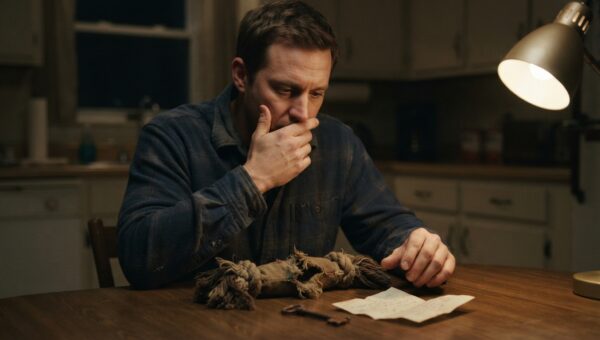
That evening, I sat down at our dining table with a yellow legal pad and wrote out a detailed balance sheet.
I wrote down the exact amounts I had paid out of pocket to recover my property:
– Storage tubs buyback: $60
– Reading chair buyback: $50
– Miscellaneous smaller kitchen items recovered from neighbors: $90
– Flyers, replacement fuel, and neighborhood courier fees: $80
– Total buyback and recovery expenses: $280
Then I added the original $340 cash that Martha had handed me from her sales box, the money she had made by selling off my personal belongings without permission.
$340 plus $340 was exactly $680.
I called Greg into the room and slid the legal pad across the table.
“Your mother made $340 selling my life from our front lawn,” I said. “And she cost us time, dignity, and nearly lost my mother’s legacy. If she ever wants to set foot in this house again, she is going to pay the full buyback cost out of her own pocket. All $680 of it.”
Greg looked at the numbers on the yellow paper. For years, he had tried to smooth over his mother’s steamrolling behavior, making excuses about her age and her restless energy. But he looked toward the sunroom, saw the Singer sitting in the corner, and set his jaw.
“I’ll handle it,” Greg said.
ENDING
Greg drove over to his mother’s brick condo the next morning.
He didn’t yell, but he laid the legal pad on her coffee table and told her that if she ever wanted an invitation to Thanksgiving or to see our home again, she had to write a check for the full $680 to settle the debt.
Martha threw a fit, of course. She called her sister in Florida to complain that her daughter-in-law was penalizing her for doing a good deed, and she insisted she was just helping us clear out junk. But when Greg refused to back down or take her calls until the debt was satisfied, the reality finally hit her.
Two days later, a personal check for $680 arrived in our mailbox, signed by Martha in tight, angry cursive.
I didn’t cash the check into our family account to buy clothes or groceries. I took that money down to the bank, cashed it, and used it to buy two heavy-duty sewing cutting mats, professional fabric shears, three sets of sewing needles, and four bolts of sturdy cotton and flannel fabric.
I gave half the supplies to Priya.
Martha still visits our house occasionally, but her visits look very different now. She doesn’t touch the cupboards. She doesn’t open closet doors. She sits on the sofa with her handbag on her lap, drinking tea under careful supervision, and when she leaves, the front porch stays exactly as I left it. The math of respect finally added up in our family.
As for Priya, she comes over to my sunroom every single Thursday afternoon at two o’clock.
Her little girl plays with wooden blocks on the rug by the window while Priya and I sit side by side at the 1952 Singer. I show her how to guide the fabric without pulling, how to tension the thread, and how to oil the gears behind the faceplate.
Last Thursday, Priya finished sewing a little yellow sundress for her daughter, running the hem under the same chrome presser foot that hemmed my first dance skirt forty years ago.
When the needle stopped and Priya lifted the fabric into the afternoon light, smiling down at her neat, straight stitches, the room was warm and quiet.
My mother taught me on that machine. Now I teach Priya on it every Thursday.
I ran my fingers over the polished black metal, listening to the clock ticking on the mantel, knowing that some things are worth every penny it takes to bring them home.