PART 1
My father died at seventy-four from a sudden massive heart attack on a Thursday morning while sitting in his garden shed.
He had a $500,000 life insurance policy with Northwestern Mutual. For twelve years, since my mother passed, Dad told both of us the exact same thing every Thanksgiving. He would point his butter knife across the dining table and say, “Five hundred thousand, clean and clear.
Split right down the middle between the two of you. That policy stays intact so neither of my children ever has to worry about a roof.”
That was what Dad told us. That was what I believed.
Ten days after we buried him at Oak Ridge Cemetery, an official white envelope from the insurance company arrived in the mail. It was addressed to my house, but my name was not on the primary check voucher inside. The notification letter was made out solely to my younger brother, Kevin Vance, informing him that the full death benefit of $500,000 was approved for direct disbursement into his designated account.
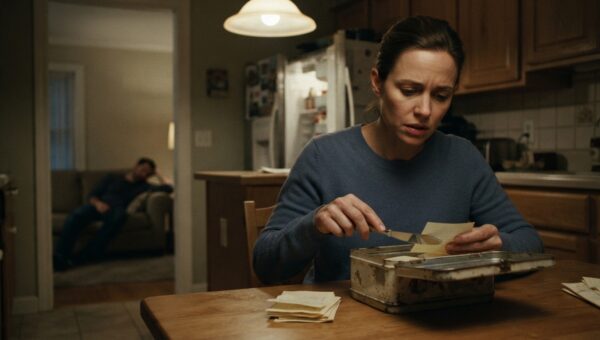
I called the claims division from my kitchen table, holding the policy number on an old carbon copy Dad had kept in his desk.
“There has to be a clerical mistake,” I told the representative. “My father was Arthur Vance. The policy was established with two equal primary beneficiaries, twenty-five percent each to me and my brother, then later updated to fifty-fifty.”
The representative typed for twenty seconds, the keyboard clicking over the line.
“Mrs. Mercer, the file shows one sole beneficiary,” she said. “A formal amendment was submitted, notarized, and processed eight months ago.”
Eight months ago, my father had moderate-to-severe vascular dementia. He had lived under my roof for six full years. I was the one who cut his waffles into small bites, changed his adult briefs, locked the deadbolts so he wouldn’t wander into traffic at two in the morning, and took him to his neurology checks. By eight months ago, Dad couldn’t remember what year it was. He thought the television news anchor was talking directly to him, and he called me by my mother’s name.
I hung up, grabbed my purse, and drove straight down to Kevin’s commercial contracting office on 4th Street.
It was noon. Kevin was sitting at his glass-topped desk, eating a turkey hoagie from the deli next door and reviewing bid sheets on his laptop. He looked up, his jaw chewing slowly, entirely relaxed.
I laid the insurance letter flat on the glass right next to his paper wrapper.
He didn’t blink. He swallowed his food, wiped his mouth with a brown napkin, and leaned back in his leather chair.
“Dad wanted me to have it, Clara,” Kevin said, his voice completely flat. “I was there every day.”
“You were there every day?” The words came out of my throat like broken glass. “I took care of him for six years in my house. You came twice. You came on Christmas two years ago for twenty minutes, and you showed up the night the paramedics wheeled his body out of my front hallway.”
Kevin looked at me with cold, steady eyes. He didn’t yell. He didn’t even get flustered.
He slowly pulled open his heavy bottom desk drawer, reached into the back, and lifted out a manila legal folder.
He flipped it open and tossed a glossy four-by-six color photograph across the desk until it tapped against my knuckles.
“Then explain this,” Kevin said.
I picked up the picture.
It showed me sitting in a leather chair inside an unfamiliar office with wood paneling and green banker lamps, holding a black pen over an official blue-backed document. Standing behind the desk was a notary public in a gray suit.
I had never set foot in that office in my entire life. And I had never signed that paper.
PART 2
I stared at the glossy print under the fluorescent lights of Kevin’s office.
The woman in the picture had my short brown bob, my silver wire-rimmed glasses, and was wearing a dark plum wool cardigan. It was the exact cardigan my daughter had bought me for my fifty-sixth birthday two years ago. The angle was taken from the side doorway, clear enough to see the profile, the posture, and the right hand resting flat on the signature page of a legal document.
Beside the photo inside the folder was a stapled photocopy of the insurance company’s change-of-beneficiary form.
On the line marked *Co-Owner / Prior Beneficiary Relinquishment*, there was a signature. It was written in black gel pen. The letters were slanted slightly to the right, just like mine, with the open loop on the C and the crossed T in Clara. Beneath it was a red rubber stamp from a notary named Donald Finch, registered in Mercer County, three counties away.
“You sat right there with Dad on March 14th,” Kevin said, tapping the desk with a pen. “You signed off on the transfer because you knew Dad owed me for equipment loans I floated him back in 2018. If you try to tell Northwestern Mutual that Dad was incompetent, they’ll pull this file. And then you’re going to look like a liar trying to claw back money you legally surrendered.”
I held the photo by the edges, my fingertips cold against the paper.
“I was not in Mercer County on March 14th, Kevin,” I said.
Kevin shrugged, taking another bite of his hoagie. “Well, Donald Finch has your driver’s license number in his official notary logbook. Go ahead and call the company, Clara. See who they believe: their certified paperwork with your picture on it, or a daughter having seller’s remorse.”
I didn’t argue. I didn’t shout. Arguing with Kevin when he had built a wall only gave him time to shore up the loose bricks.
I took the photograph, slipped it into my purse, and walked out to my car.
I sat in the front seat with the doors locked and pulled out my phone. I opened my digital calendar app, scrolling back eight months to Friday, March 14th.
On March 14th, Dad had an emergency dental extraction at nine in the morning because an infected molar had swollen his jaw. The oral surgeon in Canton had given him heavy sedation. I had spent that entire day sitting on the vinyl chair in room 3 of the surgical clinic until two o’clock, and then I spent the afternoon at the pharmacy down the street waiting for his liquid pain medication.
I pulled open my pharmacy account on my phone. The time stamp for my prescription pickup at the Canton Health Mart on March 14th was 1:42 PM.
Mercer County was a two-and-a-half-hour drive from Canton. It was physically impossible for me to be sitting in a notary’s chair in Mercer County on the afternoon of March 14th while picking up antibiotics in Canton.
More importantly, Dad had been in my car, groggy and drooling on a towel. He hadn’t been in Mercer County either.
I looked at the woman in the photograph again.
I zoomed in on her hands. The fingers were holding the black pen near the nib. On the left ring finger was a thin gold band with a small oval emerald.
I did not own an emerald ring. My wedding band was a plain silver channel set with three tiny chips of diamond, and I had worn it on my left hand every single day since 1991.
There was only one person in our family who wore a thin gold band with an oval emerald.
It was Kevin’s wife, Sandra.
Sandra had received that exact ring from her grandmother on her thirtieth birthday. Sandra was two inches shorter than me, but from a seated side profile, with a wig or a matching haircut and my spare cardigan from the back of Kevin’s car, she looked enough like me to fool a notary who glanced at a forged license for ten seconds.
PART 3
I drove home, sat down at my desk, and called an attorney named Marcus Reed.
Marcus had handled our family’s probate and real estate work for twenty years. He was eighty miles away, but when I told him about the photograph, the dental records from March 14th, and the notary stamp from Mercer County, he told me to get in my car and bring him every scrap of paper I had.
“This isn’t an estate squabble, Clara,” Marcus said over his speakerphone. “This is felony forgery, identity theft, and grand larceny against an insurance underwriter. If Sandra impersonated you before an officer of the state to divert five hundred thousand dollars, they have committed state and federal wire fraud.”
We didn’t go to Kevin first. We went straight to Mercer County.
On Friday morning at ten o’clock, Marcus and I walked into the small storefront office of Donald Finch, Notary and Title Services, located in a strip mall between a dry cleaner and a tax preparer.
Donald Finch was a thin man in his sixties with suspenders and a nervous cough. When Marcus laid his legal bar card on the counter and placed the enlarged color printout of the photograph in front of him, Finch pushed his reading glasses up his nose.
“Mr. Finch,” Marcus said, his voice smooth and dangerous. “On March 14th, you notarized a change-of-beneficiary waiver on policy 481-992 for Northwestern Mutual. The woman sitting in this chair signed the name Clara Mercer.”
Finch blinked at the picture. “Yes. I remember that. The brother came in with her. He said his sister was waiving her rights to an estate policy.”
“Look at the woman standing beside me, Mr. Finch,” Marcus said, gesturing to me.
Finch looked from the photo to my face. His eyes moved over my cheekbones, my silver glasses, and my jawline. Then his gaze dropped to my left hand resting on the counter, showing my silver band.
“She has your ID,” Finch stammered, pulling open a heavy metal filing cabinet behind his desk. He thumbed through a binder and pulled out the logbook page for March 14th.
On line 14 was the name Clara Vance Mercer. Listed as identification was an Ohio driver’s license number.
I looked at the number. It was my driver’s license number, but the expiration date in his logbook was listed as 2028. My actual driver’s license had been renewed two years early and expired in 2026.
Kevin had used an old paper photocopy of my previous license, the one I had left in Dad’s glove box four years ago when I helped register his Buick, to create a temporary credential or slide it into a dark wallet sleeve.
“Mr. Finch,” Marcus said, pulling a voice recorder from his breast pocket. “You are facing immediate revocation of your state commission and criminal charges as an accessory to a $500,000 fraud unless you state for the record right now whether this woman standing in front of you was the person who signed line 14.”
Finch’s hands began to shake so badly he had to set his pen down on the counter. He looked at me, his face slick with sweat.
“No,” Finch whispered. “It wasn’t her. The woman who came in was shorter. She had a green ring on her finger. The brother did all the talking. He paid me forty dollars cash to rush the stamp because he said their father was in hospice and they needed the filing done before five o’clock.”
“Did you take the photo, Mr. Finch?” I asked.
“The brother took it,” Finch confessed, his voice cracking. “He said he wanted a picture of his sister signing the release for their family records so there wouldn’t be any confusion later.”
Kevin had taken the photograph himself. He had staged the entire scene with his own wife, using my sweater and an old haircut, so he would have visual proof to intimidate me into silence if I ever questioned the payout. He thought I was too tired, too worn down from six years of wiping Dad’s chin and folding bedsheets, to fight a document with my own face on it.
Marcus had Finch sign a sworn, four-page affidavit admitting the discrepancy, identifying Sandra’s description, and certifying that the signature on line 14 was an absolute forgery.
At two o’clock that afternoon, Marcus and I walked back into Kevin’s contracting office.
We didn’t knock. Marcus pushed the door open, followed by an investigator from the county prosecutor’s financial crimes unit whom Marcus had called from the highway.
Kevin was on the phone with a lumber distributor. When he saw the county badge on the investigator’s coat, the receiver slipped out of his fingers and hit the desk blotter with a hollow plastic thud.
Sandra was sitting on the leather sofa in the corner, holding a stack of tile samples. When she saw me, her fingers twitched, and she instinctively crossed her hands in her lap, tucking her left hand beneath her thigh.
I walked right up to the sofa.
“Show the investigator the ring, Sandra,” I said.
Sandra didn’t move. Her mouth fell open, her eyes darting toward Kevin in sheer terror.
Marcus laid Donald Finch’s sworn affidavit on Kevin’s desk, right on top of his open bid sheets.
“The fraud department at Northwestern Mutual has already placed an administrative hold on the $500,000 disbarment,” Marcus told Kevin. “The Mercer County prosecutor is preparing two indictments for grand larceny, identity fraud, and criminal conspiracy. You have one hour to decide whether you want to sign a full confession and mutual release, or let the investigator escort both of you out to the squad car in front of your employees.”
Kevin looked at the affidavit. He read the notary’s confession, read his own name, and saw the date on the Canton pharmacy receipt Marcus laid beside it.
The smug, careless confidence that had carried him through thirty years of taking what he wanted vanished in an instant. His chest hitched. He looked at his wife, then down at his glass desk, completely cornered by his own staged photograph.
“It was supposed to be mine,” Kevin choked out, his voice turning into a pathetic, whining rasp. “Dad always favored you. He gave you the house.”
“Dad didn’t give me the house, Kevin,” I said, leaning over his desk until I was inches from his face. “I bought this house with my own mortgage. Dad lived in my spare room because you refused to take his calls when he started forgetting his own name. You didn’t care about Dad. You only cared about what he was going to leave behind.”
ENDING
Kevin signed the voluntary withdrawal and estate release in the conference room twenty minutes later with the county investigator watching every stroke of the pen.
To spare Sandra a public trial and keep his contracting business from immediate bankruptcy, Kevin agreed to a formal civil settlement overseen by the probate court. Under the terms of the agreement, Kevin surrendered every legal claim to the Northwestern Mutual policy, reimbursed my attorney’s fees in full, and paid a five-thousand-dollar administrative fine to the state insurance commission.
Northwestern Mutual reinstated the original beneficiary designation from 2012.
Because Kevin had executed a sworn relinquishment during the criminal inquiry, the company processed the claim under the standard survivor terms. The entire $500,000 policy was paid out to my account three weeks later.
I didn’t keep all the money for myself.
I paid off the remaining thirty-two thousand dollars on my own home mortgage, the house where Dad had spent his final peaceful years watching birds from the kitchen window. I set up two fifty-thousand-dollar college funds for my grandchildren, and I put the rest into a long-term municipal bond portfolio that earns quiet, steady interest every quarter.
Kevin’s business survived, but our family did not.
Sandra will not look in my direction if we pass each other in the grocery store on Main Street, and Kevin has not dialed my number since the day he signed that release. Our cousins in Columbus heard about the notary logbook within a month, and Kevin stopped coming to the summer family reunions entirely.
Yesterday morning, I was cleaning out the nightstand in the bedroom where Dad used to sleep.
Tucked into the back of his wooden drawer, behind his old pocket comb and a pair of reading glasses, was a small brass key to his tackle box.
I sat on the edge of the mattress, turning the cool metal over in my hand.
For six long years, I had questioned whether I was foolish for giving up my weekends, my vacations, and my peace to look after an old man who didn’t even know who was wiping his forehead. Kevin had tried to use that exhaustion to make me feel small, to make me believe that six years of quiet sacrifice could be erased with a staged snapshot and a cheap lie.
I looked at Dad’s empty chair by the window, where the morning sun was cutting across the clean pine floorboards.
I didn’t feel angry anymore. I put the little brass key in my pocket, walked into the kitchen, and started making breakfast in the quiet of my own home.