PART 1
I balanced the checkbook every month for thirty-six years. Last Tuesday a digit didn’t add up.
My husband Kenneth was out in the garage sharpening his hedge trimmers. The kitchen table was covered with the usual clutter of a late September evening: my reading glasses, the electric bill, two water receipts, and the blue leather ledger I had carried since we bought our house on Miller Road in 1990.
I have always been the one who handled the bills. Kenneth worked forty years as an industrial pipefitter, bringing home his union check, tossing the pay stub on the refrigerator, and trusting me to keep our credit clean.
When I ran the mechanical calculator down the printed bank statement, the bottom balance was off by eight hundred dollars.
I circled the discrepancy in red pencil. Then I looked at the electronic debit column. On September 15th, an automated transfer of exactly $800 had moved out of our main household checking account. The destination line didn’t show an electric utility, our property taxes, or the truck loan. It was a simple alphanumeric code: *AUTO TRSF TO DDA XXXXX-4091*.
I pushed my chair back, walked down the hall to the spare bedroom, and opened the bottom drawer of our metal filing cabinet. I pulled out the folder labeled *Joint Checking – 2025*, then *2024*, all the way back to the heavy accordion files from the previous decade.
I sat cross-legged on the carpet under the spare bed light and flipped through the pages.
The same electronic transfer was there. The exact same amount. Every single month, on the fifteenth, without fail.
Eight years.
Eight years of eight hundred dollars quietly leaving our account every thirty days. That was seventy-six thousand eight hundred dollars.
My hands went completely numb against the paper. We had delayed replacing our central air conditioning unit three summers ago because Kenneth told me sixty-five hundred dollars was too tight with our pension margins. We had put off taking our granddaughter to Niagara Falls.
I took the latest statement down to our primary branch on Oak Street the following morning. The teller, a woman named Beverly who had cashed Kenneth’s paychecks for twenty years, looked at the transaction code, clicked her mouse three times, and then leaned back in her chair with a guarded frown.
“Martha,” Beverly said, keeping her voice low. “That receiving account isn’t held at this branch. It’s an individual depository account over at the Northgate regional office on Route 18. Kenneth is listed as the sole owner. There is no secondary signatory, and your name isn’t on the registration.”
“I am his wife,” I said, setting our joint card on the counter. “What is the balance?”
“I can’t pull that for you,” she said, shaking her head. “Because you aren’t an authorized signer on that specific account, federal privacy rules prevent me from disclosing balances or statements.”
I didn’t yell. I didn’t go home to confront Kenneth while he was drinking his lunch coffee.
I drove eight miles north to the Northgate branch on Route 18. I carried my driver’s license, our certified county marriage certificate from 1988, and forty years of joint tax filings in a canvas tote bag.
I walked into the manager’s glass office, set the papers on her desk, and asked her to pull the file.
She looked at my face, verified my identity against our tax returns, and clicked through her database.
She turned the computer screen around so I could see the ledger.
The balance after eight years of quiet deposits was not seventy-six thousand dollars. It was sitting at exactly three hundred and twelve dollars and forty cents.
PART 2
The screen had three columns: date, withdrawal, and running balance.
Nearly eighty thousand dollars had moved into that account over eight years, but it hadn’t stayed there. Every month, within forty-eight hours of my joint checking account sending eight hundred dollars north, a counter withdrawal or a direct electronic debit had pulled the money right back out.
The withdrawals weren’t spent on credit card balances, golf courses, or restaurants.
They were outgoing transfers made to a commercial property management firm called Buckeye Ridge LLC, based out of Canton.
The branch manager, a woman named Mrs. Albright, looked at the screen with me. Because our federal tax filings proved that Kenneth and I filed jointly and the source funds had been diverted from a marital asset, she allowed me to view the transaction history.
“Mrs. Miller,” she said quietly, point-blank. “These debits have been consistent since November of 2018. The memo line on every single disbursement to Buckeye Ridge reads: *Lot 14 Ground Lease / Unit Maintenance*.”
“Lot fourteen?” I repeated.
“It appears to be a residential leasehold at a manufactured housing park,” she said.
My chest felt hollow, like an empty cellar. Kenneth had an older sister named Janice who lived in Florida, and our two sons were grown with families of their own in Columbus. Neither of our boys had ever asked us for a dime since leaving trade school. Kenneth didn’t have relatives in Canton.
I drove home with the printout folded flat in my purse.
When I pulled into the driveway, Kenneth’s white pickup was gone. A yellow sticky note was taped to the microwave: *Went down to the lumber yard to get cedar pickets for the garden gate. Back by four.*
I walked into his garage workshop. The smell of sawdust, machine oil, and cold iron hung in the air. Over his workbench hung his rows of wrenches, organized by size on pegboard, every tool labeled with red masking tape. Kenneth was a man of routines. He never left a tool out of place, he never lost a receipt, and he never bought anything without checking the warranty.
I opened the bottom drawer of his red metal rolling toolbox. Beneath a stack of spare grinding discs was an old brown vinyl zippered binder he used for lawnmower manuals.
Tucked into the back pocket of that binder was a manila folder with no label.
Inside was a residential ground lease for Buckeye Ridge Estates, Lot 14, Canton, Ohio.
Attached to the lease was a copy of a birth certificate from 2018.
The child’s name was Tyler James Miller.
I stood in the cold garage with the grease under my fingernails, reading the names on the state form. The mother listed on the certificate was Cynthia Vance.
Cynthia was forty-one years old. She was the daughter of Kenneth’s former shop partner, Jim Vance, who had died of a sudden coronary on a job site twelve years ago. Jim and Kenneth had worked side by side on high-pressure steam lines for twenty years. Jim had been Kenneth’s closest friend.
And on the line marked *Father*, typed in standard county font, was Kenneth James Miller.
My husband was seventy-one years old.
The dates lined up like cold iron rails. In the fall of 2018, Kenneth had spent two weeks in Canton helping Jim’s widow and Cynthia settle Jim’s estate and clear out his union pension paperwork. He had come home from that trip quiet and worn out, telling me that Cynthia was struggling with bills and that Jim hadn’t left behind as much life insurance as everyone thought.
One month later, the eight-hundred-dollar transfers had started leaving our account.
PART 3
I sat at the kitchen table until four o’clock.
I didn’t turn on the radio. I didn’t start the potatoes for dinner. I laid the birth certificate copy, the Northgate bank ledger, and our 2018 checkbook register flat on the yellow tablecloth, right where Kenneth always set his reading glasses.
At ten minutes past four, the side door clicked open. Kenneth came in carrying a sack of brass wood screws. He hung his cap on the coat tree, looked toward the table, and stopped dead.
His eyes dropped to the paper with the county seal.
He didn’t run. He didn’t drop the screws. He just stood by the refrigerator with his work boots planted on the linoleum, his shoulders dropping two inches as if a weight he had carried for a decade had finally snapped the straps.
“Martha,” he said. His voice was hoarse and thick.
“Who is Tyler, Kenneth?” I asked.
My voice was dead level. I didn’t shout. Shouting takes energy, and I had spent thirty-six years giving this man every ounce of my youth, my labor, and my trust.
Kenneth pulled out the chair at the far end of the table and sat down. He didn’t touch the papers. He kept his calloused hands flat against his knees.
“He’s eight years old,” Kenneth said.
“Is he your son?”
Kenneth looked up at me. His eyes were watering, but his mouth stayed firm. “No, Martha. He’s not my son.”
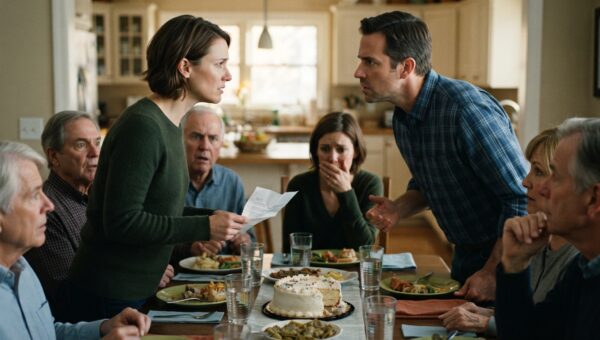
“His birth certificate says Kenneth James Miller,” I told him, pointing to the typed line. “And eighty thousand dollars of our money paid his mother’s lot rent for eight years while we sat in this house sweating through August because we couldn’t afford an air conditioner.”
Kenneth wiped his palm over his mouth. He looked at the floorboards between his feet.
“Tyler is Greg’s boy,” he whispered.
The kitchen went dead still.
Greg was our youngest son. Greg was thirty-six, an electrician with a wife, two daughters, and a neat brick home in Columbus. Greg was the golden child, the boy who had won high school football trophies, graduated near the top of his vocational class, and never seemed to stumble.
“What are you talking about?” I asked, my heart pounding against my ribs like a hammer.
“In 2017,” Kenneth said, his voice breaking down into a rough gravel, “Greg was working a commercial job down in Canton. He was staying near Jim’s neighborhood. He got involved with Cynthia before he married Rachel. When Cynthia called him in the summer of 2018 to tell him she was pregnant, Greg came to me in tears out in the garage. He had just gotten engaged to Rachel. Rachel was pregnant with their first girl.”
I stared at my husband. “Greg had a child with Cynthia Vance?”
“Greg was going to walk away, Martha,” Kenneth said, looking right into my face with raw, miserable desperation. “He said he couldn’t tell Rachel. He said if Rachel found out, she’d take his baby, cancel the wedding, and his life would be over. He told me he’d rather put his truck into a bridge abutment than face you and Rachel with the truth.”
The room seemed to shrink.
“So you put your name on the birth certificate?” I asked, the words tasting like poison.
“Cynthia agreed not to file for child support through the state if the boy had a legal father for health insurance and basic security,” Kenneth muttered. “She wanted eight hundred dollars a month for a roof over their heads at Buckeye Ridge. I told her I would sign the acknowledgment of paternity so Greg wouldn’t be dragged into domestic relations court. I told Greg I would carry it until the boy was grown.”
“You carried it?” I stood up from the table, my hands trembling with a sudden, boiling fury. “You didn’t carry it, Kenneth! I carried it! We carried it! You stole eight hundred dollars a month from our shared life, from our retirement, to cover for a thirty-year-old grown man who didn’t want to face his own responsibilities!”
“I was protecting our family!” Kenneth yelled, his face turning dark red. “I was protecting Greg’s home! If Rachel knew, Greg would have lost his daughters!”
“You protected a coward,” I said. “And you made me a fool for eight years while you played the noble martyr in secret.”
ENDING
I didn’t let Kenneth sleep in our bedroom that night. I locked the door and left his clothes in a canvas bag in the hall.
At seven o’clock the next morning, I picked up the landline phone and dialed Greg’s direct cell number.
When my son answered with his cheerful, hurried voice, on his way to an electrical site in Dublin, I didn’t ask how his daughters were doing.
“Greg,” I said, “I have the Buckeye Ridge lease and Tyler’s birth certificate on the kitchen table. You have three hours to get to this house, or I am calling Rachel myself.”
Greg didn’t make an excuse. He arrived in our driveway two hours later, his truck engine ticking hot from the turnpike.
He walked into our kitchen with his head down, looking twenty years younger and ten times smaller. When he saw his father sitting by the window with red, swollen eyes, Greg broke down completely. He dropped onto the wooden bench by the pantry, put his face in his hands, and wept like a child.
We stayed at that table for four hours.
There was no legal dodge left, and there was no hiding behind his father’s back.
I laid down the terms. Kenneth had wanted to keep the lie forever, but I told them both that the bank account transfers stopped that very day.
“You will go to an attorney in Canton next week, Greg,” I told my son. “You will legally substitute your name on that boy’s paternity records, and you will set up a formal, court-monitored child support order through the county domestic relations division out of your own paycheck. And you will tell Rachel the truth before the court papers arrive at your mailbox, or I will hand her the folder myself.”
Greg looked up at me, terrified. “Mom, she’ll leave me.”
“Then she leaves you,” I said, looking right through him. “That is the consequence of your choices. What you do not get to do is let your retired parents starve their own safety to keep your life pretty.”
Then I turned to Kenneth.
“And you,” I said to my husband of thirty-six years. “You are going to take seventy-six thousand eight hundred dollars out of your individual pension annuity buyout and restore our joint savings account by Friday afternoon. Every single penny.”
Kenneth didn’t argue. He went to the credit union the next morning, signed the withdrawal forms, and transferred the funds back into our main marital account.
Greg went home that night and told Rachel. It wasn’t clean, and it wasn’t easy. Rachel took their two girls to her mother’s house for three weeks, and they are in marriage counseling now, trying to salvage what is left of a home built on an eight-year secret. Greg’s wages are officially garnished by the state of Ohio for Tyler’s support every month, exactly as they should have been from the start.
Kenneth and I are still in the house on Miller Road.
We didn’t file for divorce. When you are seventy-one, untangling forty years of joint property and family history is like trying to pull roots out of frozen ground. But the house is different now. The silence between us has weight.
Last week, the heating and cooling company came out and installed a brand-new, high-efficiency central air conditioning system in our basement, paid for with a certified check from our restored savings.
On Tuesday, the new bank statement arrived in the mail.
I sat down at the kitchen table, put on my reading glasses, and opened the blue ledger. I ran my pencil down the debit column.
The fifteenth of the month came and went. The balance remained steady, right down to the last dollar.
Kenneth came in from the garage, smelling of engine grease. He set a fresh mug of black tea beside my ledger and stood there for a moment, waiting for me to look up.
I didn’t. I made a neat checkmark beside the ending total, closed the book, and put the cap back on my pen.