PART 1
Pastor Nealy asked me to stand up Sunday and forgive the man who killed my boy.
“It would heal this whole body, Martha,” he told me last Tuesday, leaning across the folding table in the fellowship hall with a styrofoam cup of black coffee between his palms. “Grace isn’t grace until it costs something. Think about what a testimony that would be for the valley.”
My coffee went stone cold while he talked. Twelve years ago, a drunk driver crossed the yellow double line on Route 6, two miles north of the county quarry, and hit Cole’s pickup head-on. Cole was nineteen. He had his toolbelt on the passenger seat and two fresh grease spots on his ball cap from changing the oil in his sister’s car before his shift.
The man behind the wheel of the oncoming car was named Jesse Vance. Jesse served four years in the state facility at Mercer and paid an $1,800 county fine. When he got out, he lived two towns over for eight years, working seasonal road maintenance. Then, last spring, he moved back into our district.
Two months later, he walked into Mount Zion Baptist on a communion Sunday.
He didn’t make a scene. He just slipped through the double doors five minutes before the prelude, hung his denim work jacket on the peg in the foyer, and took a seat three pews up from where I have sat on the left side of the aisle since 1984.
Since that Sunday, our congregation has lived with a split spine. Half the church thinks I owe the man public Christian grace, whispering around the casserole tables that twelve years is long enough to carry bitterness. The other half won’t look at Jesse Vance when he reaches for the wooden offering plate. Some of Cole’s old high school classmates stopped coming to Wednesday night prayer entirely.
I prayed till the words ran out. I sat in my armchair by the front window of my house every evening this week with Cole’s high school graduation portrait in my lap, asking God how a mother is supposed to stand at an altar and put a holy blessing on the worst minute of her life just to make seventy other people feel comfortable in their Sunday clothes.
This morning, I ironed my good navy dress. I pinned my mother’s silver cross to my collar and walked the four blocks to the church twenty minutes before the bells rang.
When the front doors opened, I didn’t take my usual seat in the sixth row. I walked straight up the center carpet to the third pew, stepped into the row, and sat down directly behind where Jesse Vance always hangs his jacket.
PART 2
The sanctuary filled up slowly around me. The smell of floor wax and wet wool hung in the air from the morning rain.
People noticed where I was sitting before they even set their Bibles down. Clara Higgins stopped dead in the aisle with her choir folder clutched against her chest, her eyes darting from me to the empty space in front of me. Deacon Miller cleared his throat twice as he handed out the morning bulletins, his hand trembling slightly when he passed one to my lap. Nobody said a word, but the murmur in the back pews dropped to an uncomfortable hush.
At ten minutes to eleven, the side door clicked open.
Jesse Vance walked in. He had gray in his brown hair now, cut short around his ears, and he wore a clean, stiff khaki shirt with the top button done.
He kept his eyes on the floorboards as he walked down the aisle, just like he had done every Sunday for six months.
He slid into the third pew, set his Bible on the wooden shelf, and reached to take off his denim jacket.
When he turned to lay the coat over the back of the pew, he saw me.
Jesse stopped. His knuckles turned white against the denim fabric. He stood less than three feet from me, his mouth slightly open, the breath catching in his throat. For twelve years, I had only seen this man across a mahogany defense table in the county courthouse, surrounded by bailiffs and public defenders while a judge read out vehicular manslaughter charges.
“Mrs. Miller,” he whispered. His voice was thin and rough, like gravel under a boot heel.
“Sit down, Jesse,” I said. My voice was quiet, but it carried to the four rows around us.
He sat down slowly, his back stiff as an iron rail. I could see the pulse jumping in the side of his neck.
Pastor Nealy came out from the side vestry, wearing his dark robe and carrying his leather sermon binder. When his eyes swept over the left side of the sanctuary and saw me sitting directly behind Jesse Vance, his steps faltered for half a second. He had expected me to wait in my usual pew until the invitation hymn, then walk down the red aisle to the pulpit to deliver the neat, rehearsed reconciliation speech he had laid out for me over coffee.
The service began with hymn 142, *Amazing Grace*.
Jesse stood up with the rest of the congregation. He held his hymnbook with both hands, but his lips didn’t move. He didn’t sing a single note. Right in front of me, I watched his broad shoulders rise and fall with shallow, nervous breaths.
When the choir finished the anthem, Pastor Nealy stepped up behind the wooden pulpit. He adjusted the microphone on its goose neck, cleared his throat, and looked directly down at where we sat.
“Brothers and sisters,” Pastor Nealy began, his tone solemn and full of dramatic weight. “We talk often in this house about the cross. We talk about washing away old debts. But today, the Lord has laid a heavy, beautiful burden on our hearts. We have a sister in our midst who has walked through the valley of the shadow of death, and who has come here this morning to demonstrate the ultimate power of Christian pardon.”
He extended his right hand toward our pew.
“Martha, if you would join me at the altar. And Jesse, would you step forward with her?”
Several women in the fifth row let out soft sighs. Deacon Miller nodded from the amen corner. They were waiting for the scene they had built in their minds: the grieving mother weeping, the broken sinner kneeling, the church weeping together, and everyone going home to pot roast feeling clean and righteous.
Jesse stood up from the pew. He turned to face me, his head bowed, waiting for me to step out into the aisle ahead of him.
I didn’t move toward the aisle.
I stood up right where I was, reached down into my black leather purse, and pulled out an old, water-damaged cream envelope that had sat in the bottom drawer of my cedar desk for eleven years.
PART 3
“I’m not walking up to that pulpit, Pastor,” I said.
The sound system caught my voice clearly through the pulpit mic. The sanctuary went completely dead. Nobody shifted their feet. Even the little Higgins boy in the back stopped kicking the wood of his pew.
Pastor Nealy’s hand dropped an inch. “Martha, we agreed that today was about laying down the stone.”
“You asked me to give a testimony about grace, Pastor,” I said, looking straight at the pulpit, then down at the back of Jesse Vance’s head. “So I am going to tell this church the truth about what grace actually looks like when nobody is taking pictures.”
Jesse turned completely around in his pew. His face was the color of chalk. His eyes fell on the cream envelope in my hands, and the stiffness in his shoulders seemed to snap.
“Twelve years ago,” I said, speaking clearly to the whole congregation, “Jesse Vance got drunk on whiskey at a tavern on the county line. He got into his sedan, ran across the yellow line at fifty miles an hour, and took my nineteen-year-old son away from me. He served four years in prison. The court ordered an $1,800 restitution fine, which was paid out of his state commissary funds.”
A woman in the choir softly blew her nose into a handkerchief.
“When Jesse was released eight years ago,” I continued, “he was barred from holding a commercial driver’s license. He couldn’t get hired at the sawmill. He couldn’t get hired at the limestone plant. He moved out to a rented room over a tire shop in Mercer and took thirty-dollar cash jobs digging ditches by hand.”
I held up the cream envelope.
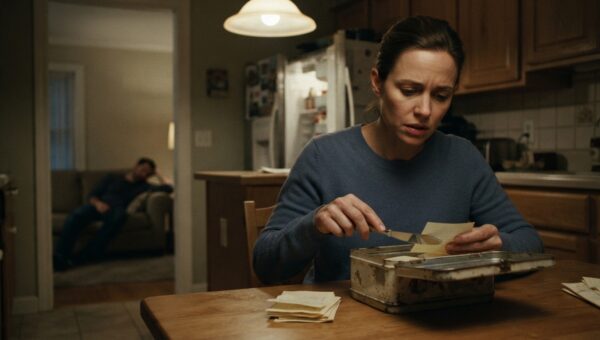
“Eleven years ago, while Jesse was still sitting in a cell at the state facility, I got this envelope in my post office box. There was no letter inside. There was an official state bank money order for forty-two dollars. The memo line had one word written on it: *Cole*.”
Pastor Nealy frowned, looking confused. Jesse hung his head, his chin pressed hard against his collarbone.
“Every single month for eight years,” I said, “on the third Tuesday of the month, another money order arrived in my box. Sometimes it was twenty dollars. Sometimes it was fifteen. Once, during a winter when the county had three blizzards, it was seventy-five dollars because he had spent three nights shoveling out municipal hydrants on foot.”
I looked across the pews at the folks who had spent the last two months whispering about whether I was being a good Christian.
“The court only asked for eighteen hundred dollars,” I told them. “Over the last eight years, Jesse Vance sent six thousand two hundred and forty dollars to my post office box. Not because a judge made him. Not because he had a lawyer telling him it would look good for a parole board. He sent it because he knew he took a life, and he knew forty dollars a month was the only way a man with a ruined back could say he was sorry.”
I opened the envelope. I pulled out six yellowed, uncashed postal money orders, still clipped together with an old steel paperclip.
“I never cashed a single one,” I said. “Not forty-two dollars. Not fifteen dollars. Because every time I held that slip of paper, I knew Cole wasn’t coming home, and I couldn’t bear to buy my groceries with the sweat of the man who took him.”
Jesse’s shoulders began to heave. He buried his face in his rough, calloused hands, weeping without a sound.
“Pastor Nealy told me this morning would heal this whole body if I stood at the altar and put on a show,” I said, looking back at the preacher. “You wanted a public handshake so this church could stop feeling awkward during Sunday school. You wanted me to say that everything was fine so people wouldn’t have to look at an empty chair in the back of their minds.”
I stepped out of the pew.
I didn’t walk toward the altar. I took two steps forward, until I was standing right at the end of Jesse’s pew.
“Jesse,” I said.
He looked up, tears running down the deep creases of his face, his eyes red and swollen.
“You don’t need this church to give you permission to sit here,” I told him, loud enough for every deacon and choir member to hear. “You paid your debt to the state. And you have spent eight years paying a debt you knew you could never settle. I am not going to hug you, and I am not going to pretend that Route 6 never happened. I miss my boy every morning when the sun comes up, and that ache is going to stay with me until they put me in the ground beside him.”
I laid the thick stack of uncashed money orders down on the wooden pew right beside his Bible.
“I am not keeping these anymore,” I said. “And I am not throwing you out of this house. If you want to sit here and pray to the Lord, you sit here. But we don’t need a circus at the altar to make peace with God.”
ENDING
The sanctuary remained completely silent for a long minute after I stopped speaking.
Pastor Nealy stood behind the pulpit with his hands resting on his binder, his mouth closed. He didn’t ask the choir to sing the final verse of the invitation. He didn’t call anyone down to the front. He looked at the stack of money orders on the third pew, then out at the congregation, and bowed his head.
“Let us pray,” Pastor Nealy said quietly.
His prayer was short. He didn’t use any high-sounding words about big testimonies or community triumphs. He just asked the Lord to give us the strength to bear our own grief, and the sense to leave other people’s souls to the mercy of God.
When the service dismissed, people didn’t linger in the aisles to chat about the weather or the potluck. They filed out quietly into the gray noon light, shaking hands with soft voices, nodding to one another with a gravity that Mount Zion hadn’t seen in twenty years.
Jesse didn’t rush out. He stayed in his seat until the sanctuary was almost empty. When he finally stood up, he took the uncashed money orders, slipped them into the breast pocket of his work shirt, and zipped his denim jacket up to his neck.
He looked over at me as I gathered my purse from the pew behind him. He didn’t say thank you. He didn’t try to make an apology he knew was too small for the room. He just gave me a slow, solemn nod of his head, turned, and walked down the aisle toward the rear doors.
That was six months ago.
Jesse still comes to Mount Zion every Sunday morning.
He sits in the third pew on the left side of the aisle, right where he has always sat. The whispering in the back pews stopped completely after that Sunday. When Deacon Miller passes the offering plate down Jesse’s row now, he looks the man in the eye and gives him a firm, respectful nod, and Jesse drops his envelope in with everyone else.
Last month, the church trustees voted to replace the rotted cedar boards on the access ramp behind the fellowship hall. When I drove by on a Saturday afternoon with my groceries, Jesse was out there in the heat with a hammer and a level, pulling the bad lumber out with his own hands, working for six hours without asking for a dime from the building fund.
I still sit in the sixth pew on the left.
We don’t talk after the benediction. We don’t share coffee during the fellowship hour. We are not friends, and we never will be. The yellow line on Route 6 will always run between our lives, cold and unbending, until the day I see Cole again.
Yesterday afternoon, I walked out to Oak Hill Cemetery to put fresh fall mums in the bronze vase beside my son’s headstone.
The leaves from the big oak tree were scattered across the grass, brown and gold in the late October light. When I knelt down by Cole’s marker to clear away the dead twigs, I noticed something resting on the corner of the granite base.
It was a small, clean piece of white river limestone, smoothed by water, the kind of gravel they dredge from the creek bed out by the county quarry.
I picked it up, turned it over in my fingers, and felt how cool and solid it was against my skin.
I didn’t toss it into the weeds. I set it gently back on the corner of the polished stone, smoothed down the hem of my coat, and walked back down the gravel path to my car.