PART 1
My son, Brian, called me on a Tuesday night to invite me to his housewarming party, but he made sure to put rules on the invitation before I could even ask what time it started.
“Mom, don’t bring Martha or Evelyn from the church circle,” he said, his voice flat through the phone. “This isn’t a potluck. The neighbors on our new cul-de-sac are all corporate people, and Courtney wants a certain tone. It needs to be polished.”
I swallowed the sting of that. I am sixty-four years old. I spent twenty-six years managing an intake desk at the county records department, and I helped Brian buy his first car and put sixteen thousand dollars toward his down payment when he and Courtney bought their four-bedroom colonial out in Oak Ridge. Martha and Evelyn had known Brian since he was seven, back when he had grass stains on his knees and ate push-pops on my front stoop.
“I can come by myself, Brian,” I told him. “That’s fine.”
The party was scheduled for five o’clock on Saturday. I spent Friday baking a lattice-crust peach pie, wrapping the ceramic dish in a clean yellow dishcloth. I almost stayed home because Courtney’s polite contempt usually gave me an upset stomach, but I wanted to be a supportive mother.
At three in the afternoon, two full hours before the guests were supposed to arrive, I drove my sedan down their street.
I wanted to drop the warm pie on the counter, help set out napkins, and get out of the way before the important neighbors showed up with their wine bottles.
When I turned the curve into their cul-de-sac, a white commercial moving truck with orange lettering was backed right up to the double garage.
Two young men in gray work shirts were hauling heavy brown wardrobe cartons down the metal ramp. The driveway was lined with neat stacks of taped boxes. At first glance, I thought they were decorative storage crates or outdoor patio fixtures Courtney had ordered for the backyard.
I was about to smile at how frantic they looked trying to set up in time. Then I stepped out of my car, carrying the hot pie against my chest, and looked at the bold black marker scrawled across the top flap of the nearest carton.
It didn’t say patio.
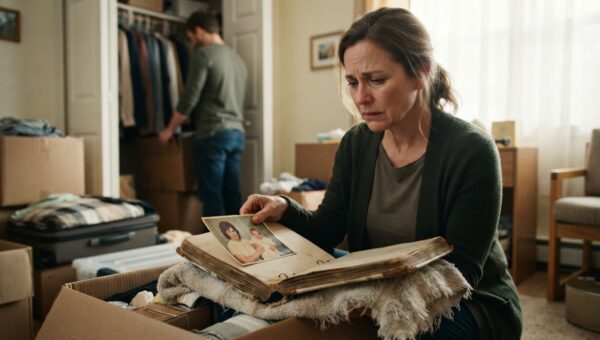
It said: ELEANOR MILLER – MASTER BEDROOM LINENS & PHOTO ALBUMS.
Below that was a red sticker from the municipal storage depot across town, dated two days ago.
My breath stopped in my throat. I took three steps closer, my rubber soles sticking slightly on the hot asphalt.
The next box was marked: KITCHEN APPLIANCES & CHINA SET. The one behind it had my sewing baskets taped inside clear plastic tubs.
Brian came walking out through the side garage door carrying a box of bottled water. When his eyes hit me standing beside the tailgate, the color drained completely from his cheeks. His hands dropped, and one of the plastic bottles rolled out of the case and bounced across the driveway concrete.
Courtney appeared right behind him in a sleeveless green linen dress. She took one look at my pie, one look at the cartons, and instantly took three quick steps forward, putting her entire body between me and the labels.
“Eleanor,” Courtney said, her voice pitched unnaturally high. “You’re early. We aren’t ready yet. Those aren’t yours, by the way. Those belong to someone else. It’s just staging furniture from the designer.”
Before Brian could get his mouth open to agree with her, the older mover stepped down off the truck ramp holding an aluminum clipboard with a yellow carbon form.
He glanced down at the sheet, wiped the sweat from his forehead with the back of his arm, and looked directly into my face.
“Excuse me, ma’am,” the driver said, holding out a black ballpoint pen. “Are you Eleanor Miller?
The office needs a signature on the transfer slip. Should I have the boys carry the rest of your belongings up to the room over the garage, or are you still sleeping at the highway motel?”
PART 2
The ceramic pie dish burned through the yellow cloth in my hands, but I couldn’t move to set it down.
“A motel?” I said. The word sounded thin and strange in my own ears.
The driver looked between me, Brian, and Courtney. He was an older man with gray hair under a navy ball cap, and he had been doing manual labor long enough to know when he had walked into the middle of a disaster.
“Yes, ma’am,” the driver said, tapping the carbon copy with his thumb. “The work order was placed on Wednesday by Mr. Brian Miller. It says: Full pack-out and transport from 412 Maple Street. Deliver to Oak Ridge address. Customer note states resident is temporarily lodged at the Oak Ridge Travel Lodge on Route 7 until upstairs garage suite is painted.”
412 Maple Street was my house.
It was the two-bedroom bungalow my late husband, Arthur, and I had bought thirty-one years ago. The house Brian grew up in. The house where I had planted hydrangeas along the walkway and where Brian had stored his college trunks in the basement until last summer.
Three weeks ago, Brian had come over on a Sunday with a professional clipboard. He had told me the wood siding on my garage needed repainting and that the town inspector was complaining about cracked front steps. He told me he was going to take care of everything while I visited my sister in Harrisburg for five days. He had insisted on keeping my spare key so the painters could come and go.
I had returned from Harrisburg on Thursday night. My front key had stuck in the lock, but Brian had called right as I pulled in, telling me the front door was sticking from the humidity and that he had arranged a room for me at the highway motel for three nights so I wouldn’t have to breathe paint fumes while they refinished the oak floors.
I had checked into room 114 with a single overnight bag, trusting my son completely.
“Brian,” I said. I set the hot pie dish on the hood of my sedan so my hands would be free. “Why are my photo albums on your driveway?”
Courtney stepped around the stack of boxes, her manicured fingers twisting a gold bangle around her wrist. “Eleanor, don’t cause a scene out here. The neighbors are already home from tennis. We were going to explain everything tonight after the party.”
“Explain what?” I asked.
Brian took a step toward me, but he wouldn’t look me in the eye. He looked down at the moving driver’s steel-toed boots.
“Mom,” Brian said, his voice quiet and strained. “Maple Street is too much for you. The roof has two years left at best, the taxes went up eight hundred dollars in January, and you’re living on Dad’s pension and social security. Courtney and I talked it over. It doesn’t make sense for you to sit alone over there when we have the finished space above the garage.”
“You cleared my house,” I whispered. “Without telling me.”
“We didn’t throw anything away!” Courtney interrupted, her tone sharp, defensiveness creeping through her polite smile. “We hired the top-tier white-glove packers. Every single knick-knack is wrapped in bubble paper. We did this for you, Eleanor. Most children just dump their mothers in assisted living. We spent thirty-two hundred dollars moving your things here so you could help with the baby when Courtney returns to work in November.”
“And Maple Street?” I asked, looking straight at Brian. “What did you do to Maple Street?”
Brian swallowed hard. His collar looked too tight for his neck.
“We listed it, Mom,” he said. “The market in that neighborhood peaked last week. We had three cash offers by yesterday morning. If we waited until spring, we would have lost forty thousand dollars in equity.”
PART 3
A cold quiet settled over the driveway. The only sound was the compressor on the moving truck clicking off.
“You listed my home,” I said. Every word was distinct. “I hold the deed, Brian. Arthur and I paid off that mortgage in 2018. You cannot sell a house you do not own.”
Courtney let out a short, scoffing breath and crossed her arms. “Brian has your full power of attorney, Eleanor. You signed the general property authorization three years ago when you had your gallbladder removed so he could pay your utility bills if you had complications. We had the title company review the paperwork on Monday. The contract is legal.”
She said it with absolute confidence, as if she were explaining a simple grocery receipt to a confused toddler.
I looked at my son. I remembered him at twelve, crying in the emergency room when he broke his wrist falling off the backyard swing, clinging to my sweater while the doctor set the bone. I remembered working four extra weekend shifts a month at county records so he could have the travel soccer cleats the other boys had.
He didn’t look like that boy now. He looked like a man who had calculated the price of my life and decided it fit neatly into a room over his two-car garage.
“You used my medical emergency paperwork from three years ago to sell my home behind my back,” I told him.
“We need the equity, Mom!” Brian said, the frustration finally bursting out of him. His hands came up in tight fists at his sides. “Our mortgage on this place is forty-eight hundred dollars a month. Courtney’s firm cut their bonus pool, and we’re underwater on the construction loan for the pool out back. Maple Street is worth three hundred and ten thousand dollars. That money clears our secondary debt and leaves you plenty to live comfortably right here with your grandchildren.”
“That is my money,” I said. “And that was Arthur’s house.”
“You’re sixty-four!” Courtney snapped, stepping right into my path. “What do you need three bedrooms for? You watch television and you weed the flower beds. You can do that here. We are offering you a home with your family, and you are standing in our driveway treating us like criminals because we solved a financial problem for everyone.”
“I am not signing that transfer,” I told the mover, turning my back on her entirely.
The driver nodded once, his expression completely neutral. “Understood, ma’am. Whose name is on the bill of lading?”
“Brian Miller,” Brian said quickly, stepping between us. “I paid the deposit with my card.”
“Then you have thirty minutes to tell me where this freight goes, Mr. Miller,” the driver said, looking at his watch. “Because company policy says if the property owner named on the crates refuses delivery at this site, I haul the load back to our bonded holding facility in West Chester, and you get billed ninety dollars an hour for secure yard storage.”
“No,” Courtney said, her voice turning shrill. “Don’t you dare take those boxes! The party starts in an hour and a half! We cannot have moving crates piled on the front lawn when the neighborhood association board walks up that path!”
“Take them to West Chester,” I told the driver.
I reached into my handbag, pulled out my driver’s license, and held it up against his clipboard so he could read my name and my face.
“I am Eleanor Miller,” I said. “Every item on that truck belongs to me. Do not unload one more carton onto this concrete.”
The driver looked at my license, then looked at Brian. Brian opened his mouth, but nothing came out.
“Boys,” the driver yelled toward the truck bed. “Ramp up. We’re rolling back to the yard.”
ENDING
The movers didn’t waste ten seconds. They pushed the two remaining wardrobe cartons back into the dark interior of the trailer, pulled the heavy aluminum ramp up with a sharp clang, and dropped the roll-up door down until the latch clicked.
Courtney stood on the edge of the manicured turf, her face tight and furious, watching the truck back out into the street.
“You ruined this day, Eleanor,” she hissed at me, not caring that the woman next door was out by her mailbox pruning a rosebush. “You ruined our housewarming. When people ask where you are tonight, I am going to tell them you refused to celebrate your own son’s success.”
“You tell them whatever you want, Courtney,” I said.
I turned to Brian. He was standing on the driveway with his head down, staring at the lone plastic water bottle still resting by the garage door.
“Brian,” I said.
He looked up slowly. There was no defiance in his eyes now, only the dull, miserable panic of a grown man who had gambled with his mother’s dignity and lost.
“I am going to the courthouse on Monday morning at eight o’clock,” I told him, keeping my voice quiet and steady. “I am revoking the power of attorney. I will file the revocation with the county recorder, and I will personally deliver a certified copy to the title company handling your listing on Maple Street. If you or your real estate agent set foot on my grass again, I will have the police escort you off.”
“Mom,” he whispered, his voice cracking. “We’re going to lose the house. We can’t carry this payment without the proceeds from Maple Street.”
“Then you should have bought a smaller house, Brian,” I said.
I picked up my peach pie from the hood of my car. The ceramic bottom was still warm against my palms. I carried it over to the passenger seat of my sedan, set it gently on the floor mat, and got behind the wheel.
I didn’t go to the highway motel.
I drove straight over to Martha’s house on Elm Street. When she opened the screen door wearing her denim apron, I didn’t say a word. I just held out the pie. Martha took one look at my face, pulled me into her hallway, and yelled into the kitchen for Evelyn to put the kettle on.
We stayed up until midnight around Martha’s round oak table. On Monday morning, Martha drove me to the courthouse in her blue station wagon. By ten o’clock, the power of attorney was formally revoked on the public record, and my title insurance agent had placed a legal hold on the Maple Street parcel.
The cash buyers walked away twenty-four hours later.
Brian and Courtney had to put their Oak Ridge colonial on the market four months later at a loss, downsizing to a two-bedroom rental apartment on the south side of town. Brian sent me a letter in November, written on lined legal paper, apologizing for letting things go so far, but I didn’t write back. Some lines, once crossed, leave the ground too broken to walk on again.
Yesterday afternoon, the commercial truck from West Chester pulled up to my curb on Maple Street.
Two young men carried my kitchen cartons through the front door, their boots thumping against the familiar hallway floorboards. I spent the evening unwrapping Arthur’s ceramic coffee mugs and setting my sewing tins back on the low shelf by the living room window.
When the sun went down, the street was completely quiet. I walked out onto my front porch, turned on the yellow carriage lantern over the steps, and sat in my wooden rocker, watching the wind move through the hydrangeas I had planted with my own two hands.