PART 1
I surrendered my brother Ray’s eleven-year-old golden retriever, Buster, to the county animal shelter on a rainy Tuesday morning in late October.
I was fifty-two years old, living alone in a third-floor walk-up apartment that had a strict thirty-pound limit on pets, and working forty-five hours a week as a medical records clerk at the regional clinic. When Ray died of sudden heart failure in August, I took Buster into my apartment because I didn’t know what else to do.
But Ray was gone, my savings were thin, and my landlord had already given me two written warnings about the dog’s heavy pacing across the floorboards while I was at work.
Between the long hours at my new job and the building rules, I just couldn’t keep him.
Buster walked beside me through the double glass doors of the shelter on a frayed red nylon leash. He was gray around the muzzle, his back hips were stiff, and he didn’t pull or bark. He didn’t resist at all. When the intake attendant stepped out from behind the counter, Buster simply turned his head, pressed his cold, wet nose into my palm one last time, and opened his mouth.
His favorite chew toy dropped onto the linoleum right at my feet with a soft, wet plop.
It was a faded yellow canvas duck with one black button eye missing, the seams chewed into fraying threads that Ray had stitched back together with blue fishing line three different times over the years.
Buster had carried that ratty duck everywhere since Ray bought it for him at a tractor supply store seven years ago.
“Just standard intake,” the clerk behind the desk said, sliding a clipboard toward me without looking up from her monitor. She handed me a pen. “That will be a fifty-dollar surrender fee, ma’am. Cash or card.”
I pulled a fifty-dollar bill from my wallet and signed the release form. I picked the wet canvas duck up from the floor, shoved it into the pocket of my rain jacket, and walked out to my car. I sat behind the steering wheel in the parking lot and cried until my throat ached, feeling like the worst sister who had ever lived.
Two weeks later, on a Friday afternoon, my phone rang while I was logging patient charts at my desk.
The caller ID showed the county shelter.
A supervisor named Carol spoke in a quiet, measured voice. She told me Buster had gone to sleep on his blanket in the quiet kennel ward on Thursday night and simply hadn’t woken up.
His old heart had given out peacefully in his sleep. She asked if I wanted his ashes, but private cremation was two hundred and twenty dollars that I didn’t have, so I told her no.
I walked into my quiet apartment that evening, looked at the empty corner where his water bowl used to sit, and felt a heavy twinge of guilt settle right in the middle of my chest.
I took off my coat, walked over to the entryway table, and picked up the ratty yellow duck. It was dry now, smelling faintly of old river water and dog biscuits. I walked into the kitchen, stepped on the pedal of the plastic trash can, and dropped the toy toward the garbage bag.
The canvas caught on the jagged metal edge of an empty soup can.
The old fabric ripped open along Ray’s blue fishing-line stitches with a sharp tearing sound.
As the gray cotton stuffing spilled out across the plastic liner, something small, hard, and metallic hit the rim of the can and bounced onto the linoleum.
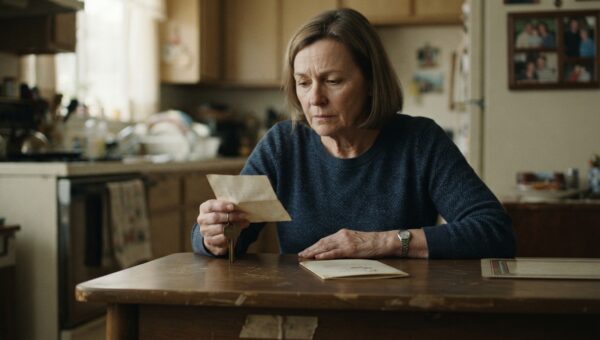
It was a small, tarnished brass key with two notches cut into the tip, wrapped tightly inside a folded strip of yellow legal pad paper held together by a piece of scotch tape.
I picked it up and peeled the tape back with my fingernail.
Written in Ray’s familiar, cramped left-handed script in black ballpoint ink were six words:
“If he gave you this, it means they…”
PART 2
The note ended right at the torn bottom edge of the paper, where Ray’s pen had gouged through the fiber without finishing the sentence.
I stood by the kitchen counter with the little brass key resting in the palm of my hand.
Ray had been fifty-six when he collapsed in the gravel lot outside his small independent auto repair shop on Route 11. He had never married, had no children, and lived in a rented cinderblock cottage behind his garage bay. When he died, his business partner of nine years, Dale Vance, took over the property lease and the customer accounts within forty-eight hours.
Dale had come to my kitchen two days after Ray’s funeral with a single cardboard box containing Ray’s work boots, three flannel shirts, and an empty leather wallet. Dale told me Ray had died owing forty-two thousand dollars to parts suppliers across the state line, and that the shop’s commercial bank accounts had been cleared out by supplier liens before the body was even cold.
“Ray was drowning, Clara,” Dale had said, leaning his hands on my small laminate table. “He was a good mechanic, but he was terrible with books. You’re lucky the vendors aren’t coming after his personal effects. Just take Buster and let the shop go.”
I had believed Dale. Ray had always avoided paperwork, keeping receipts in shoe boxes and doing estimates on the backs of paper bags. I had accepted Dale’s word, signed the probate release form Dale brought me, and walked away with nothing except an old dog and a broken heart.
Now I looked down at the brass key. Stamped into the head of the key was a tiny three-digit number: 184.
Beneath the number was a microscopic anchor logo.
I knew that logo. It was the trademark of the River Valley Storage depot down on the county canal road, four miles south of Ray’s garage. Ray had kept an outside parking spot there years ago for an old flatbed wrecker.
On Saturday morning at eight o’clock, I drove my sedan out to the canal road.
The storage facility was surrounded by a tall chain-link fence topped with barbed wire. A gray-haired man in a faded thermal shirt was sitting in the front office, watching a small portable television on his desk.
I set the brass key on the counter.
“My name is Clara Albright,” I said. “My brother, Ray Albright, passed away in August. I found this key among his things.”
The man adjusted his wire-rimmed glasses, picked up the key, and read the number.
“Unit 184,” he said. He swiveled his computer monitor toward him and tapped the keys with two fingers. “Yeah. Ray Albright. Account has been active since 2018. Paid up through the end of this December on an annual cash prepayment.”
“Is it a locker?” I asked.
“Ten-by-ten indoor climate-controlled bay,” he said. “Ray was in here every couple of months. He listed you as the alternate emergency contact on the original contract, Clara. If you have your driver’s license and his death certificate, I can buzz you through the interior gate.”
I had kept two certified copies of Ray’s death certificate in my glove box since August. I handed them over, signed the visitor log, and walked down the long, concrete-floored hallway lined with blue roll-up garage doors.
Unit 184 was near the fire exit at the very back of the building.
I slid the brass key into the padlock hanging from the heavy steel latch. The cylinder clicked, the shackle sprang open, and I rolled the metal door up into the ceiling.
The unit smelled of motor oil, dry cardboard, and sweet pipe tobacco, the exact smell of my brother’s jacket.
Sitting in the center of the concrete bay was Ray’s prized 1972 red Ford pickup truck, covered with a gray canvas drop cloth to protect the paint. And stacked neatly against the back wall were three heavy gray steel filing cabinets, each secured with a small brass master lock.
PART 3
I walked over to the first filing cabinet. Taped to the top drawer was a spare key on a red plastic tag labeled *Shop Ledgers 2021-2024*.
I unlocked the drawer and pulled it open.
Inside were sixteen thick green accounting binders, arranged in chronological order. Tucked into the front of the 2024 binder was a white legal envelope with my name written across the front in Ray’s hand: *Clara – Keep this private.*
I sat down on the running board of Ray’s old truck, opened the envelope, and unfolded three pages of handwritten notes clipped to a printed bank audit statement dated two weeks before Ray had his heart attack.
Ray’s handwriting filled the page:
“Clara, if you are reading this, Dale found a way to lock me out of the garage. For the past two years, Dale has been taking cash payments from regional fleet accounts off the books and routing them through a dummy shell company called Blue Ridge Fleet Service. When I caught the discrepancy in May, he told me that if I went to the sheriff, he would alter the state tax filings to make it look like I was the one pocketing the unreported revenue. I hired an independent forensic accountant in July to pull the vendor clearinghouse logs. The documents in this unit prove that Dale embezzled $146,000 from our partnership account between January 2023 and June 2024. He didn’t pay the parts vendors because he was buying a residential building parcel down in Rockingham in his wife’s name. I hid these records here where Dale couldn’t find them, and I put the locker key inside Buster’s duck because Dale hated that dog and wouldn’t ever touch it.”
The audit statement attached to the back showed five distinct wire transfers from the shop’s primary operating account into Dale’s personal credit union account, each stamped with Dale’s private commercial signature.
There were no supplier liens. Ray had not died in financial ruin. Dale had drained the accounts, manufactured the debt narrative, and intimidated me into signing a probate release so he could claim Ray’s fifty-percent equity in the business for zero dollars.
I folded the papers, put them inside my purse, and locked the storage unit.
At ten o’clock that morning, I didn’t drive back to my apartment. I drove straight down Route 11 to Albright & Vance Automotive.
The hydraulic lifts were humming inside the open service bays. Dale was standing by the service desk in his blue mechanic overalls, wiping his hands on a red shop towel while talking to a customer about brake pads.
He looked up when the screen door banged shut. When he saw me walking across the concrete floor, his friendly customer smile vanished.
“Clara,” Dale said, stepping toward the counter. “What are you doing out here? I told you there wasn’t anything left to settle. The business accounts are still frozen by the tax department.”
I walked right up to the wooden counter and laid the printed forensic audit sheet flat against the laminate, right next to his invoice book.
“Blue Ridge Fleet Service,” I said. My voice was completely steady, cutting right through the background noise of an impact wrench. “One hundred and forty-six thousand dollars, Dale. Transferred from Ray’s operating capital into your personal credit union account between January of last year and June.”
Dale looked down at the document. His mouth fell open, his eyes scanning the account numbers and the familiar dates. The color drained from his jaw, leaving his face looking like raw dough under the fluorescent shop tubes.
“Where did you get this?” he whispered.
“Ray kept his own books,” I told him, leaning forward until my hands rested on the counter. “He kept them in Unit 184 on the canal road. Along with the complete certified copies of every parts invoice you claimed went unpaid while you were buying five acres of land in Rockingham.”
Dale’s hands tightened around his red shop towel until his knuckles went gray. He took a hurried look toward the service bays to make sure his junior mechanic was out of earshot.
“Clara, wait,” Dale stammered, his voice dropping into a desperate, hushed plead. “You don’t understand the cash flow problems we had. Ray was losing his grip. I had to move funds to protect the company from vendor attachments. We can work this out. I can write you a check right now for twenty thousand dollars. Personal cash. You don’t need to get lawyers or the county involved.”
“Ray didn’t lose his grip, Dale,” I said. “You stole his life’s work while his heart was failing, and you handed me a cardboard box of dirty shirts and told me my brother died a failure.”
“Think about the business, Clara!” he hissed, his face flushing red as fear turned into panic. “If you take this to the district attorney, they will shut these bays down! Four guys will lose their jobs! Ray wouldn’t have wanted the garage destroyed!”
“Ray put the key in Buster’s toy because he knew you’d never touch something you despised,” I told him. “He wanted me to find it.”
I picked up the paper, slipped it back into my handbag, and turned toward the glass door.
“Don’t leave!” Dale yelled, stepping out from behind the counter. “Clara, please! Talk to me!”
I walked through the door, climbed into my car, and drove directly to the county courthouse downtown.
ENDING
I spent three hours in the office of Arthur Vance, an estate and commercial attorney who had known Ray since high school.
When Mr. Vance reviewed the forensic ledgers and the original partnership agreement, he didn’t waste an hour. By Monday morning, he had filed an emergency petition in county circuit court to vacate my earlier probate release on grounds of intentional fraud and concealment of assets.
Along with the civil filing, Mr. Vance hand-delivered the audit documents to the county prosecutor’s commercial fraud division.
The consequences moved with the steady, unyielding weight of the law.
Within ten days, a judge froze Dale’s personal accounts and placed a lis pendens on the Rockingham property. Facing felony counts of grand larceny and partnership embezzlement, Dale’s private attorney negotiated a full restitution agreement six months later. Dale was forced to deed over his entire equity in Albright & Vance Automotive, surrender the five-acre parcel to Ray’s estate, and pay $68,000 in direct cash restitution from his personal retirement funds.
The shop was sold in the spring to a regional repair group for three hundred and ten thousand dollars.
After estate taxes, attorney fees, and the remaining legitimate business bills were settled, Ray’s estate closed with two hundred and eighty-four thousand dollars, transferred directly into my name as his sole legal heir.
I didn’t stay in the third-floor apartment.
In May, I gave my thirty days’ notice to the landlord, resigned from my records desk at the medical clinic, and bought a small yellow brick cottage on an acre of land two miles outside of town. The house has a big wrap-around front porch, an old maple tree in the front yard, and a fenced pasture behind the barn where the morning sun comes up clean and quiet.
I had Ray’s 1972 red Ford truck detailed and tuned up, and I drive it to the grocery store every Friday morning.
Yesterday afternoon, I drove out to the county animal shelter on the bypass.
I didn’t carry a clipboard, and I didn’t have to count change in my purse. I walked through the double doors, paid the fifty-dollar surrender fee for two older hounds whose owner had passed away, and wrote a five-thousand-dollar donation check to their veterinary care fund in Buster’s name.
When I got back home to my cottage, the house was completely still.
I walked into the front parlor, where Ray’s old wooden rocking chair sits beside the fireplace. On the small wooden table next to the chair rests a clean glass jar. Inside the jar is that tarnished brass key, resting on top of the folded slip of yellow legal paper with my brother’s handwriting facing out.
I reached out, touched the cool glass with my fingertips, and looked out through the screen door at the green grass stretching toward the fence line.
Ray hadn’t left me with a burden. He had simply trusted me to finish the work when his own hands couldn’t carry it anymore.