PART 1
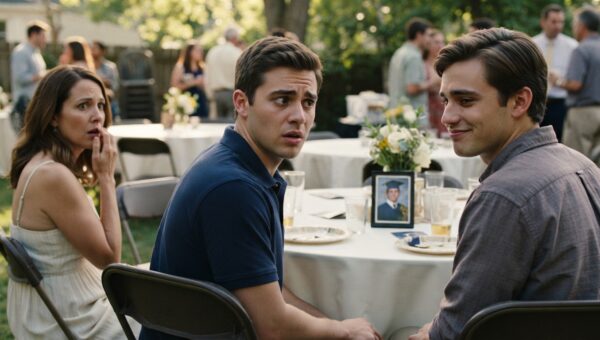
When our twenty-four-year-old son, Luke, sat at our round kitchen table on a Sunday evening and announced he was leaving the family framing business to become a paramedic, his father called it a waste of everything we had built.
My husband, Ray, had run Albright Carpentry for thirty years. His father had started it with a single trailer and an eight-foot level, and Ray had spent the last seven years teaching Luke every angle, every rafter cut, and every building code in our county.
Ray had already ordered new magnetic signs for the doors of our three-quarter-ton Ford pickup, planning to paint “Ray Albright & Son” across the tailgate before winter.
Ray pushed his chair back so hard the wooden legs screeched against the linoleum.
“You’re throwing away a licensed trade that feeds you three meals a day to ride around in the back of an ambulance for twenty dollars an hour,” Ray said, his face mottled red under his gray stubble. “After thirty years of breaking my back so you wouldn’t have to start from scratch.”
Luke kept his head down, looking at his rough, calloused knuckles. “It isn’t about the money, Dad. I want to do something that matters.”
“Carpentry matters,” Ray barked, tossing his cloth napkin onto his plate. “Putting a roof over people’s heads matters. You think this business is nothing?”
He walked out of the kitchen, let the heavy wooden basement door slam, and stayed down near his table saw until midnight.
I couldn’t sleep that night. I knew how stubborn both of them were.
Luke had inherited Ray’s jawline and his habit of setting his boots side by side by the mudroom door, but Luke carried a quiet streak that had only grown deeper over the last few years.
On Monday morning, while Ray was out on a job site measuring headers, I pulled Luke aside by the kitchen counter.
“Give your father four weeks,” I asked him. “Don’t sign the final acceptance papers at the technical college today. Work through the end of the month, let him finish the Anderson barn roof, and let the dust settle before you make it official.”
Luke looked tired, but he agreed. “One month, Mom. But my mind is set.”
During that month, Ray stopped speaking to our son.
They rode to the job sites together in the same cab in complete silence. Ray would point with a framing hammer to show where a stud went, or he would write cut lengths on a piece of scrap two-by-four and shove it across the sawhorses, but he never asked Luke how his day was, never passed him a thermos of coffee, and never looked him in the eye over dinner.
When Luke left for his evening emergency medical textbook class, Ray would stare at the television with his arms crossed like a block of granite.
The month ran out on the second Tuesday of November.
It was the morning of Luke’s first twelve-hour ride-along with the county emergency services squad. His dark blue uniform trousers were pressed, his black boots were shined, and his small medical kit sat on my kitchen counter beside his lunchbox.
Ray had left the house at five in the morning without touching his eggs.
At six-thirty, I drove Luke across town to the county rescue station on Fourth Street. The morning air was twenty-nine degrees, the grass frosted stiff along the road.
I pulled my sedan up to the curb by the ambulance bays. Luke turned to me, gave me a tight, grateful smile, and reached across to squeeze my hand.
“Thanks for the ride, Mom,” he said.
He had barely shut the car door when the heavy rumble of a diesel engine shook the street behind us.
Ray’s white work truck pulled up crooked against the curb, blocking my sedan from the front.
Ray stepped out into the freezing wind without his heavy coat, wearing only his flannel shirt.
His knuckles were pale, and dangling from his right hand was the heavy brass ring holding the keys to the company truck.
He walked right up to the sidewalk where Luke was standing with his gear bag slung over one shoulder.
“You forgot something,” Ray said, holding the keys out between them.
Luke looked at the brass ring, then at his father’s hard, unblinking face. He reached his hand out to take them, but Ray didn’t let go. Ray closed his thick fingers around the key ring, pulled Luke half a step closer, and asked him one question about the accident we never discuss.
“Does this have anything to do with the night we pulled Miller’s boy out of the ditch on Route 9?”
PART 2
The question seemed to freeze the air between them right on the sidewalk.
Route 9 was three years ago, on a freezing November night when Luke had just turned twenty-one.
Ray and Luke had been driving home from framing an addition two counties over, carrying their toolboxes in the bed of the truck through a heavy sleet storm. Two miles outside of town, they came upon a crushed sedan rolled upside down in the creek culvert. It was young Jimmy Miller, a boy who had played junior varsity football with Luke.
Ray had pried the driver’s door open using a five-foot wrecking bar from the truck bed, but the boy’s legs were pinned beneath the crushed dash.
Ray and Luke had stayed in that icy mud for thirty-five minutes before the county rescue truck arrived from twenty miles away. When the paramedics finally got down into the creek bed, Jimmy was gone from severe blood loss.
Ray had never spoken Jimmy’s name again. That night, Ray had walked into the bathroom, scrubbed his hands with powdered soap until his knuckles bled, and told me never to ask about it.
Now, standing outside the county ambulance bays, Luke did not pull his hand away from the keys. He looked his father square in the face.
“Yes, Dad,” Luke said, his voice quiet against the cold morning wind. “It has everything to do with that night.”
Ray’s fingers stayed clamped over the brass ring. “We did everything men could do, Luke. We pulled the door off the hinges. We wrapped him in two work blankets. We flagged the road. A carpenter can’t stop internal bleeding with a framing square.”
“That’s why I’m standing here, Dad,” Luke said.
The front doors of the rescue station opened, and an older paramedic in a navy jacket stepped out onto the concrete apron, carrying a clipboard. He looked at Luke, then at Ray’s truck parked across the curb.
“Albright?” the medic called out. “Shift meeting starts in ten minutes.”
“Be right there, Frank,” Luke called back.
He looked down at the brass keys in his father’s grip.
“I loved working with you, Dad,” Luke said softly. “I loved learning how to square a wall. But every time I hold a hammer now, all I see is Jimmy’s face in the mud while we stood there with our hands empty, waiting on someone with a medical bag to show up from twenty miles out. You told me that night that men do what needs doing. This is what needs doing.”
Ray stood there on the pavement, his breath rising in white clouds. He didn’t drop his eyes, but the hard, stubborn set of his jaw softened just enough for his thumb to loosen from the keys.
Luke didn’t take the truck keys.
He gently lifted his fingers away, leaving the ring resting entirely in his father’s palm.
“Keep the truck on the road, Dad,” Luke said. “You built that company. It belongs to you.”
Luke turned on his heel, adjusted his gear bag on his shoulder, and walked up the concrete ramp into the rescue bay without looking back. The double doors swung shut behind him.
PART 3
Ray stood on the curb for a long minute, looking at the glass doors of the station with his hand hanging empty at his side.
The keys dangled from his fingers, clinking together in the wind.
I rolled down my passenger window. “Ray. Get in the car before you freeze.”
He didn’t get in my car. He walked over to his work truck, climbed into the high cab, and sat there with his hands resting on the steering wheel, not starting the engine.
I pulled out from behind him and drove home.
The house was empty and quiet. I made a fresh pot of coffee, wiped the breakfast crumbs off the table, and sat near the front window with my cup, watching the road.
At nine o’clock, Ray’s truck pulled into our gravel driveway.
He didn’t go down to the basement to hide behind his power tools. He walked through the back door, took his boots off neatly by the mat, and sat down at the kitchen table across from where Luke had sat the night before.
He had the truck keys sitting on the table beside his rough palms.
“I thought he was walking away because he was ashamed of the sawdust,” Ray said, staring at the salt shaker. “My old man told me when I was twenty that if you don’t build something with your hands that stays standing when you’re dead, you didn’t leave a mark on the earth. I spent thirty years thinking that was the only way a man keeps his dignity.”
“Building houses is good work, Ray,” I told him, pouring him a mug of black coffee. “Nobody ever said it wasn’t. But Luke isn’t running from your work. He’s running toward his own.”
Ray wrapped both hands around the hot ceramic mug. “Jimmy Miller died thirty inches from my knees, Clara. I kept telling the boy to hold on. I told him his mom was waiting. I told him we had help coming.”
He had never told me that. For three years, that sentence had been locked behind his teeth, carried around on every roof he framed and every rafter he nailed.
“Luke remembers that too,” I said gently.
Ray took a slow sip of his coffee. He didn’t speak for a long time.
Then he pushed his chair back, stood up, and picked up his truck keys.
“The Anderson barn roof has four sheets of plywood left to lay before the rain hits tonight,” Ray said, his voice gruff again, but clear of the bitterness that had poisoned our house for four weeks. “I have to get back out there.”
He worked until six o’clock that evening alone, hammering through the cold wind until the barn was watertight.
At seven-fifteen that night, the phone on the kitchen wall rang.
It was Luke. His voice sounded hoarse, tired to the bone, but steady.
“Mom?” he said. “I’m off shift. They had us out on two farm equipment calls and a chest pain transport down in the valley.”
Before I could answer, Ray reached across my shoulder and took the receiver from my hand.
Ray cleared his throat twice.
“Luke,” Ray said, his voice rough.
The line stayed quiet for three seconds on the other end.
“Yeah, Dad?” Luke asked.
Ray gripped the plastic receiver tightly, his eyes fixed on the calendar hanging beside the refrigerator.
“Your mother has pot roast in the oven,” Ray said. “The driveway is iced up by the garage. Park behind my truck so you don’t slide into the ditch.”
ENDING
Luke came through the back screen door twenty minutes later.
He looked exhausted, his navy uniform shirt creased under the arms, but his eyes were clear in a way they hadn’t been since that cold night on Route 9.
He dropped his boots by the door, right next to Ray’s heavy work boots.
Ray didn’t say anything grand. He dished out three plates of beef, potatoes, and carrots, set them on the table, and handed Luke the basket of warm rolls.
They ate together in the warm kitchen, the wind rattling the storm windows just like it had for twenty-four years. When dinner was finished, Luke stood up to clear his plate, but Ray stopped him with a motion of his fork.
“The county rescue squad has that auxiliary station out by the county line,” Ray said, chewing a bite of roll. “The roof on their storage shed is sagging under the gutters. The soffits are rotted out.”
Luke looked at his father. “Chief said they didn’t have the county budget to fix it until next fiscal year.”
Ray picked up his napkin and wiped his mouth. “Tell your chief that Albright Carpentry is donating the lumber and the labor on Saturday. If my boy is going to be running calls out of that station, I’m not having the roof leak on the trucks.”
Luke didn’t smile, but he reached across the table, took his father’s rough hand, and gave it one firm, solid shake.
“I’ll tell him tomorrow morning, Dad,” Luke said.
That was two years ago.
Luke finished top of his class at the regional academy and now works full-time on the county’s primary paramedic rig. Ray still runs his framing crew, though he hired two young men from the vocational school to help with the heavy trusses.
Yesterday was Saturday.
I stood at my kitchen window around noon, washing a skillet, and looked out toward the gravel driveway.
Ray’s big white truck was parked by the barn with the tailgate down. Ray was sitting on a wooden milk crate in the gravel, showing Luke how to hone the blade of an old drawknife on an oilstone, their heads bent close together over the steel.
The side panels of Ray’s truck still just say “Albright Carpentry” in black block letters.
The company name didn’t change, and the truck will never be passed down to our son. But on the back window of the cab, right beside Ray’s county builder’s permit sticker, is a small blue star of life decal that Ray stuck on the glass with his own two hands.