PART 1
My older sister, Brenda, promised to care for our father after his stroke, so I trusted her and kept working my dispatch job two states away in Ohio.
I carried heavy guilt for trusting her, but the real reason I stayed quiet was that Dad had begged me not to start another fight. Brenda was fifty-four, three years older than me, and had always been the child who kept score.
If anyone questioned her methods, she would threaten to walk away and leave everyone scrambling. Before Dad had his stroke in June, he pulled my wrist at the rehabilitation center and whispered, “Just let Brenda run the house, Clara. If you push her, she’ll pack her car, and I can’t live alone.”
So I backed off. Dad moved into Brenda’s split-level home outside of Greensburg, Pennsylvania, and I sent two hundred dollars from every biweekly paycheck to help with his soft foods and co-pays.
Every Sunday afternoon around four o’clock, Brenda sent me a photo on my cell phone.
The picture was always the same setup: Dad sitting in a plush brown leather recliner by a sunlit bay window, wearing a navy plaid flannel shirt, with a tray table holding a mug of tea and a bowl of peach slices. In every picture, Dad had a small, tired smile on his face, looking toward the camera with his left hand resting on his knee.
Under each picture, Brenda would text: “Dad had a good week. Physical therapist says his leg strength is steady. Resting comfortably.”
I saved every single image to my phone. When the ache of being three hundred miles away kept me awake, I would look at that navy plaid shirt and tell myself he was safe, warm, and taken care of by his own daughter.
Then came a freezing Tuesday night in mid-November.
My landline telephone on the kitchen wall rang at twenty past one in the morning. I stumbled out of bed, thinking it was a late freight call from the trucking yard.
When I picked up the plastic receiver, a man’s voice came through the line, weak and rough, trembling with cold.
“Clara?” he whispered.
“Dad?” I gripped the handset. “Dad, what’s wrong? Why are you calling from a strange number?”
“Why did you stop visiting me, Clara?” he asked. The line rattled as his breath hitched. “Did I do something wrong?
It’s been so long. The light won’t turn on down here, and the tea is cold.”
“Dad, I was there in August,” I said, my chest tightening into an iron knot. “Brenda told me you were sleeping eighteen hours a day and that company overstimulated your recovery.”
“I haven’t seen the yard since the leaves were green,” he whispered.
Then the line went dead with a sharp click.
I didn’t pack a suitcase. I pulled my work slacks on over my thermal bottoms, grabbed my heavy winter coat and purse, and climbed into my station wagon at one-forty-five in the morning.
I drove five and a half hours through freezing rain across two state lines, the windshield wipers slapping back and forth against the dark glass.
I pulled into Brenda’s paved driveway just as the gray morning light broke over the ridge at seven-fifteen. Her husband’s pickup was gone for work, but Brenda’s sedan sat near the garage.
I walked up the front steps and tried the brass knob. It was locked. I took the spare key Dad had cut for me years ago from my key ring, turned the deadbolt, and pushed the door open.
The main floor of the house was warm and smelled of cinnamon potpourri.
Brenda came out of the master bedroom wearing a thick velour robe and fuzzy slippers, holding a ceramic coffee mug. When she saw me standing in her foyer with wet boots, she stopped dead in the hall.
“Clara?” she snapped, her voice immediately rising into sharp irritation. “What on earth are you doing here at seven in the morning without calling?”
“Where is Dad, Brenda?” I asked.
“He’s asleep,” she said, stepping forward to block the hallway leading to the guest room. “He had a restless night. You can’t just barge in here and wake him up. His neurologist specifically said routine is everything.”
I didn’t ask for permission. I walked right past her shoulder.
The door to the sunny upstairs guest bedroom was open. The room was empty. The bed was made with decorative pillows, the brown leather recliner was pristine, and not a single pair of slippers sat on the carpet.
A draft of freezing air brushed against my ankles from the bottom of the basement stairs off the kitchen.
I pulled open the narrow wooden basement door and walked down the unfinished pine steps into the dark cellar.
The basement smelled of damp concrete, old cardboard, and musty laundry. Tucked behind the noisy oil furnace, in a partitioned corner with exposed floor joists overhead, sat an old cot with a thin foam pad and two scratchy wool army blankets.
Sitting on the edge of that cot, shivering under an unzipped winter jacket, was our seventy-six-year-old father.
He was wearing that same navy plaid flannel shirt from the Sunday photos. The cuffs were gray with grime, the collar was frayed, and his bare feet rested directly on the bare, icy concrete floor.
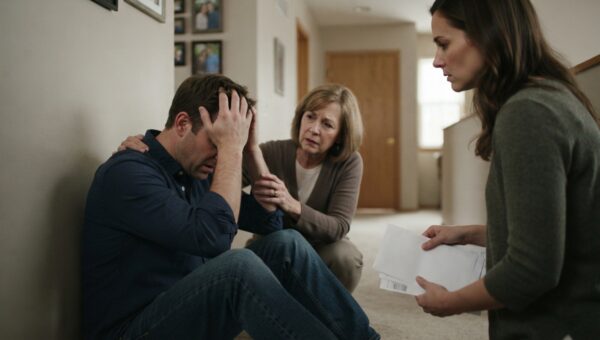
“Dad,” I choked out, running across the cold floor to fall on my knees beside his cot. His skin felt like cold clay.
Brenda came stomping down the stairs behind me, her voice shrill and defensive.
“He is confused, Clara!” she shouted, waving her coffee mug. “He wanders at night! We put him down here three weeks ago because he tried to go out the front door in his socks! The upstairs floor is too slick for his balance! You are coming in here and upsetting him when you don’t know the daily strain of his medical care!”
Before I could get to my feet to answer her, Dad reached out with his right hand.
His fingers were trembling so hard they could barely hold steady. He pointed a pale index finger toward the concrete foundation wall beside his cot and looked at me with clear, lucid eyes.
“Clara,” he whispered, his jaw shaking with the cold. “That calendar is not from this year.”
PART 2
I turned my head and looked at the wall where Dad was pointing.
Tacked to an exposed vertical two-by-four with a single bent brass thumbtack was a promotional paper calendar from a local grain elevator.
Across the top of the page was the year: 2024.
The month displayed was August.
The days were covered in heavy black pencil lines, scratched through one by one up until the fourteenth day of the month. After August 14, the boxes were left blank.
I looked back down at Dad’s cot.
Beside his thin pillow was a small plastic side table. On that table sat an old flip phone with a cracked plastic screen, plugged into an extension cord running across the bare floor from the furnace outlet.
“He called me from that phone, Brenda,” I said, standing up slowly. My knees made a cracking sound in the quiet cellar.
Brenda’s face went tight. She set her coffee mug on the top of the oil furnace with a hard clatter.
“I bought him that prepaid phone so he could dial nine-one-one if he felt faint,” she said, crossing her arms over her robe. “He shouldn’t have been calling you in the middle of the night. His dementia has progressed significantly since September. He gets anxious, he makes up stories, and he doesn’t understand what month it is. That calendar has been hanging down here since we bought the house three years ago.”
“Dad didn’t have dementia when I sat with him in August,” I said, my voice dropping low and flat.
“You were here for thirty-six hours, Clara!” she yelled, stepping closer, her slippers kicking up dust from the concrete. “You don’t see him when he gets combative. You don’t see him refusing to take his water pills. I have sacrificed my entire fall to manage this house, and you roll in here from Ohio acting like a health inspector because he has a chill.”
I reached out and touched the collar of Dad’s flannel shirt.
The wool was stiff around the buttons with dried food stains. On the front pocket, right where a button was supposed to be, was a small, three-cornered tear that had been stitched closed with bright yellow sewing thread.
I took my phone from my coat pocket.
I unlocked the screen and opened the Sunday photo album. I pulled up the picture Brenda had texted me two days ago, on Sunday afternoon at four-twelve.
I zoomed in on Dad’s chest in the image.
In the picture, Dad was sitting in the warm upstairs leather recliner, smiling toward the bright bay window.
The front pocket of his shirt had that exact same three-cornered tear, stitched with that exact same yellow thread.
I swiped back to the photo from the first Sunday in November.
The tear was there. The angle of his left thumb on his knee was identical. The shadow of the window mullion fell across his right shoulder at the exact same forty-five-degree slant.
I swiped back to October. Then September.
Sixteen photographs.
Every single Sunday, Brenda had sent me the exact same photograph of our father, cropped slightly different or adjusted with a warm lighting filter on her phone.
She had not taken a new picture of Dad since August.
She had taken five or six photos of him on the day he moved into her house in the good chair by the window, saved them in a folder, and doled them out to me once a week while she moved him into the dark cellar beside the oil tank.
“You took this picture in August,” I said, holding the glowing screen an inch from her face.
Brenda didn’t look at the screen. She looked toward the basement stairs, her throat moving as she swallowed hard.
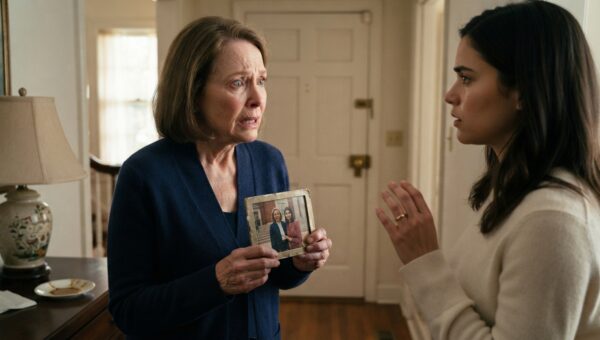
“I took several photos that day because he looked so handsome,” she muttered, though the loud certainty had completely drained from her voice. “He hates having his picture taken now, Clara. He gets agitated when the flash goes off. I didn’t want to worry you with how fast he was declining, so I used an older photo to keep your mind at ease. Is that a crime? Trying to protect my sister from seeing our father fall apart?”
“Where is his social security check going, Brenda?” I asked.
The basement went dead silent. The only sound was the intermittent hum of the furnace blower kicking on, rattling the sheet metal ducts over our heads.
PART 3
Brenda took a half-step back toward the pine stairs.
“His social security goes directly into his care fund,” she said, her voice turning sharp and guarded again. “You have no right to question my household finances. I pay for the heat, I buy the groceries, and I take him to his doctor’s appointments.”
“Dad doesn’t have heat down here,” I said, pointing at the concrete floor. “There isn’t even a register cut into these ducts. It’s forty-five degrees in this room.”
Dad reached up and pulled my sleeve.
“Clara,” he whispered. “The papers are in my shoe.”
Brenda moved toward the cot with her hand outstretched. “Arthur, stop this nonsense right now! You’re working yourself up!”
I stepped between Brenda and the cot. I am not a small woman, and thirty years of working freight dispatch in unheated warehouses makes you solid on your feet. I looked Brenda square in the eye, and she stopped dead three feet away, her jaw trembling with pure venom.
“Don’t you touch him,” I said.
I knelt down beside Dad’s feet. Underneath his cot sat a pair of worn brown leather work boots. Tucked inside the left boot was a folded white business envelope, creased and soft from being hidden against the leather.
I pulled the envelope out and opened the flap.
Inside were three documents.
The first was a bank statement from First Commonwealth Bank, dated October 31.
Dad’s direct-deposit pension from thirty-two years with the state highway road crew was eighteen hundred dollars a month. His social security was fourteen hundred.
Together with the four hundred dollars I sent each month from Ohio, his monthly care income was thirty-six hundred dollars.
The statement showed that on September 4, October 2, and November 3, an automatic electronic transfer of three thousand dollars had moved from Dad’s checking account into an account labeled *Brenda Miller – Personal Savings*.
The second document was an administrative letter from the county council on aging, dated September 18.
The letter was a formal notice that Dad’s state-funded in-home physical therapy aide had been canceled at the request of the primary caregiver, Brenda Miller, stating that the family had made alternative private care arrangements.
The third document was a printed receipt from a travel agency in Pittsburgh, dated October 12.
It was a paid invoice for four thousand two hundred dollars for an all-inclusive seven-day Caribbean cruise for two passengers: Brenda Miller and Keith Miller, departing the first week of December.
I held the papers in my hand, looking from the bank transfers to the cruise ticket, and then at my sister standing in her plush velour robe.
“You canceled his physical therapist,” I said, every word coming out cold and clear. “You took three thousand dollars a month of his pension, and you put him in a damp cellar with a flip phone while you booked an ocean cruise.”
Brenda’s face flushed a deep, blotchy purple from her chin to her forehead.
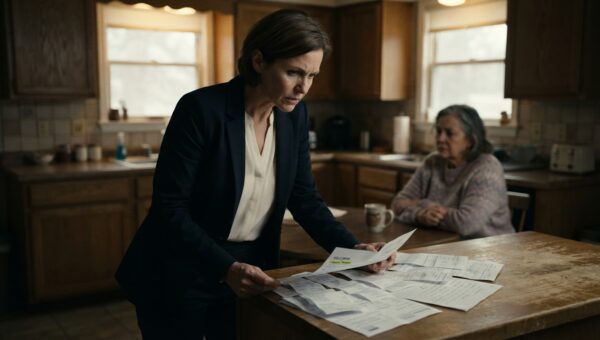
“I earned that money!” she screamed, throwing her hands in the air. The echo of her voice bounced off the concrete walls. “You live three hundred miles away! You go to your little job and you sleep through the night! I have to empty his bedside commode! I have to listen to him drag his feet across the floorboards all morning! Do you know what full-time memory care costs in this county? Six thousand dollars a month! I was saving our family thirty thousand dollars a year by keeping him under my roof, and I deserve to be compensated for losing my freedom!”
“You didn’t keep him under your roof, Brenda,” I told her, pointing to the ceiling joists above us. “You kept him under your floorboards.”
“Get out of my house,” she hissed, stepping back onto the first step of the stairs. “Take your car and get off my property right now, Clara. Or I will call the township police and have you removed for criminal trespass. I hold his medical power of attorney. The county granted me guardianship paperwork three months ago.”
I looked at the bank statement again. Then I looked at Dad, who was clutching his thin blankets against his ribs, watching me with wide, terrified eyes.
“Call the police, Brenda,” I said.
She blinked, caught completely off guard. “What?”
“Call them,” I said, pulling my phone from my pocket and setting it on Dad’s wooden tray. “Tell them your sister is in your basement. Tell them you have an eighty-year-old disabled stroke victim living beside a furnace in forty-five-degree cold with no toilet, no heat, and a forged care plan while you siphon his pension into a travel agency.”
Brenda didn’t reach for her phone. She stood on the second step of the pine stairs, her mouth opening and closing like a landed fish, her fingers digging into the velour of her pockets.
She knew, just like I knew, that the moment a township patrolman set foot down those stairs, the adult protective services investigators would be right behind him with a clipboard and a court order.
“Wrap him in his blankets,” I told her, my voice brooking no argument. “Right now.”
ENDING
Brenda didn’t move. She stood on the stairs, frozen in the cold draft, watching me do the work.
I took Dad’s heavy winter coat from the metal pipe where it was hanging, slid his arms into the sleeves, and tied his brown boots onto his feet. I wrapped both of his wool blankets around his shoulders, helped him stand on his stiff legs, and supported his weight against my left side.
He was lighter than he had been in August. His ribs felt narrow against my forearm as we took the pine stairs one step at a time.
Brenda had to back up the steps ahead of us, flattening herself against the kitchen wall as we passed into the warm morning light of her dining room. She didn’t say a word. She didn’t try to touch him. She just stood there, clutching her cold coffee mug, watching her sister walk her meal ticket out the front door.
I helped Dad down the front porch steps and settled him into the front passenger seat of my station wagon, turning the heater on high until the warm air filled the cab.
Before I pulled out of the driveway, I didn’t head for the highway.
I drove two miles into town, straight to the Greensburg emergency department.
The intake physician took one look at Dad’s core body temperature, ninety-five point two degrees, and admitted him immediately for observation, hypothermia, and severe dehydration. By noon, a hospital social worker was standing in Dad’s room with a county protective services case manager.
I laid the First Commonwealth bank statements, the canceled physical therapy notice, and the cruise receipt on the rolling tray table.
The social worker took notes for forty minutes.
Under Pennsylvania adult protective statutes, the county immediately filed an emergency motion to suspend Brenda’s power of attorney on grounds of gross financial exploitation and physical neglect.
The sheriff’s office opened an investigation forty-eight hours later.
Faced with formal criminal charges for elder endangerment and theft from a vulnerable adult, Brenda’s husband forced her to sign a comprehensive restitution agreement through the district attorney’s pre-trial diversion unit.
She was forced to return the nine thousand dollars taken from Dad’s pension, surrender all access to his accounts, and execute a complete waiver of all future custodial claims. The cruise was canceled, and the refund went straight back into Dad’s primary account to pay for his medical recovery.
Dad stayed in the hospital for six days before I signed his transfer papers.
I didn’t send him to a nursing home, and I didn’t leave him in Pennsylvania.
I took two weeks of family medical leave from the trucking yard, loaded Dad into my station wagon, and brought him home to my small two-bedroom house in Ohio.
I converted my sunny first-floor sewing room into his bedroom. I bought a low maple bed with safety rails, a thick wool rug to keep his feet warm, and set his favorite wingback armchair right beside the window where he can watch the birds at the feeder in the mornings.
Yesterday was Sunday.
Around four o’clock, the afternoon sun was coming in bright and clean through the glass, warming the whole room.
Dad was sitting in his chair with a cup of hot black tea and a plate of fresh ginger snaps on his lap. He was wearing a brand-new gray fleece vest I bought him at the supply store, his cheeks pink and his eyes clear.
I walked into the room carrying a brand-new wall calendar with large, bold black numbers.
I walked over to the wooden frame beside his chair, lifted the small brass nail, and hung it up right where he can see it every time he opens his eyes.
Dad looked up at the numbers, reached out with his warm right hand, and touched the clean white paper.
“What day is it, Clara?” he asked, a small, peaceful smile touching his mouth.
“It’s Sunday, Dad,” I told him, sitting on the footstool beside his knee. “November twentieth. And you are right where you belong.”