Why did Brenda keep that faded Manila folder in the bottom of her cedar chest for twelve years, even after she moved across the state line to Petoskey? That is the question I kept turning over in my head while the fluorescent lights in the maternity ward hummed their steady, miserable tune at 4:14 in the morning. I was supposed to be resting after forty-two hours of hard labor and a scheduled C-section that left my abdomen feeling like it had been stitched together with coarse twine.
Instead, I sat upright in the adjustable hospital bed, staring at the small plastic bassinet where our baby boy was finally sleeping. We had named him Jonah. He had my nose and a donor’s genetic blueprint, a clean slate we had prayed for after three years of heartbreak and empty negative tests.
My husband, Lyle, had been sleeping in the sagging vinyl armchair by the window, his chin pressed against his chest. He looked exhausted, the dark circles under his eyes carved deep from months of worrying about my health. We had built our life in a quiet lake community outside Traverse City, running a small hardware store that kept us busy from dawn until sundown. We weren’t rich, but we had a warm house, a dog that barked at the mail carrier, and a love that felt sturdy enough to weather anything. Or at least I thought it was.
The trouble started on the second day, right when visiting hours opened at noon. Brenda marched into room 214 like she owned the building, her heels clicking a sharp rhythm against the linoleum floor. She didn’t bring flowers or a rattle. She brought a cold look and a tongue that had always tasted like alum. Lyle was down in the cafeteria getting coffee, which meant I was alone when she leaned over the bassinet, her coat still zipped against the March chill.
“I suppose you think this one actually counts,” Brenda said, her voice dropping into that low, venomous register she used whenever she wanted to make sure I felt small. “Using some nameless vial from a catalog doesn’t make him a real part of this family. Lyle deserves blood of his own flesh, not some medical experiment.”
I remember my hands tightening around the itchy hospital blanket until my knuckles went stark white.
I told her to drop it, that Jonah was here and he was healthy and we were happy. But Brenda just scoffed, shaking her head so her perfectly coiffed blonde bob barely moved an inch. She didn’t stop there. Later that afternoon, when my mother drove two hours from Cadillac just to hold her new grandson for the very first time, Brenda physically blocked the doorway to the nursery. She told my seventy-one-year-old mother that she had no right to touch a child who didn’t even share Lyle’s DNA, causing a scene that brought a nurse running down the hall. I was shaking with fury by the time Lyle got back, but he was always the peacemaker, begging me to let it go because Brenda had always been high-strung and difficult since her own divorce.
I refused to let it go this time. That evening, after visiting hours ended, I called the hospital nursing supervisor and lodged a formal complaint about Brenda harassing a patient and blocking family members from the nursery.
I figured she would get a mild warning from security and stay away for the rest of our stay. I had no idea that my simple complaint was about to pull a thread that would unravel every single thing Lyle believed about his entire life.
The next morning, at 8:30 sharp, a woman with short brown hair and a heavy canvas briefcase knocked twice on our open door and stepped inside. Her name badge said Department of Health and Human Services, and she introduced herself as Carla Vance. Lyle was sitting on the edge of my bed, feeding me a spoonful of lukewarm applesauce, when Carla pulled a thick manila folder from her bag. She didn’t look like she was there to congratulate us on a new baby. She looked like someone about to deliver an eviction notice.
“Mrs. Miller, and Mr. Miller,” Carla said, her voice entirely flat and professional. “I’m here because of an administrative flag triggered by a formal inquiry filed late last night through our regional office. It requires immediate clarification regarding household lineage and paternity verification for the infant currently registered in this room.”
I let out a dry, humorless laugh, thinking Brenda had somehow called in a spiteful anonymous tip about our donor process just to humiliate us. “If this is about the donor paperwork, our clinic attorney filed every single state clearance months ago,” I said, my voice sharp with exhaustion. “My sister-in-law is just angry because she doesn’t approve of how we built our family.”
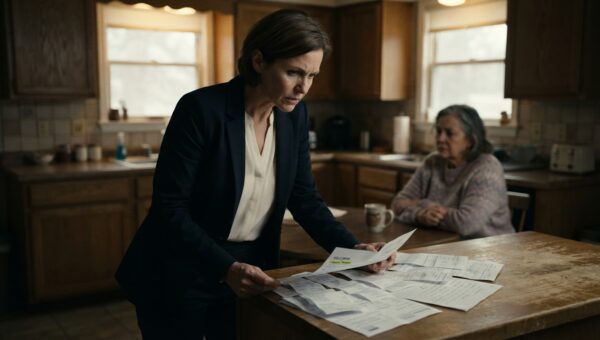
Carla didn’t smile. She just pulled a single, folded sheet of cream-colored paper from the folder and laid it flat across my lap. “This isn’t a donor dispute, Mrs. Miller. This is a paternity review initiated by Brenda Miller acting as an authorized guardian of record. Look at the primary file number.”
I looked down. The header of the form was stamped with an official state seal from fourteen years ago, long before Lyle and I had even met. Right beneath the seal was a black-and-white photograph of an infant wrapped in a coarse hospital blanket, staring up with dark, wide eyes that looked startlingly, hauntingly familiar. Beside the photo was a typed birth date: October 14th. The exact same date Lyle’s first partner, Clara, had given birth in a hospital two counties over, a birth that Lyle had carried as a crushing grief ever since he was twenty-two years old.
“What is this?” I whispered, my throat suddenly dry as dust. “This is from the old hospital in Grayling. Clara’s baby… the little girl who didn’t survive.”
Lyle stood up so fast he knocked the plastic applesauce cup onto the floor, where it clattered loudly against the tiles. “Clara’s baby died,” Lyle said, his voice hitching in his throat like he had swallowed a stone. “The doctors told us right there in the hallway. They said she was stillborn. I signed the release papers in the parking lot because I couldn’t even walk back inside. Clara wouldn’t even look at me for six months after that.”
Carla Vance looked down at her clipboard, her expression softening just a fraction, though the professional armor stayed firmly in place. “According to the adoption surrender registry and the probate archives we pulled this morning after your complaint flagged the family name, Mr. Miller, that child was never stillborn. The birth certificate on file shows a live female infant surrendered through a private agency authorization signed by your sister, Brenda Miller, who held power of attorney for Clara while she was recovering from the emergency C-section.”
Lyle didn’t say anything. He just stared at the photograph on the paper, his chest heaving as if he had just run up a steep hill in freezing weather. The silence in that hospital room grew so heavy I could hear the rhythmic beep of the hallway monitors through the closed door.
“She told me,” Lyle choked out, his voice breaking right down the middle. “Brenda drove me there. Brenda handled the funeral arrangements. She told me there wasn’t a body to bury because the hospital handled the cremation.” He reached out a trembling hand and touched the edge of the paper, his fingers brushing the corner of the infant photograph. “She lied to me. For fourteen years, she let me carry that grave in my head.”
He didn’t scream. He didn’t curse. Lyle simply sank straight down in the middle of the hospital floor, his knees hitting the cold linoleum with a dull thud, and he began to cry with the broken, heavy sobs of a man whose entire past had just been ripped away from him in thirty seconds. I threw off my light hospital blanket, ignoring the sharp pull of my fresh surgical stitches, and slid out of the bed to pull him against me. We sat there together on the hospital floor, holding each other while Carla stood quietly by the window, giving us whatever dignity she could spare.
The rest of that morning moved in a blur of sharp edges and cold realization. Carla explained that Brenda had weaponized our donor birth simply because she was terrified we were establishing a permanent family line that didn’t include her control. Brenda had kept tabs on the adoption file for over a decade, using her administrative contacts in the county health department to keep the secret buried, but when she decided to attack our new baby’s legitimacy, she had inadvertently pulled the wrong administrative lever. By filing a malicious paternity review using the old family archive numbers, she had tripped an automated state audit that linked her original signature from fourteen years ago directly to our current hospital room.
We didn’t wait to be discharged before taking action. Lyle stood up from that floor twenty minutes later, his face pale and set into lines of cold, unyielding granite that I had never seen on him before. He took his phone from his pocket, his thumb shaking only slightly, and dialed his sister’s number on speaker while Carla stood by to witness.
Brenda answered on the second ring, her voice dripping with that familiar, smug condescension. “Lyle, if you’re calling about your mother-in-law, you need to teach her some manners before she, “
“Pack a bag, Brenda,” Lyle said, his voice entirely dead and level. “Or wait right there in your kitchen because the state police are already reviewing the probate files from October fourteenth. I know about the baby. I know you signed the papers.”
The line went dead silent for three long seconds. There was no denial, no feigned confusion, just the sharp click of a woman realizing her entire house of cards had just collapsed into dust.
“Lyle, let me explain,” her voice finally sputtered through the speaker, thin and frantic. “It was for the family trust. That girl was born out of wedlock, you were too young, it would have ruined, “
“Don’t say another word,” Lyle cut her off, his voice dropping into a register that made even me shiver. “Don’t ever speak my name, don’t look at my wife, and don’t come near my son again. If you aren’t out of that house by the time the investigators arrive with the warrant, I’ll make sure you spend every year you stole from me behind bars.”
He hung up the phone and dropped it onto the mattress. The room was quiet again, save for little Jonah letting out a soft, sleepy sigh from his plastic bassinet. The relief didn’t feel like a celebration. It felt heavy and bruised, like waking up after a bad wreck and realizing you survived, even if the car was totaled.
By the following week, the formal investigation was moving forward with terrifying speed. Brenda’s administrative access was revoked, and the state attorney’s office opened a formal inquiry into the fraudulent adoption placement and forged surrender documents from fourteen years ago. The path won’t be easy, and Lyle and I know we have a long, painful road ahead of us as we work with family services to locate a teenage girl who was told she had no living father, but we are taking those steps together.
Tonight, while the house is quiet and the wind rattles the bare oak branches outside our bedroom window, Lyle stands by the nursery window holding our newborn son against his chest. On the oak dresser beside the rocking chair, right next to Jonah’s tiny cotton socks, he has placed an old, framed photograph of himself from twenty-two years ago alongside the newly recovered state adoption registry paperwork. It isn’t a neat Hollywood ending wrapped up with a clean bow, and the grief of those lost years is still a cold weight in our bones, but the lie is gone. The record is open. And for the first time in his life, Lyle is looking into the light of the truth without anyone standing in his way.