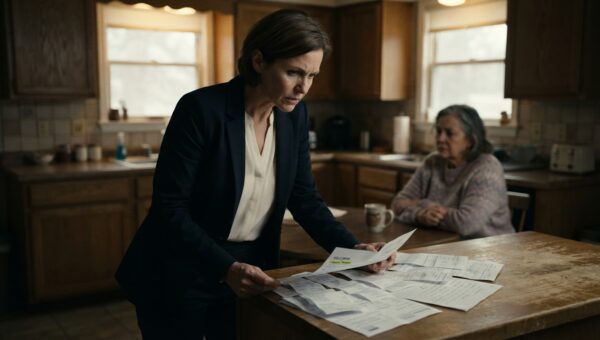
The ceramic mug hit the kitchen tile with a sharp, flat crack that made my fingers jerk. Coffee splashed across the baseboards in a dark, spreading fan. Evelyn did not reach for a towel. She just stood there with her hands frozen inches above the counter, her eyes wide and wet as she stared right through my face.
She looked like she had just seen someone climb out of a grave.
“Cedar Falls,” she whispered. Her voice was thin, like dry paper tearing in the wind. “Have you ever lived in Cedar Falls?”
I felt the skin on my arms go cold. I had not thought about that town in twenty years, not since the summer my father crammed our suitcases into the trunk of the Buick and told me never to speak of the place again. I said yes, but only for one summer when I was nineteen.
Before I could ask how she knew, Evelyn spun around, her shoulder catching the edge of the pantry door, and all I heard was the loud, heavy click of the bathroom lock turning from the inside.
I stood alone in that sunlit kitchen with the smell of spilled roast and burnt grounds heavy in the air. My fiancé, Lucas, was still out in the gravel driveway unloading our overnight bags from the trunk, completely unaware that his mother had just locked herself away like I was holding a knife.
The house smelled of cedar and old dusting wax, the kind of quiet, heavy smell that belonged to people who lived alone for too long.
I did not want to touch anything, but my feet moved toward the hallway table because the silence behind that bathroom door was starting to ring in my ears.
There was a stack of mail, a bowl of hard lemon candies, and a single framed photograph turned slightly toward the wall.
I reached out and picked it up. It was an old polaroid, faded at the edges into a soft, yellowed blur. The background was the red brick facade of the Cedar Falls county courthouse with its tall white pillars. Standing on the bottom step was Evelyn, twenty-five years younger, wearing a blue linen dress that hung loose on her frame. Next to her was a younger version of me, my hair cut short in that terrible bob I wore at nineteen, wearing a faded denim jacket.
My thumb traced the corner of the glass. I did not remember the picture being taken.
I did not remember posing on those steps with a stranger. But as I looked closer at Evelyn’s wrist in the frame, tucked awkwardly behind her own back, I saw the dark, ugly smear of a purple bruise wrapping around her skin like a bracelet.
The front door clicked open, and Lucas’s heavy boots scraped across the doormat in the mudroom.
“Mom?” Lucas called out, his voice echoing down the narrow hall as he dropped his keys into the brass dish. “You okay in there? We brought the bag with the cider.”
I didn’t answer right away. I set the photograph back down, making sure it sat at the exact same angle. My chest felt tight, the way it used to feel whenever my father cleared his throat in the hallway back when I was a kid, that sudden drop in the air before the storm hit.
The bathroom door creaked open an inch. Evelyn stepped out, her face drained of color, her fingers trembling as she wiped them on the hem of her cardigan.
She walked past Lucas without a word, her eyes fixed on me as I stood by the hall table.
She stopped three feet away, her gaze dropping to my left hand where the modest gold band Lucas had given me sat against my knuckle.
“Your father,” Evelyn said, her voice shaking so hard the words barely came out, “promised me you would never come back.”
Lucas stepped between us, his brow furrowed in that familiar, protective way that usually made me feel safe. “Mom, what are you talking about? This is Clara. We’re getting married in October. What do you mean about her father?”
Evelyn didn’t look at her son. She kept her eyes locked on mine, and in that look, I saw twenty-five years of fear that had never quite died down to ash.
“She has his eyes,” Evelyn whispered, her hand rising to touch her own wrist unconsciously. “The same cold, steady look he gave me across the judge’s bench when he told me I didn’t exist.”
The kitchen grew so quiet I could hear the refrigerator hum in the corner. Lucas looked from his mother to me, his hands dropping to his sides. He asked who we were talking about, his voice rising a fraction of an octave, the panic starting to bleed through his usual calm.
I looked down at the floor where the spilled coffee was starting to dry into a sticky brown ring. I thought about my father, about his immaculate study with the leather-bound books and the locked filing cabinet he kept in the closet. I thought about the way he had pulled me out of Cedar Falls in the middle of July, throwing my art supplies into the dumpster behind the motel and driving straight through the night without stopping for gas until the sun came up over the state line. He had told me the town was full of bad people. He had told me we were protecting ourselves.
“Arthur,” I said, the name tasting like copper in my mouth. “My father is Arthur Vance.”
Evelyn closed her eyes and let out a long, shuddering breath that sounded like a sob she had been holding for a quarter of a century. “He didn’t protect you,” she said softly. “He just made sure you never saw what he did to the rest of us.”
Lucas stepped back, his back hitting the coat rack by the door. He asked how I could know his mother if we had never met before today. He asked what my father had to do with a small town in Missouri where he thought I had only spent a week visiting a cousin.
“I never had a cousin in Cedar Falls, Lucas,” I told him, and my own voice sounded small and far away to my own ears. “My father was a lawyer there that summer. He said he was working on public records. He said we were just staying in a rental house by the river for a change of scene.”
Evelyn walked over to the kitchen table and pulled out a wooden chair, her movements stiff and slow like an old woman’s. She sat down and gestured to the empty seat across from her.
“He wasn’t working on records,” Evelyn said, her eyes fixed on the grain of the wood. “He was working for my husband’s family. They wanted me out. They wanted the baby gone, or at least out of the picture. I was nineteen, with nowhere to go and no money for a lawyer. I sat on those courthouse steps every Tuesday for two months, crying until I couldn’t breathe.”
She looked up at me then, and the anger I expected to see wasn’t there. There was only a terrible, heavy exhaustion.
“And you walked up to me,” Evelyn continued, her voice steadying. “You didn’t know who I was. You were just a kid with a sketchbook and a pocketful of peppermint candy. You sat down on the step next to me and gave me a piece because you said I looked like I needed something sweet. Your father found us ten minutes later. He grabbed your arm so hard he left red marks, and then he looked at me like I was a piece of trash on his shoe. He told me if I ever spoke to you again, or if you ever found out what he was doing in that courthouse, he would make sure I never saw the inside of a courtroom again.”
Lucas was staring at me now, not with anger, but with a look of pure, uncomprehending shock. He asked if I knew. He asked if I had any idea what my father had done.
“I was nineteen, Lucas,” I said, my own voice breaking as the tears finally came, hot and fast down my cheeks. “I didn’t know anything. He told me we had to leave because a client was threatening him. I believed him because he was my father.”
The kitchen stayed frozen. The grandfather clock in the hall ticked off five heavy seconds before anyone moved.
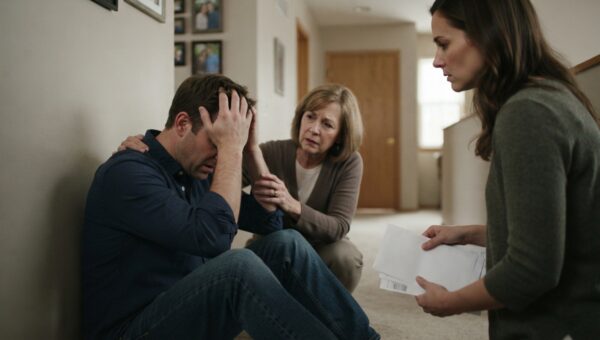
Lucas didn’t yell. He didn’t slam the door or storm out to his car the way men do in movies. He just walked over to his mother, put his large hand on her narrow shoulder, and stood there in the silence, letting the weight of twenty-five years settle between the three of us.
I reached into my pocket and pulled out my phone. My fingers were shaking so badly I dropped it twice against the counter before I managed to hit my father’s contact. I didn’t wait for him to speak. When the line picked up with his familiar, measured hello, I just asked him why he lied about Cedar Falls.
There was a long pause on the other end, the kind of silence that confirms everything you were hoping wasn’t true. Then the line went dead with a soft click.
I set the phone down on the table next to the spilled coffee.
Evelyn looked at the phone, then at her son, and finally at the engagement ring still gleaming on my finger. She didn’t tell me to take it off. She didn’t tell us to leave. Instead, she reached out across the table and pushed the framed courthouse photograph face down into the dark wood of the surface.
“The past is a terrible landlord,” Evelyn said quietly, her fingers resting on the back of the wooden frame. “It stays long after you’ve stopped paying rent.”
Lucas looked at me, his eyes red around the edges, and walked around the table to take my hand. His grip was warm and steady, nothing like the cold, hard hold my father had used to drag me away from those courthouse steps all those years ago.
We stayed in that kitchen until the sun went down behind the ridge, talking in low, halting sentences about things that should have been said twenty-five years ago. We didn’t fix everything in one afternoon, and the shadow of what my father had done didn’t magically disappear because we finally spoke his name out loud.
When we finally stood up to leave, the old courthouse photograph was still lying face down in the drawer where Evelyn had swept it. In its place on the hallway table, sitting in a simple glass jar, was a handful of wild yellow mustard flowers Lucas had picked from the edge of the drive on his way back from the car. They smelled like dust and warm earth, the clean, ordinary scent of a present we were finally going to get to keep.