PART 1
My aunt Helen raised me from the time I was nine years old, taking me into her four-room house after my parents died in a winter highway crash outside of Canton.
Helen was thirty-eight then, working forty hours a week as a clerk at the county agricultural extension office. She never married, never bought new clothes for herself, and stretched her modest paycheck to make sure I had dental cleanings, school band shoes, and a clean wool coat every November.
She was not a woman who gave long hugs or soft speeches, but she checked my homework every night at the kitchen table and kept our small home running with military precision.
When I married my husband, Greg, at twenty-six, something shifted in the way she looked at me.
Greg was twenty-eight, working steady hours as a junior estimator for a commercial roofing contractor. We rented a modest two-bedroom duplex on Maple Street, bought our furniture secondhand, and kept our heads down to save for a mortgage down payment.
Yet every time Helen came through our front door for Sunday lunch, the visit turned into a cold inspection.
She would walk straight into my kitchen, lift the lid off the Dutch oven on the stove, and peer inside with a tight, disapproving line to her mouth. She would ask what cut of meat I had bought, how much the vegetables cost per pound, and whether I was cooking from scratch or relying on store-bought broth.
Then she would sit on the sofa, look out the window at Greg’s six-year-old pickup truck in the gravel drive, and demand to know how many payments were left on the note. When Greg answered politely that we had fourteen months remaining, she would shake her head, tap her fingers against her purse, and warn us that debt was a trap for careless people.
The worst part was the nursery question.
Before she picked up her coat to leave, she would look at the spare bedroom we used for storage and ask why there were no children yet. She asked if we were being selfish, if Greg was putting his hobbies before a family, or if I had forgotten that a home without a child was just an empty box.
I took the criticism for two years because I remembered who had washed my school blouses and packed my lunch tins.
Greg stayed patient, biting his tongue while she checked the seal on our refrigerator door or criticized the brand of laundry detergent on my washstand.
The breaking point arrived on a rainy Sunday in October.
Helen stood in the middle of our kitchen, looked at the rotisserie chicken I had picked up from the grocery deli after working a six-hour Saturday shift at the clinic, and pushed the plate away.
“If a woman cannot make a proper hot gravy on a Sunday afternoon, she has no business running a household,” Helen said, her voice cutting through the small room like a rusted blade. “Greg works fifty hours a week on roofs. You have a car payment hanging over your head, no savings in the drawer, and an empty cradle in the back room. You are drifting, Rachel.”
Something inside me snapped.
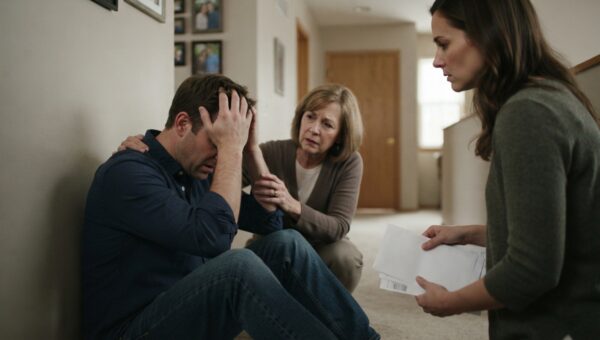
“Get out of my house, Helen,” I told her. My voice was shaking so hard the water in my glass trembled. “I am thirty years old.
My husband is fed, our bills are paid on time, and my private life is none of your business. Stop coming here to grade me.”
Helen stood up, pulled her woolen scarf around her neck without looking at me, and walked out the door into the rain.
The next morning, still burning with humiliation, I sat at my kitchen table, took a plain ivory greeting card from my desk drawer, and wrote four sentences on the inside fold.
I told her that until she could treat me like a grown woman and respect the husband who took care of me, she was not welcome at my table. I told her that her constant picking was poisoning the gratitude I had carried for twenty years.
I sealed the envelope, addressed it in my dark blue fountain pen ink, put a first-class stamp in the corner, and dropped it into the mailbox on the corner.
Helen did not call. She did not write back.
For nearly a year, the silence between us stretched out like cold wire. When her name came up at family reunions, I made an excuse and changed the subject. I told myself I was standing up for my marriage, but every holiday felt hollow, and every Sunday morning carried a dull ache in the center of my ribs.
Then, in late August, the administrator at the county hospital called my clinic extension.
Helen had fallen on the wet stone steps outside her church, shattering her left wrist and cracking two ribs. She was seventy-four years old. The county records listed me as her only surviving local contact.
I took two weeks of leave from the clinic, drove out to the regional rehabilitation center, and signed her discharge paperwork.
When they wheeled her out to the curb in a hospital chair, her left arm was immobilized in a thick fiberglass cast held tight against her chest by a dark blue sling. She looked smaller than she had in October, her gray hair thinned at the temples, her posture curved forward like dry birch wood.
She was quiet during the twenty-minute drive to her brick cottage. She did not comment on my car, did not ask what Greg was doing, and did not complain about the traffic.
I spent the next three weeks sleeping in my old childhood bedroom, cooking her oatmeal, washing her clothes, and trying to repay some of the massive debt of care she had given me when I was nine years old.
On a bright Thursday morning while Helen was resting in the front sunroom, I sat at her oak roll-top desk in the corner of the dining room to sort through eleven months of backed-up utility stubs and church bulletins.
Pushed against the wooden dividers of the mail caddy, sitting beneath an unopened water bill from June, was an envelope addressed in my own dark blue ink.
The postmark was stamped October 14 of the previous year.
It was the exact day our silence had begun.
The envelope sat before me, looking completely unopened. But when I lifted it from the wooden slot, I realized the top fold had been sliced open with a paper knife, so neatly that the paper still rested flush against the edge.
I pulled the card out.
Tucked behind my angry handwritten note was a black-and-white photograph from decades ago, an image I had never seen in my entire life.
PART 2
The photograph had yellowed along the white borders, the glossy paper cracked with tiny hairline creases from decades of being handled in the dark.
It was taken in the late summer of 1971.
A young woman stood on the wooden porch of a low, unpainted tenant cottage beside a gravel road. She was barely twenty years old, wearing a faded cotton house dress with short sleeves, her dark hair pulled back into two simple clips.
It was Helen.
She was looking directly into the camera lens with hollow, sunken eyes, her cheeks sharp and pale under the midday sun. Cradled in her thin arms, wrapped in a coarse knitted receiving blanket, was a tiny infant with a tuft of dark hair, its small fist pressed against Helen’s collarbone.
Standing on the bottom step of the porch, looking away from the camera with his thumbs hooked into his belt loops, was a tall young man in grease-stained denim work trousers.
Behind them, parked crooked in the dry grass beside the ditch, sat an old two-door sedan. Tucked beneath the passenger-side windshield wiper was a bright yellow cardstock notice, the kind county marshals used for judicial property attachments.
I turned the photograph over with fingers that felt cold and numb.
Written on the back in dark, faded blue fountain pen ink was a single line from 1971:
*Clara Jean. Born June 4. Left us October 12, 1971.*
Beneath that line, written in fresh pencil lead that had left faint indentations in the cardboard backing, was Helen’s cramped, uneven handwriting, dated October 16 of last year:
*I was not judging your kitchen, Rachel. I was just terrified you would not see the water rising until you were drowning like I did.*
I sat at that roll-top desk, staring at the little girl’s name on the paper.
Clara Jean.
I was thirty years old, and for twenty-one years, from the morning my aunt walked into the county children’s intake ward to take my hand, I had believed Helen was a solitary woman who had never known a man, never held a child, and never felt the weight of a ruined home.
She had never kept a baby rattle in a drawer. She had never hung a wedding portrait on the wall. Her cedar chest contained only church linens, winter woolens, and our family Bible with our grandparents’ birth dates penciled inside the cover.
I took the photograph and walked down the hallway to the small sunroom off the kitchen.
The morning sun was coming in through the double-hung windows, warming the braided oval rug. Helen was sitting in her straight-backed maple rocking chair, her left cast resting on a blue floral throw pillow in her lap, looking out at the sparrows picking at the birdfeeder beside the fence.
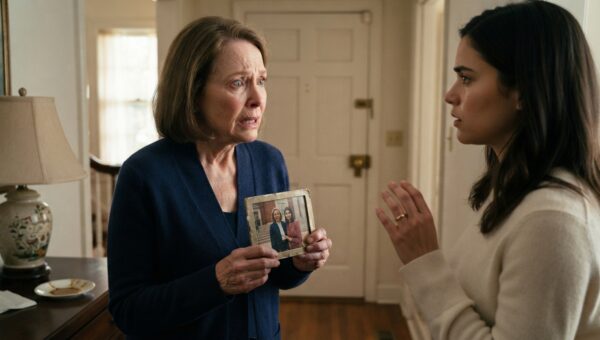
I didn’t make a speech. I pulled the footstool over, sat down directly in front of her knees, and laid the yellowed photograph flat on the pillow beside her cast.
Helen looked down.
She did not flinch. She did not pull the pillow away. Her right hand, calloused and spotted with age, moved across the fabric and rested two fingers against the tiny white bundle in the picture.
The sparrows fluttered against the feeder outside, their wings making a dry, papery rattle against the glass.
“Where did you find it?” Helen asked. Her voice was barely a whisper, flat and dry like autumn leaves.
“In the mail caddy, Aunt Helen,” I said. “Inside the card I sent you last October.”
Helen looked up from the photograph, her gray eyes watery behind her bifocals, looking at me with an expression of quiet, exhausted defeat.
“I read your card the day it came, Rachel,” she said softly. “You told me I had no right to grade your life. You were right. You were an adult woman with a husband, and I was an old busybody who couldn’t keep her tongue behind her teeth.”
“Who was Clara Jean, Helen?” I asked.
Helen closed her eyes. Her chin trembled once, but she caught herself, drawing a slow, rattling breath through her nose.
“She was my daughter,” Helen said.
PART 3
The words seemed to drop into the quiet room like heavy stones falling into deep water.
“Her father was Dale Vance,” Helen began, her hand remaining still over the photograph. “I married him in the spring of 1970 when I was nineteen years old. My father told me not to take him. Dale had charm, a fast laugh, and big ideas about running an independent logging rig down along the river.”
She looked out toward the fence line, her eyes unfocused, looking backward into fifty years of silence.
“Dale couldn’t manage a dollar,” she continued, her voice dropping into a steady, measured rhythm. “He bought that two-door car on a commercial loan with forty percent interest because he wanted to look successful when he drove through town. He took out credit tabs at the tractor dealer, the tire depot, and the diner by the bridge. Whenever I asked to see the bank slips, he told me that business was a man’s work and that my job was to keep the kitchen clean.”
She paused, swallowing hard.
“In the summer of seventy-one, the timber contracts dried up. Dale stopped paying the loan installments. The grocery store cut off our line of credit on flour and lard. By August, we were boiling cabbage leaves and salt pork twice a week because the pantry was down to bare pine boards. The marshals put that yellow paper on the car in September.”
I looked down at the photograph, at the hollow, frightened eyes of the nineteen-year-old girl holding that baby on the porch steps.
“What happened to the baby, Helen?” I asked, my throat tight.
“Clara came down with croup on a Tuesday night in early October,” Helen said, her voice dropping so low I had to lean closer to hear her. “The weather had turned wet and freezing, and we had run out of heating oil four days earlier. The house was forty degrees inside. I had Clara wrapped in every sweater Dale owned, sitting by the gas stove with the burners on, trying to keep her chest warm.”
She reached up with her right hand and wiped a single tear that had escaped into the deep line beside her nose.
“Dale had taken our last twelve dollars to the tavern to talk to a contractor about hauling work,” she said. “The doctor in town wouldn’t come out to the tenant house without cash up front because Dale owed him sixty dollars from the delivery fees in June. By the time Dale came home at four in the morning, Clara’s lips were blue. We carried her to the county clinic in our neighbor’s truck, but her little lungs were already full of fluid. She died in my arms on the intake bench.”
The silence in the room was so complete I could hear the mantel clock ticking in the dining room thirty feet away.
“Dale cleared out three weeks later,” Helen said, looking back down at the photograph. “Left the county, left the debts, and left me with thirty-four hundred dollars in vendor liens and a baby’s grave in the potter’s field behind the Baptist church. My father had to sell three dairy cows to pay the mortuary so they wouldn’t bury her in an unmarked trench.”
She looked directly into my face, her eyes clear and unblinking.
“I spent eight years paying off the last of those grocery store bills, Rachel,” she told me. “I took the job at the extension office, rented this four-room house, and swore on Clara’s grave that I would never owe another human being a nickel for as long as I drew breath. When your mother and father died on that highway in eighty-five, you were nine years old, standing in that county hall with your little suitcase and grease stains on your winter coat.”
She reached out and took my hand. Her fingers were stiff with arthritis, but her grip was tight and desperate.
“I looked at you, Rachel, and I saw my Clara all over again,” Helen whispered. “I swore before God that no child in my care would ever go hungry, would ever freeze in a cold bedroom, or would ever be left helpless because some man was careless with money. I taught you how to budget. I checked your clothes. I made you save every dollar from your summer jobs.”
“And when I married Greg?” I asked softly.
“When you married Greg, every old ghost in my head came awake,” she said, her voice breaking into real, ragged grief. “Every time I saw an open bill on your counter, I saw Dale’s collection notices. Every time I smelled store-bought chicken, I remembered boiling cabbage water in an empty kitchen. Every time I looked at your car, I saw that yellow marshal’s tag flapping in the wind. And when you told me you were waiting on children, all I could see was that empty cradle by my kitchen stove.”
She bowed her head, her forehead resting against our joined hands.
“I didn’t know how to love you without watching the doors, Rachel,” she sobbed into our fingers. “I thought if I stopped checking the perimeter, the roof would fall in on you just like it fell in on me. I drove you away because I couldn’t separate my old terror from your good life.”
ENDING
I didn’t pull my hands away.
I leaned forward, wrapped my arms around her narrow shoulders, and held her against my chest. Her cast pressed hard against my collarbone, rigid and uncomfortable, but she leaned into me with her whole seventy-four years of hidden grief, crying the tears she had kept locked behind her ribs since October of 1971.
We stayed like that on the sunroom floor until the morning sun had crossed the sill, warming our backs through the window glass.
I didn’t leave her house that afternoon.
I called Greg at four o’clock, explained what I had found in the desk, and asked him to pick up groceries on his way home from the roofing yard.
At six-fifteen, Greg’s truck pulled into the gravel drive. He came through the back door carrying two bags of fresh potatoes, carrots, and a fresh beef roast from the butcher shop in town.
He didn’t make a formal speech. He set the groceries on the counter, washed his hands at the sink, and walked into the sunroom. He knelt beside Helen’s rocking chair, touched her cast gently, and asked her how her ribs were feeling.
Helen looked at him for a long, quiet moment, seeing the dry drywall dust on his work shirt and the clean kindness in his eyes. For the first time in three years, she reached out her good right hand and rested her palm against his forearm.
“Thank you for the potatoes, Greg,” she said softly.
We cooked dinner together in her kitchen that evening. Helen sat on a stool by the counter, peeling carrots with her right hand while Greg chopped the onions with her carbon-steel knife.
The house smelled of braised beef, rosemary, and hot broth. It was the exact smell of the kitchen she had kept for me when I was a frightened nine-year-old girl learning to sleep without crying.
Before we sat down to eat at her oak table, I took that old black-and-white photograph from the roll-top desk.
I walked into her bedroom, opened the top drawer of her dresser, and found a small, standing silver frame that had held an old pressed clover for forty years.
I took the clover out, set the photograph of Helen and baby Clara inside the silver border, and polished the glass with the corner of my apron.
I carried the frame back to the dining room and set it squarely in the center of the wooden sideboard, right beside her brass candlestick.
Helen looked up as she carried the basket of warm rolls to the table. She saw the silver frame standing in the bright light of the chandelier.
Her breath hitched, her fingers tightening around the edge of the wicker basket, but she didn’t ask me to move it. She pulled her chair back, sat down between Greg and me, and let her eyes rest on her daughter’s face for three quiet seconds before bowing her head for the blessing.
Her wrist cast came off six weeks later, in the middle of October.
The doctor told her the bone had knit clean and strong, though she would need to keep using her wooden cane on gravel paths.
She comes to our house on Maple Street every Sunday now.
She walks up our front porch steps without hesitation, takes off her coat, and hangs it on the brass peg beside the door.
She doesn’t lift the lids on my stove anymore, and she doesn’t check the driveway for payment receipts.
Yesterday was Sunday.
Around one o’clock, the afternoon sun was filling our living room with cool, clean autumn light.
Greg was out in the yard raking dry maple leaves into piles along the garden border.
Helen was sitting on our sofa, wearing her gray wool sweater, with our five-month-old daughter, Clara, sleeping soundly against her shoulder. The baby’s dark hair was tucked under Helen’s chin, one tiny fist resting against Helen’s collarbone in the exact same curve from fifty-five years ago.
Helen looked down at the sleeping child, her right hand rocking the baby with a slow, steady rhythm that needed no instructions and carried no fear.
I brought two cups of hot black tea from the kitchen, set them on the low table, and sat beside her on the cushions.
Helen looked up at me, a peaceful, unhurried smile touching her mouth, and took a slow sip of her tea in a house where the doors are finally safe.