The hearse had barely turned off Cemetery Road when Dwayne started loading the truck. He backed his old Ford up to the side door of Dad’s workshop with the tailgate down and the hazard lights blinking against the gray Nebraska afternoon. I was sitting on the back steps of the porch with my coat pulled tight around my throat, watching my boots turn gray in the damp grass.
“We need to clear the heavy stuff before the tax man or the county starts asking questions,” Dwayne said, dragging Dad’s heavy cast-iron table saw toward the tailgate with a screech of rusted metal. “The preacher needs his envelope paid by Tuesday, and you know as well as I do that Dad’s checking account was practically down to lint.”
I didn’t answer him. My head felt like it was packed with wet cotton wool, and every time I blinked, I saw Dad sitting in his worn leather armchair with his reading glasses slipping down his nose. He had died on a Tuesday morning while I was driving out from Grand Island with a gallon of milk and a loaf of rye bread.
Dwayne wiped his forehead with the back of a greasy flannel sleeve and pointed toward the corner where Dad kept his row of red steel tool chests. “I can get twelve hundred for the Milwaukee set alone if I take them down to Leo’s place before he closes up for the weekend. It covers the plot fees and the printing for the programs.”
He said we needed money for the service, and I was too numb to argue. That was the phrase I kept repeating to myself over the next seven days whenever a fresh wave of exhaustion hit me. I signed the release slip for the funeral home without reading the fine print twice, and I let Dwayne load up half the workshop into the back of his truck while I stayed inside cleaning out the pantry cans of soup that had expired back in nineteen-ninety-four.
A week later, the house was entirely too quiet. The refrigerator hummed a low, dry note in the corner, and the smell of Dad’s pipe tobacco had finally started to fade from the upholstered curtains in the parlor. I drove into town to pick up the official death certificates from the county clerk, but on my way back, I pulled my sedan into the gravel lane behind Leo’s Pawn and Exchange on Fourth Street.
Leo was wiping down the glass counter with a stained rag when I walked in, the little brass bell above the door pinging like a church bell in the wind. He looked up from behind his thick bifocals, stopped his rag mid-wipe, and gave me a long, complicated look that made the hairs on the back of my neck stand up straight.
“You’re Arthur’s girl,” Leo said, his voice gravelly from forty years of indoor tobacco smoke and shouting over band saws. “Lois, right?”
“Lois, yeah,” I said, stepping up to the scarred oak counter. “Dwayne brought some of Dad’s tools in here last Tuesday. I just wanted to see if, well, honestly, I don’t even know why I’m here. I guess I just wanted to touch them one last time before they got sold off to some stranger.”
Leo didn’t ring up a sale or reach for a ledger. Instead, he turned around, walked slowly back to the metal shelving units near the ledger books, and hauled up a small, beat-up green tin toolbox that had a strip of yellow masking tape across the latch with Dad’s initials printed in block letters.
“Your daddy brought this in himself six months ago,” Leo said, setting the box down on the counter between us with a dull clack. “He told me to hold it right here until you came in asking questions. He said if Dwayne showed up first, I was supposed to let him take the big gear off the floor to keep the peace, but this box stayed put no matter what.”
I stared at the green tin. My fingers shook slightly as I unlatched the rusty metal clasp. Inside sat Dad’s brass-trimmed measuring tape, a heavy-handled screwdriver with a chewed-off red rubber grip, and a single folded pink pawn ticket dated six months before his heart gave out.
I unfolded the paper with cold fingers. The ticket listed Dwayne’s full legal name as the depositor, but the single item pawned was listed in Dad’s unmistakable, blocky handwriting: One house deadbolt key, front entry. And then I noticed the ink. It wasn’t the cheap ballpoint blue Dwayne used on his pickup notes or the standard black ink from the bank down the street. It was an oily, deep blue-black shade that looked almost purple under the fluorescent shop lights, the kind of archival drafting ink Dad hadn’t touched since the county courthouse remodeling project back in the late eighties.
“Why would he pawn his own house key?” I whispered, looking up at Leo.
“He told me his boy was spending money that didn’t belong to him,” Leo said softly, leaning his forearms on the counter. “Said Dwayne had found where he kept his checkbook stubs and was forging signatures on the lumber supply accounts down at the co-op. Your daddy wasn’t a rich man, Lois, but every board foot of lumber in that workshop was paid for with cash he saved from working the county line until his hands went arthritic.”
I drove straight from Leo’s shop to the Hendershot Funeral Home on Main Street, my heart hammering against my ribs like a trapped bird. The director, a neat man in a dark charcoal suit named Mr. Vance, looked surprised when I walked in through the front doors unannounced on a rainy Thursday morning.
“Is there a problem with the final balance, Lois?” he asked, tapping a pen against his polished walnut desk. “Your brother settled the account in full last Wednesday afternoon.”
“I just want to see the original contract,” I said, keeping my voice as level as I could manage. “The one Dad signed when he set up his pre-planning file back when Mom passed.”
Mr. Vance frowned, pulled a thick manila folder from the top drawer, and slid a yellowed carbon copy across the desk. I ran my finger down the itemized columns until my eyes hit the bottom total. The entire service, from the plot opening to the organist’s fee, had been paid in full with a single check drawn on a mutual fund account back in two thousand and eight. There was no balance due. There had never been a balance due.
“Dwayne told me the funeral cost four thousand dollars,” I said, the words tasting like dry ash in my mouth.
Mr. Vance didn’t look up from his desk. “Your brother asked for an itemized cash-out rider on the excess trust funds to cover immediate family expenses. We issued him a cashier’s check for the remaining balance of four thousand, two hundred dollars on the morning of the viewing.”
I didn’t go home after that. I drove straight out to the old homestead on County Road 12, my tires throwing up gravel against the mud flaps. Dwayne’s Ford was parked right in the middle of the drive, blocking the entrance to the empty machinery shed.
I pulled my car right up behind his bumper, cut the engine, and sat there for a long minute watching the rain tap against the windshield. My hand went to the glove box and pulled out the small green toolbox, my thumb tracing the worn edge of the measuring tape inside. Dad hadn’t just been losing his memory at the end like Dwayne liked to tell the neighbors at the diner. He had been tracking every single unauthorized withdrawal with the stubborn precision of a man who spent forty years building houses that didn’t lean to the left.
The back door was unlocked because Dwayne had lost the knack of carrying his key ring without dropping things in the mud. I stepped into the kitchen, the linoleum cold beneath my socks.
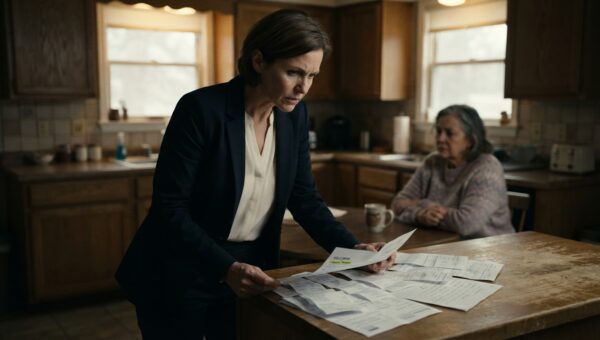
Dwayne was sitting at the oilcloth kitchen table with a stack of bank statements and check ledgers spread out around an empty coffee mug. He looked up when the screen door slammed back against the cedar siding, his face going hard before he tried to force an easy, brotherly smile onto his mouth.
“Well, look who’s finally back from town,” Dwayne said, gathering up a fistful of papers. “I was starting to think you got lost in the hardware store again.”
I didn’t take off my coat. I walked right up to the table, reached into my pocket, and dropped the pink pawn ticket, Dad’s old drafting ink signature facing up, right onto the middle of his bank statements.
Dwayne stared at the slip for three seconds. The color drained out from under his tan so fast he looked like bleached canvas.
“Where’d you get that?” he asked, his voice dropping an octave.
“Leo’s shop,” I said. “And after that, I went to see Mr. Vance down at the funeral home.”
Dwayne stood up so fast his chair tipped backward, hitting the pantry door with a dull thud. “Dad didn’t know what he was doing at the end. You know how he was with his papers. He got confused about who had access to the safe.”
“He knew,” I said, and my voice didn’t shake anymore. “He knew well enough to use the blue-black ink he hadn’t touched since the courthouse job so I’d know it wasn’t a forgery from last month. He knew well enough to pay for his own funeral seventeen years ago so you couldn’t loot the trust.”
“I was just borrowing against the inventory,” Dwayne shouted, his face twisting into an ugly, desperate snarl as he slammed his palm down on the oilcloth table. “The co-op was going to put a lien on the property if I didn’t clear my truck note by Friday.”
“You didn’t borrow anything,” I said, stepping closer until I could smell the stale coffee and cheap menthol cigarettes on his breath. “You stole from him while he was too weak to walk down the cellar stairs, and then you sold his tools before he was even in the ground to cover your tracks.”
“You can’t prove half of this,” he muttered, backing away toward the stove with his hands stuffed deep into his pockets. “The probate court is going to sign off on my administration papers tomorrow morning. Everything in this house defaults to me as the primary male executor under the old will.”
“There is no old will anymore,” I said, pulling the heavy brass key out of my coat pocket and letting it dangle from my index finger by its leather fob. “Dad changed the executor designation three days after he pawned that deadbolt key. I have the lawyer’s receipt right here in my bag, signed with the exact same blue-black ink.”
Dwayne opened his mouth to say something else, but no words came out. He looked down at the pawn ticket on the table, then over at the empty corner where Dad’s drill press used to sit before the truck took it away. He looked smaller suddenly, like a boy who had broken his father’s favorite transit and was waiting for the heavy hand to come down on his shoulder.
“Get out of the house, Dwayne,” I said softly.
He didn’t argue. He grabbed his denim jacket off the back of the chair, mumbled something about lawyers and rights, and walked out the back door without looking back. The screen door banged once, twice, and then settled into its latch.
I stood alone in the quiet kitchen for a long time, listening to the old refrigerator cycle on and off. The sunlight broke through the gray clouds outside, casting a long, clean line of yellow light across the linoleum floor right where Dad used to stand to wind his pocket watch every evening at five o’clock.
I walked over to the front door, inserted the heavy brass key into the deadbolt, and turned it until it clicked firmly into place. The mechanism moved smooth and true, exactly the way Dad had measured it to fit. I slid his old wooden measuring tape back into my coat pocket, feeling the metal crank click against my thumb, and finally let myself breathe all the way down to my boots.