PART 1
My son died at sixteen after eleven days in intensive care following an accident on Route 9.
His father never cried at the funeral. Not once.
Robert stood beside the casket in his stiff navy suit, his hands folded across his belt, staring straight ahead at the brass cross on the chapel wall. When people from the high school came down the receiving line to press our hands, Robert nodded once, said thank you, and looked away.
When they lowered David into the ground on a gray November afternoon with freezing rain hitting the awning, Robert didn’t bend down. He didn’t touch the bronze handles. He didn’t shed a single tear.
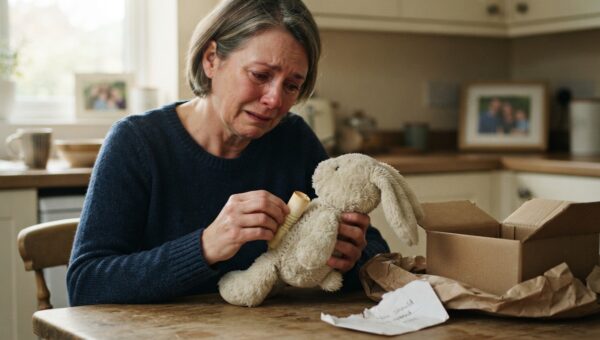
I sat in the front row of folding chairs clutching David’s track jacket to my face, crying until my ribs ached. Looking up at Robert standing there like an iron post, I felt something split open between us that had nothing to do with shock. I decided right then that he was empty. I convinced myself he had never truly loved our boy, because no father could bury his only child with dry eyes unless his heart was made of stone.
We divorced that winter.
I packed my clothes, my teaching supplies, and David’s track ribbons into my station wagon and moved forty miles south to Wooster. Robert stayed in the cedar-sided ranch house outside Ashland where we had raised David.
In the settlement, I asked for very little beyond my car and my state pension account. I didn’t want the house. I didn’t want his savings. I didn’t want anything that connected me to a man who could walk away from our son’s grave as if he were clocking out of a shift at the machine shop.
For twenty-two years, that was the story I lived with.
Whenever an old friend from our hometown asked about Robert, I gave them the same cold answer. I told them Robert was a distant man who shut down when things got hard, someone who walked away because he simply didn’t care enough to hurt. Carrying that anger was easier than looking at the empty bedroom in Wooster. It gave my grief an enemy.
Then Robert died of a heart attack at his kitchen table last March.
Because we had no other children and his parents had passed years ago, the county coroner’s office contacted me as his surviving contact on file.
I drove back to Ashland on a cold Tuesday morning, mostly out of a quiet sense of duty to make sure he was laid to rest in the family plot beside David.
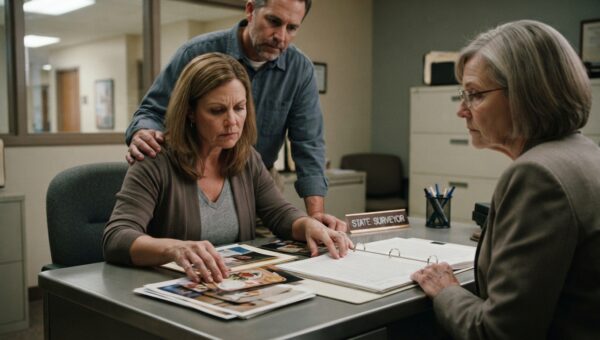
The funeral home on Center Street was warm, smelling of carnations and carpet cleaner. The director, a woman in her late forties named Janice who had taken over the business from her father, brought me into a wood-paneled office and offered me a glass of water.
She opened a thin green file on her desk and slid a payment slip across the blotter.
On top of the papers was an official hospital receipt for $9,200.
“What is this?” I asked, looking down at the red rubber stamp on the paper. “I haven’t authorized any services for Robert yet.”
“That isn’t for Robert’s funeral, Mrs. Miller,” Janice said softly. “Robert arranged his own burial and plot nearly a decade ago. He brought this receipt into our office every October.”
“Every October?”
“He paid this every year,” she said.
My hands went numb.
I picked up the receipt, my fingers catching on the rough edge of the paper. Across the top was the faded blue seal of Samaritan Regional Health System. The patient account name was David Miller, with the billing code for the pediatric intensive care unit.
It was an installment receipt for the eleven days our boy had spent on life support before his heart gave out in November of 2002.
PART 2
I looked up from the paper, my breath shallow in my throat.
“This bill was over two hundred thousand dollars,” I said. “Our union health insurance capped out at fifty thousand back then. The hospital sent two collection notices to our house that first month, and then the letters stopped. Robert told me the hospital board took pity on us and wrote the balance off as charitable relief.”
Janice shook her head. She pulled a green canvas binder from the bottom shelf behind her desk and laid it flat between us. Inside were dozens of clear plastic sleeves, each holding an itemized bank draft slip.
“They didn’t write it off, Mrs. Miller,” Janice said. “Robert went to the hospital billing office the morning after David’s funeral. He signed a personal guarantee to pay $9,200 every single year until the entire balance was cleared. He never missed an installment. His final payment cleared last October.”
Twenty-two years. Nine thousand two hundred dollars every year.
I sat back against the leather chair, staring at the rows of bank stamps.
Robert had worked as a maintenance machinist at the pump factory in town. In 2002, he was making forty-two thousand dollars a year before taxes and overtime. Nine thousand two hundred dollars was nearly a quarter of his take-home pay. For twenty-two years, while I lived alone in Wooster believing he had walked away without a scar, he had been paying for the room where our son died.
“Why would he bring the receipts here?” I asked.
“My father handled David’s service,” Janice explained. “Robert asked my dad to keep a duplicate record in our safe. He told my father that if he died before the debt was paid, he wanted me to give the file to you so you would know the hospital couldn’t put a lien on the family cemetery plots. And he left money with us for the grave.”
“What money?”
“He paid for a fresh arrangement of white carnations on David’s headstone on the fourteenth of every month,” she said. “Without fail. For twenty-two years.”
I couldn’t speak.
The fourteenth was the day David was born. Over the years, whenever I drove up to Ashland to visit David’s grave on Memorial Day or his birthday, I had always found fresh flowers in the granite cup. I had assumed David’s track coach or the church ladies had placed them there. It had never once occurred to me that Robert had ever returned to that cemetery.
Janice opened the back flap of the binder and slid a yellowed piece of lined paper onto the desk.
It was a scrap torn from a grocery pad. On the front was my own handwriting from the week of the accident, listing skim milk, wheat bread, and laundry detergent.
On the back of the scrap, written in Robert’s heavy carpenter pencil, was a long column of dates.
November 14, 2002. December 14, 2002. January 14, 2003. The dates ran all the way down the page in tight rows, each marked with an amount and the initials of the local flower shop.
Clipped behind the grocery list was an index card from Robert’s personal envelope.
Janice turned the card toward me. Across the center, in that same blunt pencil script, Robert had written one single sentence:
“He never knew I was the one who bought him the truck.”
PART 3
The room went completely silent.
I stared at the pencil marks on the card until the letters blurred.
In October of 2002, three weeks before the crash, David had turned sixteen. He had spent that whole summer baling hay and bagging groceries at the market, saving nine hundred dollars in an old coffee can. He had fallen in love with an older blue Ford pickup that was sitting on the gravel lot by the lumberyard. The sticker price was twenty-eight hundred dollars.
I told David no. I told him he was too young, that old trucks were dangerous, and that he had to wait until his senior year.
Two days later, David came running into the kitchen with the keys jingling in his hand, his eyes wide with excitement. He told me the lot owner had agreed to take his nine hundred dollars as full payment under an end-of-year student promotion. Robert was sitting at the kitchen table drinking black coffee behind the evening paper. He barely lowered the page, muttering that the boy had gotten lucky and ought to keep the oil checked.
I had been angry with the dealer. I called the lot to ask why they were giving trucks away to teenagers, but the salesman insisted it was a seasonal discount.
Sitting in that office twenty-two years later, the truth hit me with sickening clarity.
Robert had gone to that car lot before sunrise. He had paid the remaining nineteen hundred dollars in cash out of his tool savings, told the salesman to invent the student story, and let David believe he had earned that truck entirely on his own.
Three weeks later, on a curve slick with wet autumn leaves near the reservoir, the steering arm on that truck snapped.
The air felt thin in my lungs.
“He blamed himself,” I whispered.
Janice looked down at her hands on the desk. “My father was here the night David died, Mrs. Miller. He told me that when Robert came down to the preparation room to bring David’s suit, he couldn’t walk through the door. He sat on the floor in the hallway with his head against the wall, shaking so hard my dad had to sit with him for two hours. He told my father that if he had left that truck on the lot, his boy would still be doing his homework at the kitchen table.”
The funeral came back to me, but every detail looked different now.
The stiff posture. The folded hands. The dry eyes.
Robert hadn’t stayed dry-eyed at the chapel because he was cold. He had stayed dry-eyed because he believed he had no right to cry. He thought tears were for grieving parents, not for the man who paid for the machine that killed his son. He had stood there like an iron post because he thought breaking down would be asking for comfort he didn’t deserve.
He had taken my hatred, my accusations, and the divorce without a single word of defense. He let me leave for Wooster believing he was heartless, because in his own mind, my hatred was the only fair punishment left in the world.
“Did he leave anything else?” I asked, my voice barely carrying across the desk.
Janice opened the top drawer and pulled out a small brown coin envelope.
Inside was an old brass Ford key, its edges worn down to dull silver. A piece of blue electrical tape wrapped around the head had the initial D scratched into the plastic.
Robert had kept that key in his pocket every single day of his life.
ENDING
We buried Robert on a Friday morning under a pale, chilly sun.
There were only four people beside the grave: two retired machinists from the pump plant, Janice, and me. The cemetery grass was damp from an early thaw, the soil soft along the edge of the vault.
When the minister finished the brief committal prayer, the two men from the shop tipped their caps, shook my hand, and walked slowly toward their cars.
I stayed by the open ground.
I took the brass Ford key from my coat pocket, along with the grocery list with the twenty-two years of dates written on the back. I stepped to the edge of the pit and set them gently on top of Robert’s cedar urn, right beside the bronze marker bearing his name.
“I know, Robert,” I said into the wind. “I know.”
The air was quiet, but the bitterness that had sat in my chest for over two decades was finally gone.
I had spent twenty-two years using anger as a shield. It was easier to believe my husband was unfeeling than to face the raw, terrifying unfairness of a cold November road. I had turned him into a villain so I wouldn’t have to look at the randomness of what took our son.
Robert hadn’t avoided the grief. He had carried the full, crushing weight of it alone in that quiet house on Route 9, working overtime, skipping vacations, and eating supper by himself at the kitchen table, just to make sure the hospital where our boy drew his last breath was paid to the penny.
He had loved David with a love so heavy it broke him in silence.
After the cemetery gates closed, I drove down Center Street to the flower shop near the square. The shop was small, with rows of glass vases and buckets of fresh stems near the counter. An older woman with silver hair looked up from a ribbon spool as the bell above the door jingled.
“Can I help you?” she asked.
“I’m here about the monthly order for David Miller,” I said, opening my purse.
The woman paused, her fingers resting on the ribbon. “Mr. Miller’s account expired this month. We were told he passed.”
“I know,” I told her, setting my checkbook on the counter. “I’m his wife. I’d like to renew the order for two arrangements now. On the fourteenth of every month.”
She nodded quietly, took her pen, and began to write.
Now, on the fourteenth of every month, two small sprays of white carnations sit on the hill overlooking the valley. One rests beside the stone carved with the track shoe. The other rests three feet away, beside the man who kept his watch in the dark until the debt was finally settled.