The outlet by our bed really was loose. I knew that for a fact because I had jammed a little folded piece of cardboard under the faceplate myself six months ago just to stop it from rattling every time I plugged my reading lamp in. So when Curtis started taking his phone down the hall every night and leaving it out in the garage to juice up on his workbench, I did not think much of it. It made sense in a practical kind of way. He said the buzzing text alerts kept him awake, and since he had to be up at five to check the inventory down at the feed store, sleep was worth protecting.
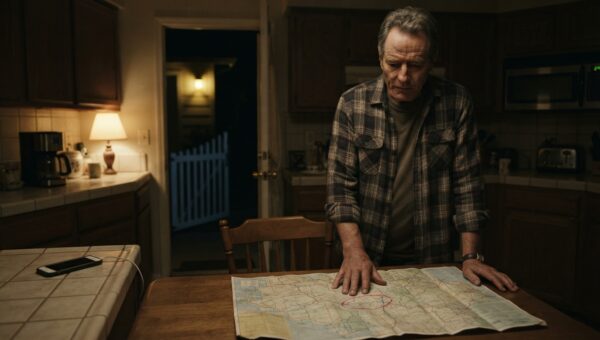
Except the garage routine did not stop with the phone charger. After about three weeks of that quiet little habit, he started taking his morning coffee out there too. He would pour two cups from the pot, hand me mine at the kitchen island, and then walk right past the back door with his own mug, muttering something about checking the oil on the riding mower or looking for a misplaced crescent wrench. I would watch him from the kitchen window through the steam rising off my own mug, standing out there by the workbench with his back to the glass, holding his phone in one hand and staring down at the concrete floor like he was waiting for a bus that was never going to show up.
The change in him happened so slow I almost missed it. He stopped talking about the local ball games, he chewed his supper with his eyes locked on the salt shaker, and whenever I asked him how things were going down at the yard, he would just nod and say everything was fine. It was that flat, heavy kind of fine that usually meant a storm was sitting right over the ridge. I kept telling myself I was being silly. We had been married twenty-two years, after all. You do not spend two decades building a life with a man just to start imagining bogymen behind every closed door.
Then came that Saturday morning in late October. The air outside was sharp enough to bite your nose, and the sycamore leaves out in the yard were dropping fast, making that dry scratching sound against the siding whenever the wind picked up. I was looking for a flathead screwdriver to tighten up the hinge on the pantry door before it came clean off the frame, and I knew Curtis kept a spare set in the tool chest out in the garage.
The walk across the gravel driveway felt longer than usual. My boots crunched loud against the small stones, and for a second I thought about turning right back around and going back inside to fold the laundry. I do not know. I think a small part of me already knew something was sitting out there waiting for me that I was not going to like. But the pantry door had been sagging for three days, and I was tired of catching my apron pocket on it every time I walked past.
The garage door was pulled shut, but it was not latched tight. There was about a two-inch gap of gray daylight showing at the bottom where the rubber weather strip had rotted away last winter. I walked up slow, my hand raised to push it open, when I heard the sound.
It was not the radio. It was a woman crying.
It was a low, ragged kind of sound, the kind you make when you have cried so long your throat is raw and you have nothing left to push against. I froze right there on the concrete stoop with my knuckles hovering an inch from the cold aluminum handle.
Then came Curtis’s voice, cutting through the muffled quiet of the space. He sounded tired, but there was an edge to him I had never heard in all our years together. He sounded cornered, like a dog backing up against a fence wire.
“I can’t keep hiding this from her,” he said.
The words dropped into the cold air between us like heavy lead shot. My chest went tight, and my breath caught in my throat so fast I thought I might cough. I did not wait to hear the woman’s answer. I did not push the door open to see who was sitting on the old red vinyl stool by his workbench. I backed away down the gravel path, my boots slipping twice on the loose stones, and hurried straight back into the kitchen before the back door could even click shut behind me.
I stood by the kitchen sink for twenty minutes with my hands braced flat against the white laminate counter, staring out at the bird feeder until my breathing finally slowed down. My brain felt scrambled, like someone had taken our whole life and dumped it out on the floor to see what pieces rolled under the cabinets. A woman in the garage. My husband telling her he could not keep hiding something from me. The math of it did not add up to anything clean, and every time I tried to force the numbers, they just broke apart in my hands.
The rest of the day dragged on like a week. Curtis did not come back inside for nearly an hour, and when he finally did, his face was scrubbed clean and his hair was combed flat, like he had spent time trying to erase whatever had just happened out there in the dark. He asked if I wanted him to fix the pantry door, and his voice sounded entirely normal, steady and mild, the same voice he had used every Saturday since we bought the place. I looked right at him, at the small grease smudge near his thumb and the familiar lines around his eyes, and I wondered how a man could look so ordinary while carrying around something that felt so heavy.
“I found the screwdrivers,” I said, keeping my voice level. “Though I didn’t end up needing them after all.”
He just nodded, grabbed a handful of crackers from the pantry, and went back out to the truck to check the tire pressure.
The real test came that evening right after we finished up washing the supper dishes. The kitchen was quiet except for the hum of the refrigerator and the wind outside rattling the loose pane in the pantry window. Curtis was sitting at the table working the crosswords from the Saturday paper, his pencil moving slow across the squares.
I walked over, drying my hands on the dish towel, and looked down at him. “Who were you talking to in the garage this morning, Curtis?”
He did not even look up right away. He finished filling in a five-letter word for a tropical fruit before he lifted his chin. His eyes were flat, completely closed off, the way they get when he has already decided to dig his heels in.
“Nobody,” he said.
The word came out too easy. Too smooth, like a stone skipped across a pond that sinks straight to the bottom without leaving a ripple.
“I heard a woman’s voice,” I said, my voice dropping an octave lower than I meant it to. “And I heard what you said to her. You told her you couldn’t keep hiding it from me.”
He laid the pencil down on the newsprint with a sharp little click. He did not look angry, and that was what scared me the worst. He just looked tired, the kind of tired that comes from carrying a load that is too big for your back.
“You’re hearing things, Martha,” he said, and right then, looking straight into my eyes, he lied right to my face. “There was nobody out there. I was just on the phone with the parts dealer down in Charleston about the alternator.”
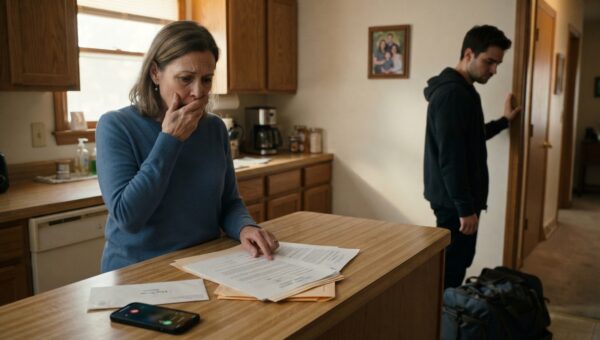
I opened my mouth to tell him about the garage gap, about the way the light hit the floor, about the ragged sound of that crying voice, when the phone on the counter let out a sharp, electronic chirp.
It buzzed once, hard enough to slide two inches across the granite top before stopping against the edge of the knife block. The screen lit up bright against the darkening room, flashing a preview banner across the dark glass.
It was a photo of a tiny plastic hospital bracelet wrapped around a wrist so thin it looked like a bird’s bone, followed by six words that made the room spin right out from under my feet.
She deserves to know she’s ours.
I stood there staring at those glowing letters until the screen went black again, leaving my own reflection staring back at me from the dark glass. Curtis didn’t move. He sat at the table with his hands flat on the newspaper, his jaw clenched so hard I could see the muscle twitching right below his ear.
“Who is she, Curtis?” I asked, and the kitchen felt suddenly very cold. “Who is she, and what does that bracelet mean?”
He didn’t answer for a long time. The refrigerator compressor kicked on with a low rumble, and outside, a car drove past on the county road, its headlights sweeping a long yellow arc across our ceiling before fading into the trees. He reached out slowly, turned the phone face down on the counter, and finally looked up at me with something close to shame in his eyes.
“It’s my sister Clara,” he said, and the name came out like something he had been holding under his tongue for ten years. “My sister Clara that you never knew existed.”
The words sat between us like broken glass. I had known Curtis since we were nineteen years old down at the Methodist youth social, and he had never once mentioned a sister. He always told me he was an only child, that his parents had passed away before we met, leaving him with an empty house and a small insurance policy that we used to put the down payment on this very farm.
“You told me your folks didn’t leave anyone,” I said, my voice shaking in spite of myself. “You said you were all alone.”
“My daddy left a lot more than an empty house,” Curtis said, looking down at his large, rough hands folded on the table. “He left a trail of wreckage that took me half my life to sweep up. Clara is ten years younger than me. When our mother died, I tried to raise her, but I couldn’t. I was twenty-two, working double shifts at the mill, and I dropped the ball. She got mixed up with the wrong crowd, ran off down to Huntington, and we stopped speaking. We didn’t talk for fifteen years.”
The kitchen grew so quiet I could hear the clock ticking out in the hall, second by second, measuring out the distance between us.
“Then why is she here now?” I asked, keeping my eyes fixed on his face. “And what does that hospital bracelet have to do with us?”
“Because she’s sick, Martha,” he said, and his voice finally cracked, the hard shell breaking open to show the raw, scared man underneath. “She’s got liver failure. She’s been in St. Francis down in Charleston for three weeks, and she’s not coming home. When she knew she was running out of time, she called me. She didn’t want anything for herself. She wanted me to take her little girl. Her daughter, Maya. My niece.”
The air went completely out of the room. I sank down slowly into the chair across from him, my fingers tracing the grain of the wooden table where we had eaten thousands of meals together, laughing, arguing, planning our quiet life.
“A little girl,” I whispered. “And you’ve been hiding her?”
“I wasn’t hiding her from you because I didn’t trust you,” he said, reaching out across the table like he wanted to touch my hand, then pulling back before he made contact. “I was hiding her because I was ashamed. Ashamed of my family, ashamed of the mess I left behind, and terrified that if I brought a child into this house, it would break everything we built. I wanted to get her settled first. I wanted to pay off the medical bills through the garage account, fix up the spare room without making you ask questions you didn’t have answers for.”
“And you thought lying to me was the way to do it?” I asked, and the anger finally flared up hot and sharp right behind my ribs. “You thought sneaking around behind my back, taking calls in the dark like some kind of criminal, was protecting our marriage? Curtis, we built this life on the idea that we didn’t keep secrets. When my mother got sick, we shared it. When the tractor loan went under, we shared it. You don’t get to carry the world by yourself just because you’re too proud to ask your wife to help you lift it.”
He didn’t argue. He didn’t try to smooth it over or tell me I was overreacting. He just bowed his head, his shoulders dropping two inches, and let me say every hard thing I needed to say to clear the air between us.
“She’s nine years old,” he finally said into the quiet. “Clara signed the temporary guardianship papers two days before they moved her to the intensive care unit. The social worker is bringing her up here on Monday morning. I was going to tell you Sunday night, after I had the room painted. I was just… I was scared out of my mind, Martha.”
I sat there for a long time, looking at the man I had loved for half a lifetime, seeing the fear and the stubbornness and the desperate, clumsy love that had driven him to hide in the garage like a thief in his own home. It wasn’t an affair. It wasn’t betrayal of the heart. It was just a broken man trying to fix a broken family all by himself, and nearly breaking us in the process.
“If there’s a child coming into this house,” I said slowly, standing up from the table and walking over to the sink to pour myself a fresh glass of water, “she comes in through the front door. Not through the garage.”
Curtis looked up, his eyes bright and wet in the dim kitchen light, and nodded once.
The sun was already high enough by Monday morning to burn the mist off the bottom pastures, turning the grass a bright, sharp green. The garage door was standing wide open to the cool autumn air, the old wooden panels pulled back so the morning light could flood right into every dark corner where he had been hiding for the past month.
Inside the kitchen, two white ceramic coffee mugs sat side by side on the quartz counter right next to the fruit bowl, both of them filled with hot, dark roast, waiting for us to finish our breakfast before we drove down to the county line to pick up a little girl who didn’t know us yet.