My sister canceled Thanksgiving by sending a group text that said, “I can’t host this year. I’m sorry.”
I called her immediately.
“What do you mean, you can’t host?”
“I mean I can’t host.”
“But Mom already ordered the turkey.”
“Then she can return it.”
“Diane, you’ve hosted Thanksgiving every year since Dad died.”
“I know.”
“Our kids expect it.”
“They can eat somewhere else.”
I was standing in the grocery store parking lot with my cart in the trunk.
I had bought the cranberry sauce and a bag of pecans for the salad I always brought. “You’re breaking a tradition that matters to all of us.”
She was quiet. Then she said, “It matters to you because I do all the work.”
I had no answer that did not sound like an excuse.
My sister’s name is Diane. She is four years younger than me, though she has always seemed older when there was something practical to do. After our father died, she took over Thanksgiving because Mom’s knees were bad and I lived forty minutes away. Diane had a dining room table that could seat ten. She knew how to roast a turkey without drying it out. She liked the family gathered around her, or so I thought.
I had never asked.
The first year, she said she would host. The second year, I asked if she was hosting.
By the third year, we all knew the address. I brought salad, Mom brought pies, and our brother, Peter, showed up with wine. My children came when they could. Diane made lists, shopped, cooked, and cleaned. We said thank you when we left.
I had believed that was fair.
After our call, I sent a message to the family group: “We need to figure out a new plan. Mom has already ordered food, and everyone was expecting to be together.” Diane did not respond. Peter wrote, “Maybe we should rotate.” My daughter sent a thumbs-up emoji. My son asked whether the Packers were playing that day.
I went to Diane’s house the following weekend. I brought coffee and the cranberry sauce I had bought. She opened the door in a sweatshirt and socks.
“I thought we agreed to leave it alone,” she said.
“We didn’t agree. You ended the call.”
She stepped aside, and I went in. The house smelled like toast and dust.
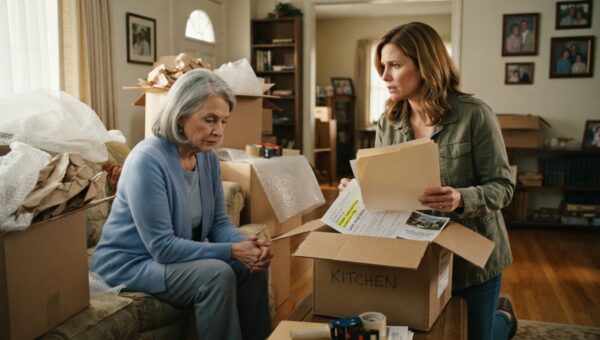
The dining table was covered with boxes. Diane was moving to a smaller apartment in January. I had known she was thinking about it, but I had not realized she had started packing.
“Why didn’t you tell me?”
“I did. You told me you’d help after Thanksgiving.”
I remembered. I had been listening to a work email at the time and said, “Sure, after the holiday.” I had not understood that she was trying to pack now.
“Are you okay?” I asked.
“I’m fine.”
There was a stack of empty boxes by the wall. A list was taped to the refrigerator: donation center, utility transfer, paint estimate, kitchen cabinet. My name appeared beside “family photos.”
“I can help with the move.”
“I know you can.”
“Then why cancel Thanksgiving?”
She looked at me. “Because I don’t want to host a holiday in the middle of packing. Because I don’t want to cook for eleven people and then scrub the kitchen while everyone else talks about how much they ate.
Because I want one year where I’m not the reason the family gets together.”
I sat down at the table. “I thought you liked hosting.”
“I do like having people over. I don’t like being assigned to it.”
That was the part I had missed. I had mistaken her competence for a preference. Diane had been good at making Thanksgiving work, so I assumed she wanted to keep doing it.
I started thinking through the holiday from her side. She had texted the family in October to ask about allergies, then asked again because no one answered. She had bought the turkey before the sale ended, cleared the freezer, and moved her own work meetings so she could shop before the weekend crowd. She made the gravy while Mom told stories in the dining room. She took the turkey out of the oven when the timer went off, even if she was in the middle of eating. She washed the roasting pan before it hardened. I had seen all of that. I had just treated it as background.
One year, Peter arrived two hours late with wine and said he had been caught in traffic. Diane had kept his portion warm. Another year, my daughter forgot the salad and Diane pulled out a bowl of greens from her refrigerator without saying a word. I had laughed and called her prepared. I had not wondered how often being prepared meant she had to make room for everyone else’s forgetfulness.
I remembered one Thanksgiving when my son had a stomach bug. Diane had called me that morning and said she was exhausted. I told her I could pick up dessert on the way, and she said that would help. I had arrived with pies and assumed I had done my share. Only later did I learn she had been up all night changing sheets because her own son was sick. She still made the turkey. She still set the table. She had put a bowl of crackers beside the couch for him and kept checking his temperature between stirring the gravy.
I had not asked whether she wanted me to come early. I had not even noticed that she had stopped sitting down.
The family had learned to rely on Diane’s quiet competence. We did not have a meeting where we assigned her the work. We simply kept accepting it, year after year, until her house became the only place Thanksgiving seemed possible.
“I should have noticed,” I said.
Diane shrugged, but there was no comfort in it. “I should have said no sooner.”
“You did say you were tired.”
“I did.”
“And I kept calling it tradition.”
She looked at me. “That word made it hard to stop.”
I thought about how often we used tradition to mean that something had always happened, not that it had to happen again. We had kept the date, the menu, the place, and the roles as if changing them would make us less of a family. Maybe what mattered was that we still wanted to sit at a table together.
“Why didn’t you tell us?”
“I did. I said I was tired. I said I needed help. You brought salad.”
I thought about the years of arriving at her house at two, carrying a dish. I would ask where to put it, then sit down. I never asked whether she needed help peeling potatoes, clearing the table, or getting the trash out. I had treated the invitation as a service she provided.
“I’m sorry,” I said.
She took a sip of coffee. “I’m not asking you to fix everything. I’m asking you to stop deciding for me.”
“I thought Thanksgiving mattered to you.”
“It does. That’s why I kept doing it.”
The answer surprised me. It was possible to love a tradition and resent the job it had become.
I called our brother from Diane’s kitchen. He answered over the sound of a television.
“Diane’s not hosting,” I said. “We need a new plan.”
“Okay. I can host.”
“Can you cook?”
“I can order a turkey from the grocery store.”
“That is not the same as cooking.”
“It’s a turkey.”
Diane laughed despite herself. “Peter can host if we split up the work.”
We made a list. Peter would order the turkey and clear his basement. I would bring the vegetables and arrive early to help set the table. Mom would bring one pie instead of three. Diane would not cook anything unless she wanted to. The younger generation would bring drinks, rolls, and dessert. Everyone was assigned a task before the conversation ended.
After the call, I phoned my daughter. She had been on the group text but had not said much.
“I think I’ve treated Aunt Diane’s house like a restaurant,” she said before I could explain.
“So have I.”
“I never thought about who did the dishes. I used to leave to put Noah in the car, and then I’d tell her I’d help next year.”
“We all thought she didn’t mind.”
“Maybe because we didn’t ask.”
My daughter offered to bring rolls and to arrive early. My son volunteered to take the trash to the curb and drive Mom home. Those were ordinary offers. I felt embarrassed that they seemed so significant.
Peter sent a picture of his basement after he cleared it. There were still boxes stacked against one wall, but he had set up the folding tables and found enough chairs. Diane replied with a thumbs-up, then texted me separately to say she was nervous that the day would be a mess.
“It might be,” I wrote. “But it won’t be your mess alone.”
She sent back a laughing face. I knew she had heard the apology inside it.
The week before Thanksgiving, I went to her house and helped label boxes for the donation center. We worked for two hours without talking about the holiday. When I left, she walked me to the car and said, “I’m not trying to make everyone feel guilty.”
“You don’t have to manage our feelings about the work you’ve been doing.”
She seemed surprised by that. “I’m used to it.”
“I know. We can learn a different way.”
She hugged me, one quick squeeze. “Let’s try.”
Mom was not happy when I called her. She had already bought apples and planned to make two pies.
“Diane’s moving,” I said. “She needs a break.”
“She could have told me.”
“She has.”
Mom sighed. “I suppose I didn’t hear it.”
“You can still bring one pie if you want.”
“I want to bring one pie.”
“Then that’s what you’ll do.”
On Thanksgiving morning, Peter’s basement was too cold, and the folding chairs wobbled. The turkey was late because the store had given him the wrong pickup time. My daughter arrived with rolls and helped me peel carrots. Diane brought a salad she had picked up at the market. She came in carrying only her purse.
No one asked her to take off her coat and start cooking.
Mom sat at the end of the table with her single apple pie beside her. She looked nervous when she saw how different the room was from Diane’s house. Then Peter opened a bottle of wine and announced that he had not been trusted with gravy, so we would be using a jar.
“Your father would have hated jar gravy,” Mom said.
“He hated my gravy too,” Peter replied.
We laughed. It was the first time in years that I had heard my mother laugh at Thanksgiving without immediately needing something from the kitchen.
While Peter carved the turkey, Mom leaned toward me. “Your father would have complained about the basement.”
“He complained about Diane’s dining room too.”
“He liked things the way he liked them.”
She looked around at the folding tables and the mismatched chairs. “I miss the old house on this day.”
I took her hand. “I do too.”
“Diane used to set the table with me when she was little. She liked arranging the napkins.”
I had not known that. In my memory, Diane had always been the person who knew what to do. I had forgotten she had once been a child learning how to fold cloth beside our mother.
“I think she misses being a guest sometimes,” I said.
Mom looked across the room at my sister, who was sitting beside her grandson and letting him tell a story about school. “I suppose we all do.”
After the meal, Mom asked Diane if she wanted the old recipe card box. Diane said she would take it when she moved, but only if Mom wrote down the recipe for the apple pie she had brought. Mom laughed and said there was no recipe; she used whatever apples looked good. Diane insisted that was not a recipe. They argued cheerfully about cinnamon and sugar while Peter cleared the dishes.
It felt like family without needing everyone to perform the same role. Mom could miss the old house. Diane could stop hosting. We could still make something together in a different room.
After dinner, I stood up with my plate and carried it to the counter. My daughter followed me. Peter began stacking dishes. Diane stayed at the table talking to Mom. No one had to be asked twice.
When I finished, I sat beside Diane. “You don’t have to come next year,” I said. “Or you can come and do nothing.”
“I know.”
“I mean it.”
She looked at the family around the table. “I want to come. I just don’t want to host.”
“Then you won’t.”
The following January, I helped Diane move. She had donated the dining table that used to seat ten and bought a round one that fit four. We carried her boxes up two flights of stairs. She placed her mother’s old pie plates in the cabinet and kept the dining table clear.
Before we left, she asked me to take the extra chairs. I loaded two into my car. One had a loose rung, and I offered to fix it. Diane said she wanted to decide whether she even needed them first. I put my tools back in the trunk. It was a small thing, but I was learning to wait for her to ask.
She gave me a box of old recipes she had found behind the cabinet. Most were in Mom’s handwriting. One card had a note in Diane’s writing from when she was ten: “Do not add more pepper. Dad says it is fine.” We both laughed. I took a picture and sent it to Peter. For once, the family memory traveled to us without asking Diane to cook it for everyone.
I asked if she wanted to host dinner sometime in spring.
“Maybe,” she said. “If you bring the food.”
“I can bring the food.”
When spring came, she invited us for soup. She made it in one pot. We ate at the round table, and no one moved to the living room afterward because there was no room. We stayed and talked until the bowls were empty.
Thanksgiving did not disappear. The next year, we met at a restaurant and split the bill. The year after that, Peter hosted again. Diane came with a store-bought pie. She sat down before everyone else and did not get up until dessert.
I still love the old tradition. I also understand now that a tradition can become a burden when one person is responsible for keeping it alive.
My sister did not break our family by canceling Thanksgiving. She showed us that we had been asking her to hold it together alone.