PART 1
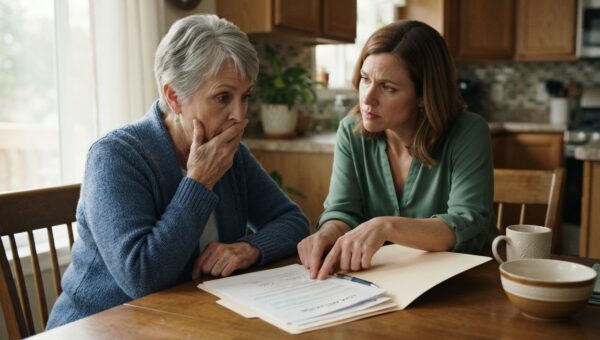
My daughter, Megan, called me on the Monday before Thanksgiving around four in the afternoon. I was in my kitchen with flour all over my apron, having just taken two pecan pies out of the oven to cool on the baker’s rack. In the refrigerator, I had a twenty-two pound fresh turkey brining in a stockpot, along with four bags of cranberries and three loaves of crusty French bread I had dried out for her favorite sausage stuffing.
“Mom,” Megan said, her voice sounding tight and hurried, the way it always sounded when her husband, Greg, was standing somewhere nearby. “I need to talk to you about Thursday.”
“I have the pies cooling right now, honey,” I said, wiping my hand on a kitchen towel. “And I found that cinnamon ice cream Toby likes. What time do you want me over to help with the gravy?”
There was a heavy pause on the other end. All I could hear was the hum of her dishwasher running.
“Greg thinks we need to do a smaller table this year,” she said. “Just the kids and us. The house has been feeling crowded lately, and Greg’s work hours have been brutal. He’s exhausted, Mom. We just need a quiet day to breathe. I think it’s better if you stay home this time.”
My throat felt tight. I looked at the little pile of wrapped packages sitting on the side table by the hallway: a remote-control dune buggy for my nine-year-old grandson, Toby, and a set of watercolor paints for seven-year-old Claire. For six years, ever since my husband, Arthur, passed away, I had spent every single holiday at their house on Crestview Drive. I was the one who bought the groceries. I was the one who scrubbed the roasting pan while Greg watched football in the den.
“A smaller table,” I repeated quietly.
“Just for this year,” Megan said quickly, not letting me ask anything else. “We can get together next weekend for lunch. You understand, don’t you?”
“Okay, honey,” I said. “I understand.”
She hung up before I could tell her about the turkey in the fridge.
I stood in my quiet kitchen for a long time. Then I wrapped the warm pies in heavy aluminum foil, packed the turkey into freezer bags, and shoved everything into the deep freeze out in the garage. I didn’t want to look at food I had bought for four people who didn’t want me at their table.
Tuesday and Wednesday passed in total silence. My phone didn’t ring once.
Then came Thanksgiving morning.
It was twenty past eight. The sky outside my window was gray and spitting wet sleet. I was sitting at my small kitchen table in my bathrobe, drinking black coffee and listening to the local radio station play old holiday standards, when my cell phone buzzed against the placemat.
The screen showed Megan’s cell number.
I picked it up right away. “Megan?”
There was a muffled scuffling sound, like fabric rubbing against a microphone, followed by the clicking of a door latch.
“Grandma?”
It wasn’t Megan. It was Toby. His voice was barely a whisper, thin and scared.
“Toby, honey?” I sat up straight, pulling the robe around my collar. “What’s wrong? Why are you whispering?”
“I’m in my bedroom closet under the winter coats,” he whispered, breathing fast. “Mom doesn’t know I took her phone off the counter. She’s downstairs in the laundry room.”
“Sweetheart, are you okay? Did you get hurt?”
“No,” he said. “Grandma, Dad lied to you. Mom said it was supposed to be small, but Dad’s whole family is coming. His brother brought three cars of people from Ohio last night. There’s twelve people staying at the house right now. Uncle Brad, Aunt Julie, their kids, and two people from Dad’s office. They’re setting up three folding tables in the living room.”
My stomach dropped into a hard knot. Twelve people from Greg’s side. The excuse about a quiet, restful holiday with just their immediate family was completely made up.
“Toby,” I said, keeping my voice as calm as I could so he wouldn’t panic. “It’s all right. If your dad wanted his brothers over, that’s okay. You don’t have to hide in the closet.”
“No, Grandma, you don’t know,” Toby whispered, his voice trembling now. “There’s an empty chair at the end of the long table. The wooden one from the dining set. Dad put a piece of masking tape under the bottom rung, and your name is written on it with a black marker. I saw him stick it there when he carried it in from the garage.”
My fingers tightened around the phone. “My name? Why would my name be taped under an empty chair?”
Toby swallowed hard. I could hear the hangers rattling as he leaned against the closet wall.
“Because I heard them fighting last night in the pantry,” Toby whispered. “Dad told Mom that everyone needs to see what kind of mother she has. Mom was crying, Grandma. She said she didn’t want to do it in front of Greg’s family, but Dad said it was the only way to settle it. Mom told him she has to tell everyone something about you before they carve the turkey.”
PART 2
The line went dead with a sharp click before Toby could say another word.
I stared at the black screen of my phone. The house was dead quiet. My cold coffee sat in front of me on the floral placemat Arthur and I had bought forty years ago when we built this brick ranch.
I didn’t call Megan back. If Toby was hiding under coats with her phone, calling would only get him caught.
Instead, I sat there and thought about what Greg could possibly want Megan to announce in front of twelve people from Ohio. Greg had always been a loud, domineering man who worked in commercial logistics and talked about family loyalty like it was a corporate policy. Over the last two years, he had made three different comments about my house. He had asked twice what Arthur and I had paid for our three acres back in 1984, and during Fourth of July, he had cornered me by the grill to explain how much property taxes were going to eat into my modest state pension.
Six months ago, Greg had come to me with a plan. He said he and Megan wanted to build a detached garage apartment behind their house for me to live in so I wouldn’t have to maintain my yard alone. In exchange, he wanted me to sign a warranty deed transferring my house and parcel into a family trust where he and Megan were the named trustees.
I had told him no. I told him plainly that Arthur had built that house with his own hands, that my garden was my own, and that I intended to stay in my bed until they carried me out in a box. Greg hadn’t brought it up again, but his visits to my porch had stopped completely after that conversation.
I stood up from the table. My knees felt stiff, but my hands were completely steady.
I walked into my bedroom, took off my robe, and put on my dark navy wool slacks, a modest gray cardigan, and my heavy winter boots. I didn’t put on makeup. I didn’t rush.
I went out to the garage, pulled the two wrapped boxes for the kids off the hall table, and walked to the freezer. The two pecan pies were frozen solid in their aluminum foil pans. I set them in a cardboard box on the passenger seat of my sedan, backed out of my driveway, and drove the five miles across town to Crestview Drive.
The neighborhood was lined with bare maples dripping wet slush. When I turned onto their cul-de-sac, the street was packed with vehicles: Greg’s black pickup, two large SUVs with Ohio license plates, and a silver sedan parked half on the grass. The front porch lights were on, casting a yellow glow through the freezing mist.
I parked near the end of the curb, picked up the box with the frozen pies and the wrapped gifts, and walked up the front sidewalk.
Laughter and the loud roar of a football game came through the wood of the front door. The smell of roasting poultry and sage leaked out into the cold air.
I didn’t ring the bell. I turned the brass knob and pushed the door open.
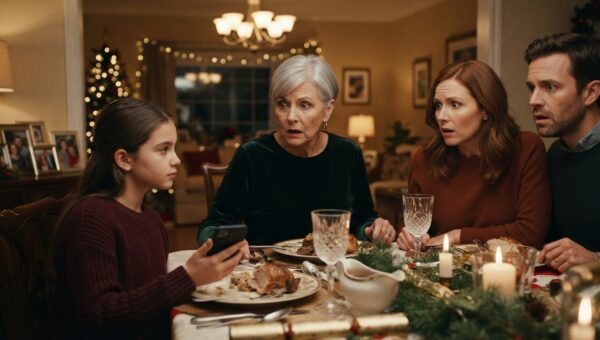
The hallway opened directly into the great room. A long banquet table had been formed by pushing the formal mahogany dining table against two plastic folding tables, covered with mismatched white tablecloths. Setting around it were eleven people holding beer bottles and wine glasses. Greg’s brother Brad was by the fireplace talking with a woman in a green sweater, while four children I didn’t know were running around the sofa playing tag.
At the head of the plastic folding table, right near the kitchen threshold, sat a single wooden dining chair with a high ladder-back. It was completely empty.
Megan was coming out of the kitchen carrying a ceramic bowl of mashed potatoes. When she looked up and saw me standing in the foyer with snow melting on the shoulders of my coat, the bowl in her hands tilted so far that potato flakes almost spilled over the rim.
“Mom?” she said. The sound of her voice made the whole room quiet down.
Greg turned around from the bar counter near the television. He had a beer in one hand and a carving knife in the other. He stopped mid-stride, his eyebrows pulling down into a hard, defensive scowl.
“Nora,” Greg said, setting the carving knife down on the counter with a dull clatter. “What are you doing here? Megan told you we were keeping things small.”
I looked across the room at the twelve faces staring at me. Brad stopped laughing. The woman in green lowered her wine glass. Over by the stairs, Toby was sitting on the fourth step, his arms wrapped around his knees, looking down at his socks.
“You have twelve people from Ohio, Greg,” I said. My voice was calm, clear, and loud enough to reach the back corners of the room. “That doesn’t look like a quiet day to breathe.”
“This is family,” Greg said, stepping around the dining table toward me. He tried to smile, but his mouth stayed tight. “We had an unexpected visit. We didn’t want to overwhelm you with the noise. You should have called before driving over in this weather.”
“I brought the pies,” I said, setting the cardboard box down on the entryway bench next to the coats. “And the kids’ presents. But that’s not why I came in.”
I walked past Greg. I didn’t look at him. I walked straight over to the empty wooden chair at the end of the plastic table.
I bent down, reached under the bottom cross-rung, and ran my fingers along the rough oak underside. My fingertips brushed against the dry edge of masking tape.
I pulled it off.
It came away with a sharp rip. Written across the center of the two-inch strip in thick black Sharpie was my full name: Nora Hastings.
I turned around and held the strip of tape between two fingers so every single person at that table could see it.
“Toby told me about this chair,” I said, looking directly at Megan. “He said you had something you needed to tell everyone before you carved the turkey. So go ahead, Megan. I’m standing right here. Tell them.”
PART 3
Megan set the potato bowl down on the tablecloth with a heavy, ceramic thud. She looked like she was twenty-two again, caught doing something dishonest in high school, her chin tucked into her chest and her eyes darting toward the hallway.
“Greg,” Megan whispered. “Don’t.”
“No, let’s have it out,” Greg said, his voice dropping into that aggressive, boardroom register he used whenever anyone pushed back against him. He stepped in front of Megan, crossing his thick arms over his chest. “You want to know what the chair is for, Nora? That chair was going to sit empty all afternoon so my family could see why Megan has been having panic attacks for three months. That chair is a monument to how you treat your own daughter.”
“Greg, please stop,” Megan cried, her voice cracking.
“Be quiet, Megan,” Greg snapped, not even turning his head toward her. He pointed a finger at my face. “Nora, you’ve been living high and mighty out on that three-acre lot for six years, acting like the saint of the family while your daughter and her husband are drowning. You know damn well the county reassessed this neighborhood last winter. Our property taxes doubled. My territory at work got cut by twenty percent in March. We asked you for help. We asked you to put that paid-off house into a trust so we could pull an equity line to cover our debt, and you told me to my face that you wouldn’t give us a single dime.”
A murmur went through the guests around the table. Brad looked down at his shoes. The woman in green looked over at Greg’s sister, clearly uncomfortable to be sitting in the middle of a family execution.
“I didn’t say I wouldn’t give you a dime, Greg,” I said. “I said I wouldn’t sign over the deed to the home Arthur built with his life savings.”
“It’s the same thing!” Greg yelled, stepping closer. “You’re sitting on four hundred thousand dollars of free-and-clear equity while your grandchildren are eating generic cereal, and you refused to lift a finger! I wanted everyone here, my brother, my sister, my coworkers, to see what kind of selfish woman leaves her daughter out in the cold. That’s what Megan was going to tell them. She was going to tell them why her mother wasn’t sitting at our table, because her mother cares more about three acres of dirt than her own blood.”
The room was so still you could hear the oil dripping inside the turkey roaster in the kitchen.
I looked at Megan. “Is that what you believe, Megan? That I never helped you?”
Megan didn’t speak. She covered her eyes with one hand, her shoulders shaking violently.
“Show him your purse, Megan,” I said quietly.
Megan froze. Her hand dropped from her face. Her eyes went completely wide.
“What does her purse have to do with this?” Greg scoffed, waving his hand toward the kitchen. “Don’t try to change the subject, Nora. You’re greedy. You’ve always been greedy.”
“Open your purse, Megan,” I repeated. My voice was very soft now, but it had the weight of thirty years of motherhood behind it. “Or do you want me to tell your husband what was in the bank envelope I handed you at the diner on October twelfth?”
Greg stopped. He looked back at Megan, his forehead creasing with sudden suspicion. “What diner? What bank envelope?”
Megan backed away from the table until her hips hit the edge of the kitchen counter. She reached under the kitchen island and pulled out her large brown leather shoulder bag. Her fingers were trembling so hard she could barely work the brass zipper.
She reached inside the side pouch and pulled out a thin, folded yellow receipt along with an official carbon slip from Farmers & Merchants Bank in town.
Greg snatched the paper from her hands before she could hold it out.
His eyes scanned the lines. His scowl slowly dissolved into total, blank confusion.
“What is this?” Greg asked, his voice losing its volume. “This is a cashier’s check receipt for thirty-six thousand dollars.”
“Read the payee line, Greg,” I told him.
Greg looked down at the paper. “Midwest Commercial Credit… account number 8812.”
He looked up at Megan, his jaw hanging slightly slack. “Megan… that’s the business loan I took out behind your back for the warehouse franchise. How did she have this?”
“She came to me three months ago, Greg,” I said, pointing at my daughter. “She was crying in my kitchen just like she’s crying now. She told me you had taken out a high-interest personal guarantee to buy into that Ohio logistics venture, and the lender was threatening to place a lien on this very house. She begged me not to tell you because your pride couldn’t take knowing she had found out about the second mortgage.”
I took one step toward Greg. He didn’t move. He stood there holding the yellow carbon paper like it was made of hot iron.
“I didn’t have forty thousand dollars sitting in checking,” I said, looking around the room at Brad, at his sister, and at the colleagues who had been invited to witness my humiliation. “I had to cash out Arthur’s remaining union life policy early and pay the early withdrawal penalty to get thirty-six thousand dollars in cash before the bank’s November deadline. I gave that check to Megan six weeks ago. She deposited it directly to Midwest Commercial Credit so the sheriff wouldn’t post a foreclosure notice on your front door this morning.”
I looked back at Megan. “I gave you Arthur’s final money to save your house, Megan. And you let your husband tape my name under an empty chair to tell his family I was selfish.”
ENDING
The silence in that dining room was heavier than any argument could have been.
Brad stood up from the far end of the plastic table. He set his beer bottle down on the tablecloth with a quiet click, walked over to the coat rack, pulled his jacket off the peg, and said to his wife, “Get the kids’ shoes. We’re going to the hotel.”
Nobody argued with him. Within five minutes, the guests from Ohio were quietly pulling on their coats, avoiding eye contact with Greg, and walking out through the front door into the freezing drizzle. The front door clicked shut four times until only Greg, Megan, the two kids, and I remained in the house.
Greg was sitting on the empty wooden chair, staring at the floor between his leather shoes, the cashier’s check receipt crumpled in his right hand. He didn’t look at me. He didn’t apologize. A man whose pride is built on shouting rarely knows what to say when the truth takes his voice away.
Megan came toward me across the great room, tears running down her cheeks, reaching out with both hands. “Mom… Mom, I’m sorry. Greg was so angry every single night about the money. He kept saying his family was judging him. I didn’t know how to stop him without telling him I found the loan papers in his truck.”
I didn’t let her take my hands. I stepped back, keeping my fingers tucked into the pockets of my cardigan.
“You let him talk about me like that, Megan,” I said. “You let him put my name under a chair to be mocked by strangers while Arthur’s money was sitting in his bank account. That isn’t fear. That’s cowardice.”
I looked over at the stairs. Toby was still sitting there, watching us with his chin resting on his knees.
I walked over to the bench in the foyer, picked up the two wrapped presents, and carried them to the bottom of the staircase. I handed the dune buggy to Toby and set the watercolor paints on the step beside him.
“Thank you for calling me, Toby,” I whispered, kissing the top of his head. “You’re a good boy.”
“Are you staying for dinner, Grandma?” he asked quietly.
“No, sweetheart,” I told him. “Not today.”
I picked up the cardboard box with the two frozen pecan pies from the bench, turned around, and walked out the front door.
The sleet had turned into soft, quiet snow. My car started on the first turn of the key, the heater blowing cold air until I reached the main county road.
When I got back to my house on the three-acre lot, the driveway was white and undisturbed. I went inside, hung my wet coat on the peg behind the door, and set the two frozen pies back on the kitchen counter to thaw.
I didn’t turn on the radio. I took off my heavy boots, put on my warm house slippers, and walked into the small den where Arthur’s framed photograph sits on the mantelpiece above the fireplace. I looked at his square jaw, his kind eyes, and the little pencil smudge he had left on the corner of the wood frame when he built the casing thirty years ago.
“We saved their house, Artie,” I said to the quiet room. “Now they have to figure out how to live in it.”
I went back to the kitchen, sliced a thick piece of the thawed pecan pie, and sat down at my own table by the window to watch the snow cover my garden.