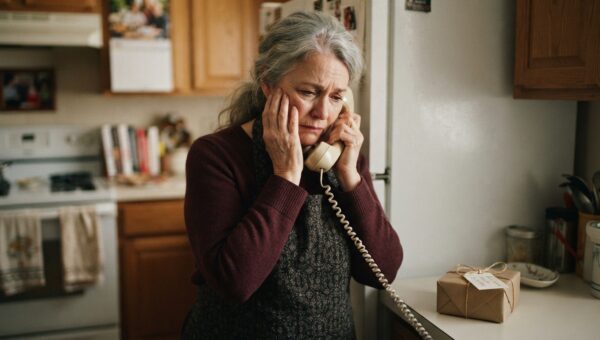
PART 1
My son, Marcus, asked me to cosign a loan for his new business back in August.
We were sitting on my back porch, watching the late summer heat rise off the garden beds. He had a slick blue folder open on his knees, filled with glossy printouts of fleet vans, commercial power-washing rigs, and financial projections that went up in steep, cheerful lines. He looked me right in the eyes, the way he used to do when he needed help with his car insurance in college, and told me he needed $35,000 to secure his commercial equipment.
“You’ll never have to pay a cent, Mom,” he told me. “My credit score took a hit from the credit card debt after the baby came, but the bank will approve the tier-one commercial rate if you put your name on the guarantor line. It’s just a formality for their underwriters. You have forty years of clean credit.”
I am sixty-seven years old. My husband died six years ago, leaving me with our modest two-bedroom ranch house and a small monthly pension that, combined with Social Security, brings in $2,180 a month. That check pays my supplemental Medicare, the heating oil, and my property taxes. There is no cushion. There is no second retirement account waiting in the wings.
I looked at Marcus and told him no.
“I can’t risk this house, Marcus,” I said. “If the business hits a dry spell, the bank won’t care that you meant well. They’ll come after my home.”
Marcus stood up so fast his chair scraped hard against the concrete. “You never believed in me, Mom,” he snapped. “Dad would have backed me. You’d rather hoard your savings than help your only son build something for his family.”
He didn’t call me that Sunday. He didn’t call on my birthday in September, and he didn’t bring my four-year-old granddaughter over for Sunday pot roast like we had done for three years straight. For two solid months, my phone was completely silent. Every time I dialed his number, it rang four times and clicked over to his automated voicemail.
Then, on a Tuesday morning in late October, a car door slammed in my gravel driveway.
I pulled back the kitchen curtain, expecting the mail carrier. Instead, I saw Marcus’s wife, Chloe, walking up the front path. She wasn’t wearing her usual bright workout clothes. She wore an old gray fleece jacket, her brown hair pulled into an untidy bun, holding a thick brown accordion folder against her ribs.
She didn’t knock. She opened the screen door, stepped into my kitchen, and set the folder right on the yellow tablecloth beside my coffee mug.
“You were right not to sign, Evelyn,” she said.
Her voice was barely above a whisper, but it sounded completely hollow.
I thought Marcus’s business had collapsed. I thought he had lost his startup capital or gotten tangled up with predatory equipment leases.
Instead, Chloe pulled a five-page document from the front pocket of the folder and laid it flat under my kitchen light. It was a formal commercial promissory note from Ridgefield Community Bank for $35,000.
My full name was typed across the primary guarantor line. My Social Security number was typed in the identity box. And down at the bottom, on the dotted line above the words *Guarantor Signature*, was a signature in black ink that looked almost like mine. The loop on the *E* was slightly too round, and the tail on the *n* didn’t slant back toward the left, but anyone glancing at it across a loan desk would have thought I had held the pen.
I stared at the page, my throat tightening until I could hardly breathe. I looked up at Chloe.
She met my eyes, her jaw clenched tight.
“That’s not the worst part, Evelyn,” Chloe said. She reached out and turned the final page over to the notary and witness acknowledgment box. “Look who witnessed it.”
PART 2
I looked down at the rectangular box stamped at the bottom of the fifth page.
The notary seal belonged to the county branch of the bank, but right beside it was the printed witness signature line.
Written in neat, slanted cursive was the name *Rachel Vance*.
Rachel was my younger sister.
She lived four miles across town in the colonial house our parents had left her. Rachel and I had spoken on the phone just three days ago about our Thanksgiving grocery list. She had asked how Marcus was doing, asked if he had called me yet, and listened to me sigh about how much I missed my granddaughter without saying a single word about a bank note.
“Rachel signed this?” I asked, my voice shaking so hard the paper rattled in my hand.
“She didn’t just sign it, Evelyn,” Chloe said. She pulled out a chair and sat down heavily, resting her face in her hands for three long seconds before looking back up at me. “Rachel was the one who helped him get the application through the branch. Her son-in-law is the assistant loan officer at Ridgefield Community. Rachel went into the branch with Marcus three weeks ago. She told the loan officer that you had severe arthritis in your hands, that you had reviewed the paperwork at home on Sunday, and that you had pre-signed the guarantor forms in front of her.”
The room felt suddenly very cold.
“How did Marcus get my Social Security number, Chloe?”
“He went into your spare bedroom while you were in the backyard cutting hydrangeas back in August,” Chloe whispered. “He told me he was using the bathroom, but he took your tax folder from the top drawer of the metal desk. He took photos of your 1099 statement and your property tax receipt on his phone.”
Chloe reached back into her folder and pulled out a bank transaction receipt dated twelve days ago.
“He told me the bank approved the loan on his own merit,” Chloe said, tears finally spilling down her cheeks. “He said an angel investor had guaranteed the balance. But on Friday night, Marcus left his iPad unlocked on our nightstand. I saw an automated email alert from Ridgefield Community congratulating him on the disbursement, and your name was listed as the primary guarantor. The first monthly installment of $840 is due on the fifteenth of November.”
“Why did Rachel do this?” I whispered. “Why would my own sister help him forge my name?”
“Because Marcus owes Rachel $12,000 from two years ago,” Chloe said. “Remember when Marcus said he had private investors for that mobile detailing trailer? It wasn’t an investor. Rachel lent him twelve thousand dollars from her husband’s life insurance payout. Marcus hadn’t paid her back a dime. When Marcus came to her and said the bank would give him $35,000 if someone helped him push the guarantor papers through, Rachel saw a way to get her $12,000 back. Marcus transferred $12,000 directly from the new business account to Rachel’s personal checking account the day after the funds cleared.”
I sat in my chair and looked at the kitchen clock. It was nine twenty.
For two months, I had been carrying the guilt of feeling like a cold, unsupportive mother. I had spent hours lying awake in bed, wondering if I should have just risked my credit to keep the peace with my only child.
Meanwhile, my son and my sister had taken my identity, forged my signature on a commercial debt, used a family connection at the local branch to bypass standard identification checks, and used the bank’s money to settle an old family debt between themselves. If Marcus defaulted on that $840 monthly payment, the bank would file a lien against my ranch house before spring.
“Marcus doesn’t know you have these papers?” I asked Chloe.
“No,” Chloe said, wiping her face with her sleeve. “He thinks the loan documents are locked in the glove box of his work truck. I took them while he was in the shower this morning. Evelyn, I have a four-year-old girl. If you file a police report, Marcus could go to state prison for bank fraud. But if you don’t do something, he is going to bleed your house dry, because his business doesn’t have any commercial contracts. He lied to both of us. He’s already spent four thousand dollars of the remaining money on personal credit cards.”
She pushed the entire brown folder toward me.
“I can’t cover for him anymore,” Chloe said. “Do what you have to do.”
PART 3
I didn’t call Marcus.
I picked up my purse, put the brown folder on the passenger seat of my car, and drove directly to Rachel’s house on Maple Avenue.
Rachel’s blue sedan was in the driveway. When I walked up the front steps and opened the screen door, I heard her humming from the kitchen where she was unloading a dishwasher.
She turned around, smiling, holding a ceramic coffee mug. “Evelyn! What a nice surprise. I was just about to brew a fresh pot. Did you find the cranberries for Thanksgiving yet?”
I didn’t answer her. I walked across her tiled floor, pulled the five-page promissory note from the folder, and laid it face-up on her counter, right beside her silver toaster.
Rachel’s smile vanished. Her eyes dropped to the paper, caught the bold black font of Ridgefield Community Bank, and her mouth set into a tight, thin line.
“What is this?” she asked.
“You witnessed my signature on a $35,000 commercial note, Rachel,” I said. My voice was completely flat. “You told your son-in-law at the bank that I was too arthritic to drive into town, and you watched him approve a fraudulent loan using my Social Security number.”
Rachel set her mug down with a hard click. Her cheeks flared bright red.
“Marcus was drowning, Evelyn,” Rachel said, raising her chin. “He made mistakes, but he’s your son. You sit over there in your paid-off house with your pension, refusing to lift a finger while your boy is struggling to put food on the table for his daughter. You’ve always been stingy with your family.”
“You took twelve thousand dollars of that money, Rachel,” I said.
That stopped her.
Her hands gripped the edge of the countertop. She looked toward the hallway as if someone else might be listening, then back at me.
“He owed me that money from two years ago,” Rachel stammered, her voice dropping into a desperate hiss. “He promised he would repay me within six months, and he ignored my calls for eighteen months. I had property taxes due on this house, Evelyn! Marcus told me he had an agreement with you. He told me you knew about the loan and just didn’t want to deal with the bank branch in person because you were upset with him.”
“Did you call me to ask?” I asked.
Rachel looked down at the floorboards. She didn’t say a word.
“You knew I said no,” I told her. “Marcus told you I turned him down in August. You didn’t care that my signature was forged because you wanted your twelve thousand dollars back before his ship went down.”
I pulled out my cell phone and set it on top of the promissory note.
“Here is what happens right now, Rachel,” I said. “It is nine fifty-five. At ten thirty, the main branch of Ridgefield Community Bank opens their executive offices. You are going to get your coat, get in your car, and meet me at that branch. You will bring your checkbook.”
“Evelyn, please,” Rachel pleaded, her voice cracking. “If the bank finds out, Tom could lose his job as a loan officer. He has two toddlers. He was just doing a favor for family because I told him it was all legitimate.”
“Then you had better hope the branch manager is willing to accept a full, voluntary loan rescission before I file a formal identity theft affidavit with the county sheriff,” I told her. “You will return the twelve thousand dollars you took. Marcus will return the remaining twenty-three thousand from his business account. If every single cent of that $35,000 note is not paid back to the bank today, I will walk straight into the magistrate’s office across the square and swear out a criminal complaint against every single person whose name is on this page.”
Rachel looked at my eyes. For sixty years, I had been the older sister who smoothed things over, the one who shared her clothes, covered for late curfews, and let family slights pass in the name of peace.
She saw none of that in my face.
She reached for her purse on the hook by the door.
We met at Ridgefield Community Bank twenty minutes later. Chloe had called Marcus and told him to meet us there immediately. When Marcus walked through the double glass doors of the bank lobby, he was wearing his work jeans, his face pale and sick with panic.
“Mom,” Marcus whispered, catching my arm in the lobby. “Mom, please. Let’s talk outside. We can handle this as a family. I can make the payments. I swear on my daughter’s life I have three commercial power-washing jobs lined up for next week.”
I pulled my arm free from his grip.
“You stole my identity out of my spare bedroom, Marcus,” I said, looking him dead in the face. “You put my house on the line so you could play businessman. We are not handling this outside.”
We walked into the office of the senior vice president, Mr. Callahan.
It took forty-five minutes of cold, brutal honesty. Rachel wrote a certified cashier’s check from her personal savings for the $12,000 she had received. Marcus, his hands shaking so violently he could barely hold the pen, executed an immediate electronic transfer of the remaining $19,200 sitting in his commercial account, and Chloe handed over a cashier’s check for $3,800 from her own pre-marital savings account to cover the difference Marcus had already spent.
The bank took every penny. Because the loan had been funded less than two weeks prior and the entire principal balance was repaid in full on the spot, Mr. Callahan agreed to cancel the promissory note and rescind the guarantor agreement without referring the file to the county district attorney.
He looked across his desk at Marcus, then at Rachel’s son-in-law Tom, who had been called into the room five minutes earlier and was standing against the wall, white as chalk.
“The loan is closed and satisfied,” Mr. Callahan said, stamping the cancellation across the original file. “Tom, you will be suspended pending an internal compliance review by human resources on Monday. And Mr. Miller, you are permanently barred from opening an account with this institution.”
ENDING
We walked out into the bright October sunlight in complete silence.
In the parking lot, Rachel tried to reach for my hand. “Evelyn, can we please talk about this? We’re sisters.”
I stepped around her, unlocked my sedan, and didn’t answer. I haven’t spoken to Rachel since that morning, and our family Thanksgiving was canceled two days later.
Marcus stood by the driver’s door of his truck, staring down at his keys, his shoulders slumped like a boy who had finally run out of lies. Chloe didn’t get into the truck with him. She took her daughter’s car seat from the back, put it into her own small hatchback, and drove away toward her mother’s house.
I drove home alone to my quiet ranch house.
I went into the spare bedroom, pulled the metal file cabinet away from the wall, and took out every important document I owned: my birth certificate, my tax returns, my husband’s pension paperwork, and my property deeds. I drove down to the local hardware store, bought a heavy fireproof lockbox with a digital combination, and bolted it to the subfloor inside my master closet.
That afternoon, I called the three major credit bureaus and placed a permanent credit freeze on my Social Security number.
Marcus came by my house once, three weeks later. He stood on the front porch in the evening chill, knocking quietly on the wood frame. When I opened the inside door, leaving the screen locked between us, he looked at me with red, exhausted eyes.
“Mom,” he said. “Chloe took the baby to her parents’. I had to sell the pressure washer to cover the rent on my apartment. I just want to know if you’re ever going to forgive me.”
I looked at him through the wire mesh. I looked at the boy I had raised, the boy whose scraped knees I had bandaged, the boy who had been willing to let the bank take the roof from over my head so he wouldn’t have to admit he was failing.
“I love you, Marcus,” I told him, keeping my voice very quiet and steady. “You are my son. But I will never trust you with a single piece of paper for the rest of my life.”
I closed the inside door, turned the deadbolt, and walked back into my warm kitchen.