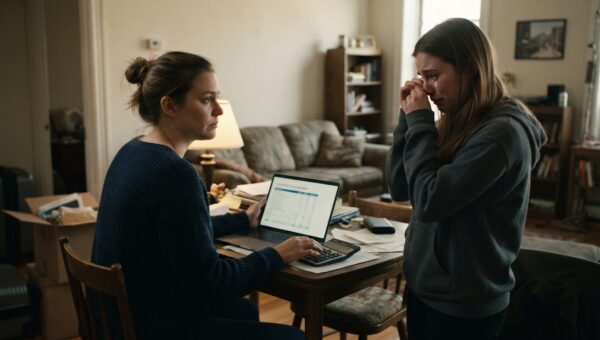
I always thought my sister Clara was just bitter about the way things turned out, but the truth was sitting right under our noses in a dusty attic box we should have opened years ago.
For as long as I could remember, Clara kept her distance from our family home. She moved across state lines the second she turned twenty-one, and she only ever visited on major holidays, staying just long enough to be polite before packing her sedan and heading back out.
I stayed close. I lived ten minutes away from Mom and Dad, stopped by every Tuesday for pot roast, and took care of the grocery shopping when Mom’s hips started acting up. Everyone in town called me the good daughter. I wore that title like a badge of honor, believing I had earned my place through sheer devotion while Clara had chosen rebellion.
Mom passed away on a rainy Tuesday in November, leaving behind a house that felt entirely too quiet and thirty years of accumulated belongings we had to sort through. Clara arrived in her usual worn-out jacket, her hair pulled back in a hasty clip, carrying herself with that old defensive stiffness she never quite shook off whenever she crossed our threshold. We spent the first two days downstairs packing up the kitchenware and clearing out the pantry, avoiding the real work waiting upstairs. Dad had passed three years earlier, leaving behind a legacy of silence and heavy footsteps that we were still learning to navigate in his absence.
By the third afternoon, we finally climbed the narrow wooden stairs to the attic. The air up there smelled of dry cedar, old paper, and the distinct damp chill of an Oregon coast winter that never quite left the rafters. We had two specific boxes waiting for us near the chimney, labeled in Dad’s sharp, sloping handwriting with our names.
Clara pulled her box toward her first, sitting cross-legged on the bare floor boards. I sat a few feet away with mine, feeling a familiar twinge of guilt as I watched her lift the lid. My box was heavy, packed to the brim with neatly organized school certificates, ribboned dance medals, birthday cards with fifty-dollar bills tucked inside, and photo albums dedicated entirely to my piano recitals and graduations.
Clara reached into hers and pulled out a single, dog-eared spelling test from the third grade and a small plastic trophy with a broken base.
That was almost it. She set the few items in her lap, looked around the empty interior of her cardboard container, and let out a dry, humorless laugh that sounded like a cracked bell.
“See?” Clara said, holding the box open toward me so I could see the bare cardboard bottom. “I always told you. You were the golden child, and I was just the guest room occupant until I finally packed my bags.”
I felt a sudden, hot wave of sickness rise in my throat. I looked at my overflowing box, then at hers, and for the first time, the comfortable narrative I had built around my special place in the family started to crack right down the middle. I didn’t know what to say to defend myself because the evidence was right there in front of us.
“Clara, I didn’t know,” I whispered, reaching out to touch the edge of her empty box. “I swear I didn’t know he packed them like that.”
Before she could answer, her fingers brushed against the floor of her box.
She frowned, pressing down on the cardboard base. It didn’t feel right. It dipped in the middle with a muffled, springy resistance that a simple piece of cardboard shouldn’t have. She hooked her fingernail under the edge of the lining and pulled.
A false bottom lifted away, releasing a trapped smell of old stationery and dried lavender.
Underneath sat neat, thick stacks of envelopes, tied together with faded pink ribbon. Every single one of them was addressed to Clara at an apartment complex in Portland she had lived in briefly during her early twenties, right after the massive family blowup that caused her to leave home in the first place. The postmarks spanned fifteen years.
Clara froze, her hand hovering over the top envelope. “What is this?” she breathed, her voice dropping to a harsh whisper.
“Open one,” I said, my heart hammering against my ribs.
She untied the ribbon with trembling fingers, pulled out a folded sheet of cream-colored paper, and started to read. I watched her eyes track back and forth across the handwritten lines, her breath hitching softly in the quiet attic. Halfway down the page, she stopped dead, her face turning pale. Without a word, she held the paper out and handed it to me.
I took the letter, my thumb brushing the familiar, delicate cursive of our mother.
“I cannot mail this to your box because your father checks the incoming post every morning before I even wake up,” Mom had written on the second page. “He told the household that you made your choice and that our door is permanently closed to you. But he doesn’t know about the spare key to the post office box down on Main Street, and he doesn’t know I keep this stash under the floorboards in the attic. I pray every single night that you’ll read these someday and know I never stopped being your mother.”
I lowered the paper, staring at the date scrawled in the corner. It was written ten years ago, right in the middle of the period when Clara had stopped calling for the holidays and I had assumed she simply didn’t care about us anymore.
“Fifteen years,” Clara whispered, staring at the tall stacks of unopened letters. “Every single week. While I spent every birthday thinking she hated me for leaving.”
“Dad intercepted everything,” I said, the pieces of our entire childhood suddenly clicking together into a terrifying, coherent picture. “He made sure you never got anything from her, and he made sure I thought you were just too proud to write back. That’s why my box was full. He needed me here, compliant and dependent, while he cut you out completely.”
Clara reached out and touched the second stack, her fingers tracing the ink of a letter dated just three weeks before Mom passed away. “She kept writing even when her hands were shaking so bad she could barely hold the pen,” Clara said, a tear finally slipping down her cheek. “Look at this one. She remembered my birthday every single year.”
We sat there together on the dusty floorboards as the afternoon light shifted outside the small window, reading letter after letter through quiet tears. There were no grand accusations left to make, and the artificial rivalry Dad had carefully engineered between us over a lifetime dissolved away in the dim light. We weren’t the favorite and the outcast. We were just two daughters who had both been kept in separate cages by a man who needed to control every piece of the house.
By the time we packed the letters safely into a canvas tote bag to take downstairs, the heavy silence that had lived between us for decades was finally gone. We walked down the attic stairs side by side, leaving the empty boxes behind, carrying the true history of our family between us.