The brass key had a jagged little notch on the side that didn’t match anything in our house, which was why I noticed it at all when I was looking for a pair of small scissors in Clara’s sewing drawer.
Clara has kept those wooden spools of Gutermann thread lined up by color since our son Ethan was in grade school, and her drawer has always smelled faintly of beeswax and lavender.
That Tuesday morning the house was too quiet, the way houses get after the children grow up and move away to cities three hours off where the work is better. I picked the key up between my thumb and forefinger because it had a green paper tag attached to it with no writing on the blank side, just a small grease stain near the hole where the string went through.
When Clara came back from her morning walk with her blue windbreaker zipped up to her chin, she didn’t look surprised when I held it out on the flat of my palm.
“We need to go down to the First National branch before they close the lobby at four,” she said, pulling off her knit gloves without meeting my eyes. “I’ll drive you.”
We had built our entire marriage on a single, stubborn rule that we repeated to each other like a prayer whenever things got lean in the grain business or when the mortgage rate jumped back in the nineties.
No secrets about money. If a dollar came in or went out, we put it on the ledger at the kitchen table on Sunday nights. I thought we had honored that rule for twenty-six years.
Driving down to the bank, the heater in our old station wagon made that familiar clicking sound under the dashboard, and the gray Nebraska sky hung low over the grain elevators by the tracks. Neither of us said a word. Clara kept her hands folded tight in her lap, her knuckles white against the dark wool of her coat.
The safety deposit boxes are down in the basement vault where the air always smells like cold concrete and old paper. Mr. Henderson, who has worked behind the counter down there since my own father had an account, unlocked the heavy steel door and left us alone in the small booth with the green felt tabletop.
Clara pulled the long tin box out of the slot herself. Her hands didn’t shake, which somehow bothered me more than if they had.
Inside were neat bundles of envelopes tied with butcher’s twine, sorted by school years and children’s names. I picked one up near the front. It had a girl’s name written in Clara’s careful cursive, someone from the south side of town whose father had lost his job at the implement plant back when the county took a hit. Inside were receipts from the parochial school lunch program and school supply orders paid in full with cashier’s checks. There were six envelopes in all, each one filled with quiet kindnesses Clara had managed out of our grocery money over the years without me ever asking a single question about where the extra twenty dollars went here or there.
I felt a sudden, heavy wave of pride mixed with confusion, and I looked over at her across the narrow metal table. “Clara, what is all this?”
Then I saw the last envelope at the very bottom of the tin.
It was larger, thick with folded papers, and had our son Ethan’s name written across the front in a hurried, nervous hand that wasn’t Clara’s writing at all.
Ethan was thirty-two now, living out in Omaha and working as an assistant manager at a logistics warehouse, calling us every other Sunday like clockwork to talk about the weather and his car’s oil change.
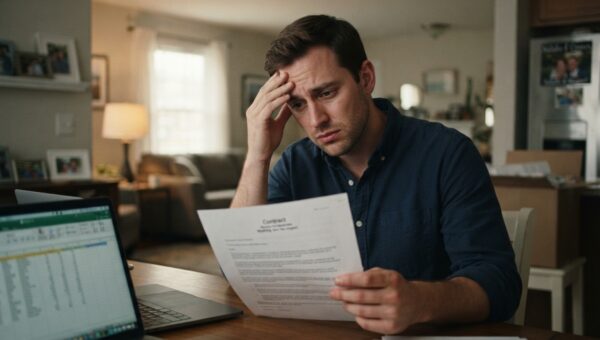
I pulled the flap open. Inside were canceled checks made out to a man named Julian Vance, drawn from an account I didn’t recognize, along with slips from the corner check-cashing place down by the grain elevators in our old neighborhood. The dates on the bottom ran back fourteen years, right up through Ethan’s college years and into his first real jobs.
I dropped the check on the green felt. “Julian Vance? Ethan hasn’t spoken to Julian Vance since he was sixteen years old. That man was mixed up in that vandalism down at the county fairgrounds, the one where the sheriff questioned half the high school track team. Ethan told us he cut him off completely.”
Clara finally looked at me then, her eyes dark and tired behind her wire-rim glasses.
“He didn’t cut him off, Henry,” she said softly.
“Then why are his checks in your lockbox?”
She reached across the table and touched my wrist, her fingers cold as lake ice. “Because he isn’t paying that person. He’s paying for what that person knows about us…”
The silence in the vault felt heavy enough to crack the concrete floor beneath our boots. I stared at her, waiting for her to smile or tell me it was some kind of terrible misunderstanding about old debts or foolish teenage loans, but her face stayed completely still.
“Start the car,” I told her, my voice sounding thin even to my own ears. “We’re going home right now.”
On the drive back, the snow started spitting against the windshield, little dry pellets that didn’t stick to the gray asphalt. Clara didn’t try to explain anything else while we were on the road. She just stared straight ahead through the wipers, clicking back and forth across the frosted glass.
When we got back to the house, she went straight to the back of the pantry, behind the surplus canned peaches and the spare sacks of flour where the old metal recipe box sat. She pulled out a thick manila folder stuffed with bank statements, handwritten notes on yellow legal pads, and photocopies of receipts that went back twice as far as the ones in the bank vault.
I sat down at the kitchen table while she laid the papers out between the salt shaker and the napkin holder.
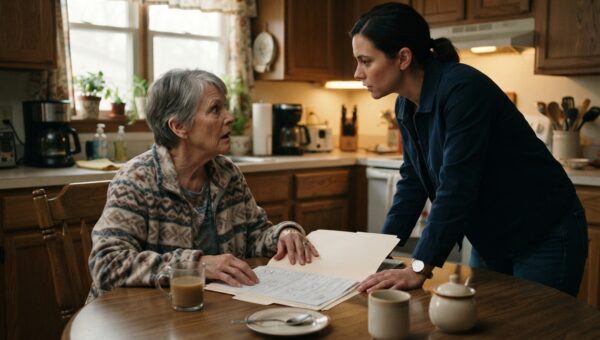
“Two years ago,” Clara began, her voice dropping into that quiet, steady tone she always used when she was tending to something broken in the garden, “I noticed an odd discrepancy in the household ledger. A sixty-dollar withdrawal from Ethan’s savings account that didn’t match his rent or his utilities out in Omaha. I called him up to ask if he was short on groceries, and he got so quiet on the other end of the line I thought the telephone had gone dead.”
She pointed a finger at a highlighted line on a bank statement from the spring of 2011.
“He didn’t want to tell me,” she continued, “so I drove out to his apartment the following weekend while he was at work. I found a receipt stuck inside the back cover of his dictionary. It was a Western Union transfer receipt made out to Julian Vance with a note attached to it. That was when I found out Julian had been bleeding him dry since the summer before he left for college.”
I looked at the numbers. Small amounts at first, fifty dollars here, a hundred there, growing larger as Ethan got older and started earning a real paycheck. Fourteen years of quiet terror wrapped up in bank routing numbers and slips of pink carbon paper.
“Why didn’t he come to us?” I slammed my hand down on the table, and the salt shaker rattled against the laminate. “We’re his parents. If someone was shaking him down, we could have gone to the sheriff. We could have put a stop to it the first week.”
Clara looked right at me, her chin coming up just a fraction. “Because of what happened the night of the county fair, Henry. And because of the boy Julian claims was in the car with Ethan when that truck went through the county fence.”
My breath caught in my throat. I hadn’t thought about that night in fifteen years. Ethan had come home at three in the morning with mud on his boots and a scrape across his forehead, swearing he had slipped while walking home from the diner. The sheriff had questioned a few kids from the track team about the truck that plowed through the drainage ditch behind the livestock barns, but nothing ever came of it. Julian Vance, who worked the late shift at the salvage yard down the road, had supposedly seen the whole thing from his tow truck.
“Julian told Ethan he had photographs and signed witness statements from another boy who ran off that night,” Clara said quietly. “Julian told him that if Ethan didn’t pay his truck insurance and his rent every month, he’d take those papers straight to the county prosecutor and see that Ethan went away to the state penitentiary instead of college. Ethan believed him. He’s believed him every single day since he was eighteen years old.”
“And you?” I asked, looking down at the pile of papers between us. “What did you do when you found out?”
“I realized Ethan was going to pay that man until he died of a heart attack or went broke,” she said, her voice dropping to a whisper. “So two years ago, I met Julian Vance behind the hardware store downtown. I told him Ethan wasn’t paying him another dime through the mail.”
I stared at her, my blood running hot and cold all at once. “You met him? Without telling me?”
“If you had known, you would have gone over there with your hunting rifle, Henry, and you would be sitting in a Lancaster jail right now instead of sitting at this table,” she said, and for the first time, her voice broke just a little bit. “I took over the payments myself so Ethan could finally breathe. I put them in that box at the bank so Julian would keep sending his demands to a secure address while I gathered every single text message, every bank deposit slip, and every recorded phone threat he left on my cell phone over the last twenty-four months.”
The kitchen was so quiet we could hear the old refrigerator compressor humming in the corner.
“He thinks he still has us on a hook,” Clara whispered, touching the corner of the manila folder. “He called me yesterday afternoon. He wants two thousand dollars by Friday or he goes straight to the prosecutor’s office with the old file.”
I stood up so fast my chair scraped hard against the linoleum. I walked over to the landline phone on the wall, picked up the receiver, and dialed our son’s number without saying another word.
Ethan picked up on the third ring. “Dad? Is everything all right? Mom usually calls on Sundays.”
“Get in your car right now,” I told him, my voice shaking so hard I could barely form the words. “Drive down here. Don’t stop for gas, don’t wait for nothing. Just get to the house.”
“Dad, what’s wrong? Is it Mom, “
“We found the box, Ethan,” I said, looking across the kitchen at Clara where she sat with her hands folded over the dark wood. “We found everything. Just get home.”
He arrived just before dark. The headlights of his sedan swept across the front porch windows, and when he walked through the back door, he didn’t look like a thirty-two-year-old manager of a warehouse. He looked like the eighteen-year-old boy who used to track mud across my clean kitchen floor after track practice.
He stopped in the doorway between the kitchen and the dining room, his jacket unzipped, his face pale and drawn. He didn’t look at me first. He looked straight at his mother sitting at the table with the manila folder open between us.
“You told him,” Ethan whispered, his voice cracking right down the middle.
“I had to, son,” Clara said softly, standing up from her chair and walking over to him. “We have to finish this. All of us together.”
Ethan didn’t pull away when she put her arms around him. He just let out a long, ragged breath that sounded like years of holding his breath underwater finally coming to an end, and he buried his face in her shoulder. “I was so scared he was going to ruin everything you guys worked for,” he choked out, his shoulders shaking. “Every time I got a promotion or thought about settling down, a letter would show up in my mailbox. I just wanted it to stop.”
“It stops tonight,” I said, walking over and putting my hand on the back of his neck. “We’re done running.”
We didn’t call the sheriff right away. Instead, we spent the next hour laying out every piece of evidence Clara had collected over the last two years, the bank records, the audio files of Julian’s voicemails stored on her phone, the dates and times of every extortion demand he had made since she took over the payments.
By nine o’clock, we had a complete file that any prosecutor in the state would look at and move on within twenty-four hours.
“He wants his two thousand dollars on Friday at the diner by the tracks,” Clara said, looking down at her notes. “He told me to bring it in cash in a brown envelope.”
“You aren’t going anywhere near that diner,” I told her. “I’m going. And I’m taking this folder with me.”
We didn’t wait until Friday. We called Jim Miller, an old friend from our church who had spent thirty years working as an investigator for the county district attorney’s office before he retired down to his farm. Jim sat at our kitchen table on Thursday morning, turning over the canceled checks and listening to the audio recordings on Clara’s phone while the coffee pot hissed in the background.
When he was done, Jim laid the phone down on the oilcloth table and let out a long whistle through his teeth.
“This isn’t just blackmail, Henry,” Jim said, shaking his head. “This is felony extortion across state lines and through banking institutions. If I take this down to the courthouse today, the DA will have a warrant signed before lunch.”
“Do it,” Ethan said from the corner of the kitchen, his voice steady for the first time all morning. “I don’t care what happens to me or that old truck incident. I’m done living like this.”
“The statute of limitations on the property damage from fourteen years ago ran out six years ago, son,” Jim told him, giving him a small, reassuring pat on the knee. “The only person going to prison today is Julian Vance.”
The arrest didn’t happen in some dramatic shootout down by the tracks. Two unmarked county cruisers pulled up outside Julian’s garage while he was under the hood of a rusted-out Ford pickup, and Jim Miller walked right up to him with the warrant in his hand while the local deputies secured the shop.
Clara, Ethan, and I stayed back at the house, sitting around the kitchen table in the quiet afternoon light. The station wagon was parked outside in the driveway, and the house smelled like fresh coffee and the lemon wax Clara used on the table every Thursday.
When the telephone finally rang around two o’clock, I picked it up on the first ring.
“It’s finished, Henry,” Jim’s voice came through the receiver over the hum of his truck engine. “We cleared out his desk. Found photocopies of Ethan’s old letters, the old witness statements, and all the rest of it. He’s locked in the back of the cruiser now on three counts of felony extortion.”
I looked across the table at Clara and Ethan. Clara let out a long breath, her shoulders dropping about three inches, and Ethan put his hand over his face for a second before looking up with something in his eyes I hadn’t seen since he was a little boy playing out in the yard.
“Thank you, Jim,” I said, and hung up the phone.
That evening, after the sun had gone down and the wind had picked up outside, rattling the loose pane in the pantry window, we didn’t turn on the television.
We carried the manila folder, the old check registers, the photocopied blackmail notes, and every last slip of paper from Clara’s safe-deposit box into the living room and laid them out in a pile right on the brick hearth in front of the fireplace.
I struck a match against the box and dropped it onto the corner of the stack.
We stood there together in the warm orange glow of the fire, watching the paper curl and turn to ash, the ink fading away into gray smoke that drifted up the chimney and out into the cold Nebraska night. Ethan stood between us, his arm resting across my shoulder and his mother’s hand held tight in his, neither of us saying a word while the fire slowly burned itself out down to the embers.