PART 1
“Please, Nana. If you tell them, Daddy will put me out like he did Aunt Deb.”
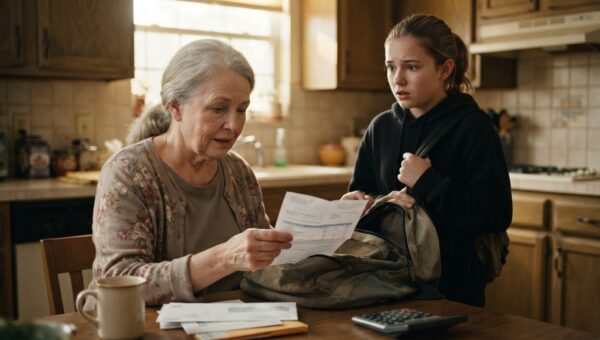
My granddaughter, Rilla, is sixteen years old. She sat at my kitchen table in New Castle, Indiana, twisting a paper napkin until it tore into tiny white ribbons on the floral placemat. She would not lift her eyes to look at the tea mug I had poured for her.
When she finally whispered the words, she told me she was ten weeks along.
Her father, my son Paul, runs a hard, churchgoing house five miles down the county road. He is an elder at the fundamental Bible chapel on the bypass, and he measures righteousness by how well people keep their heads down and follow his orders.
Thirty-two years ago, in the late autumn of 1994, Paul did the exact same thing to his own younger sister. Deb was seventeen, a senior in high school, when she brought home a boy Paul did not approve of and confessed she was expecting. Paul was twenty-one then, full of fire, and when their father had a stroke that left him unable to speak, Paul took the family Bible, stepped onto our porch, and told Deb that sin had no roof under our name. He packed her two cardboard boxes, set them on the gravel shoulder, and locked the front deadbolt.
Deb spent two nights sleeping in the locker room behind the town laundromat before an older cousin took her across the state line to Ohio. That was 1994. My daughter Deb is forty-nine years old now, lives outside Dayton, and to this day she still will not come to our table for Thanksgiving dinner.
I promised Rilla I would think on it overnight.
I did not sleep a single minute. I lay under the quilt in my front bedroom, watching the sweep of headlights from passing milk trucks cut across my ceiling plaster.
The dilemma pulled at my ribs like a pair of pliers. If I stayed quiet, I was the only soul on this earth the girl trusted, but she would be carrying a child alone, hiding doctor visits, and walking into the winter with no medical care. If I called her parents, I would break her heart, and Paul would throw her out before the sun set.
Yet a mother and father have a legal right to raise their own child, and keeping a pregnancy hidden from them felt like stealing their authority.
I am seventy-three. I live on my late husband’s small machinist pension, I have exactly $3,000 in my credit union savings account, and I have one spare bedroom that smells of lavender water and mothballs.
At six o’clock this morning, the kitchen was gray and cold. I picked up my landline receiver.
My thumb hovered over the buttons for my son’s number.
Then I looked at the little pile of torn white napkin Rilla had left on the corner of the table, and my thumb moved to a different line altogether.
PART 2
I did not dial Paul. I dialed my daughter Deb in Dayton.
I had not spoken to Deb since my sister’s funeral three years ago, when we exchanged brief, stiff greetings in the church vestibule.
The phone rang four times. When Deb answered, her voice was thick with sleep.
“Mama?” she asked. The word came out cautious and guarded. “Is something wrong with your health?”
“No, Deb,” I said, leaning both hands against the edge of the kitchen sink. “I am calling about Paul’s girl. Rilla was here last night. She is sixteen, and she is ten weeks along.”
The other end went dead silent. For five seconds, the only sound was the crackle of the long-distance connection.
“Did Paul find out?” Deb whispered. The sharpness in her voice was gone, replaced by an old, familiar tightness.
“Not yet,” I said. “Rilla sat in my kitchen shaking like a leaf. She looked at me with tears running down her cheeks and begged me not to tell her daddy because she remembers what he did to you in ninety-four. She thinks Paul will dump her suitcase on the road.”
Deb let out a shaky, bitter breath. “He will, Mama. Men like Paul don’t change because they get gray hair. He cares about his seat in that church pew more than he cares about that girl’s breath. What are you going to do?”
“I don’t know,” I said, my voice cracking. “I have three thousand dollars to my name and the spare bed. But Paul is her legal father. If I harbor her without his knowledge, he can call the county sheriff on me for interference with custody.”
“Don’t you call him alone,” Deb said firmly. “I am getting in my car right now. I will be at your house by eight-thirty.”
Deb arrived at twenty past eight in a dusty red hatchback. When she stepped through my back door, wearing an oversized winter coat and flat boots, it was the first time she had set foot in my kitchen in twelve years. She did not hug me. She looked around the yellow cupboards, saw the kettle on the stove, and set her purse on the table right next to Rilla’s shredded napkin.
“Where is Rilla right now?” Deb asked.
“She went home to get ready for school,” I told her. “She promised me she would come back here the minute the three o’clock bus drops her off at the corner.”
Deb pulled a chair out and sat. “We aren’t waiting until three o’clock, Mama. If Paul finds a doctor’s receipt or sees her getting sick in the morning, he will corner her before she gets to school. We call Paul to this table right now. But we do it with the door wide open.”
At nine o’clock, I called Paul’s cell phone. He was at his lumber dispatch office down by the railroad tracks.
“Paul,” I said, keeping my voice level. “I need you to come to my house. It is an urgent family matter.”
“Can it wait until lunch, Mom?” he asked, papers shuffling in the background. “We are loading two flatbeds for the county bridge job.”
“It cannot wait,” I said. “Be here in fifteen minutes.”
PART 3
Paul walked into my kitchen at twenty-five minutes past nine. He had his yellow safety glasses hooked to the collar of his denim work shirt, carrying a clipboard under his arm.
He took two steps past the mudroom door, saw Deb sitting at the oak table, and stopped dead.
His face went stiff. The casual, hurried expression vanished completely.
“What is she doing here?” Paul demanded, pointing the metal tip of his pen at his sister. “I thought we settled our business thirty years ago.”
“Sit down, Paul,” I said, standing by the pantry.
“I don’t have time for family reunions,” Paul snapped, turning toward the door. “If Deb wants to borrow money, she can ask the state.”
“Sit down,” Deb said.
Her voice wasn’t loud, but it had an edge like a razor on glass. She did not stand up. She kept both palms flat on the table and looked her brother straight in the eyes.
“Rilla was at this table last night, Paul,” Deb said.
Paul paused with his hand on the brass doorknob. He looked back at Deb, then at me. “What about Rilla? Her grades are fine. She was doing her geometry homework when I left this morning.”
“Rilla is sixteen years old,” Deb said, speaking slowly and clearly. “She is ten weeks pregnant. And she spent two hours crying in our mother’s lap because she is terrified that you are going to throw her out on the road like you threw me out in ninety-four.”
The clipboard slipped from Paul’s grip and clattered loudly onto the linoleum floor.
His mouth opened, but no words came out. His face flushed a dark, angry purple, from his collar all the way to his hairline.
“Who is the boy?” Paul choked out, his fists balling up at his sides. “I will go to his father’s house right now. I will have the pastor down there by noon. She has brought disgrace on my name!”
“Listen to yourself,” Deb said, standing up from the chair. “The first thing out of your mouth isn’t whether your daughter is sick, or scared, or needs a coat. The first thing out of your mouth is your church name and your pride.”
“You don’t lecture me about pride, Deborah!” Paul shouted, taking a heavy step toward the table. “You made your bed and you slept in it! I raised my children under the Word! Rilla knows what the rules are in my house! If she thinks she can live under my roof while flaunting sin in front of the congregation, she can pack her bags today!”
I stepped out from the pantry and stood directly between my two grown children.
I am five feet two inches tall. Paul towers over me by a foot. But I looked up into my son’s furious face, and for the first time since my husband died, I did not lower my eyes.
“You will not touch one button on that girl’s clothes, Paul,” I told him.
“Mom, this is my daughter,” Paul said, his voice shaking with righteous fury. “You don’t have the authority to tell me how to govern my family.”
“I have the deed to this house, Paul,” I said. “And I have three thousand dollars in the credit union. I washed your father’s work clothes for forty years, and I watched you lock that screen door on your sister when your father was too weak to lift his arm to stop you. I let you do it in nineteen ninety-four because I was a coward who was terrified of being left alone with the bills.”
The kitchen went dead quiet. The clock above the stove gave its steady, heavy tick.
“I have carried the shame of that closed door for thirty-two years, Paul,” I said, my voice dropping to a whisper that filled the room. “I will not carry it to my grave for your daughter. Rilla is moving into my spare room this afternoon. You will sign the temporary voluntary guardianship papers so I can put her on the county clinic coverage, or Deb and I will walk into the family court in Henry County tomorrow morning and tell the judge why a sixteen-year-old girl is terrified to sleep in your home.”
Paul stared at me. He looked at Deb, who was watching him with cold, unwavering certainty.
For the first time in his life, the Bible verses and the church authority failed him. He saw that the wall of family silence he had built in 1994 had finally cracked down the center.
ENDING
Paul did not shout again. He picked his clipboard up from the floor with stiff fingers, walked out the back door without buttoning his jacket, and drove away.
At one o’clock that afternoon, Paul’s wife, Brenda, came to my house alone. Brenda was crying, her eyes swollen red behind her glasses. She brought three large plastic totes of Rilla’s school clothes, her winter boots, and her geometry books. Brenda sat at my table, signed the state medical consent and temporary kinship guardianship forms without arguing, and hugged me before she left. She whispered that Paul had locked himself in his garage workshop and refused to come into the house.
When the yellow school bus stopped at the corner at three-fifteen, Rilla stepped down onto the gravel shoulder.
She walked slowly down my lane, her head down, clutching the straps of her backpack like she was walking toward an execution.
When she saw Deb’s red hatchback parked in the drive, she stopped.
I opened the kitchen storm door and stepped out onto the porch. Deb walked out behind me and stood by the railing.
Rilla looked from my face to her aunt’s face. The backpack slid off her shoulder and fell into the dry grass by the walkway.
“Nana?” she asked, her chin trembling.
“Your daddy knows, Rilla,” I told her, holding out my hands. “And your room is ready.”
The girl did not say a word. She ran up the three porch steps, buried her face into the front of my wool sweater, and sobbed so hard her whole body shook against my chest. Deb reached out, wrapping both arms around the two of us, holding the girl from the other side.
We stayed out on that cold porch for five minutes while the wind blew dry maple leaves across the yard.
Rilla is settled into my spare room now. We went to the health department clinic on Thursday morning to get her prenatal vitamins and schedule her first official ultrasound for December. I used four hundred dollars of my savings to buy her a sturdy pair of winter shoes and a warm down coat that will fit over her belly as the months turn cold.
Deb did not drive back to Dayton that night.
She stayed in town for three days, sleeping on the pull-out sofa in my front parlor. Before she left on Sunday morning, she helped me clear the dust off the cedar chest in the hallway and put a clean lace runner across the dining table.
She kissed my cheek on the porch, looked out toward the road, and said, “I’ll be here for Thanksgiving, Mama. Save three chairs.”
Paul has not called my house, and that is his choice to bear. An elder’s seat at the chapel cannot keep an old man warm when his own blood is locked out in the cold.
Yesterday evening, after supper, Rilla sat at the kitchen table doing her homework while I washed the soup bowls at the sink.
The kitchen smelled of clean dish soap, vegetable broth, and damp pine from the woods behind the shed.
Rilla looked up from her notebook, smiled shyly, and picked up a fresh linen napkin to dry the spoons.
I took the wet spoon from her hand, laid it on the towel, and tapped the chair beside me.
The house is small, the money is short, but the deadbolt is unlocked, and the porch light stays on all night.