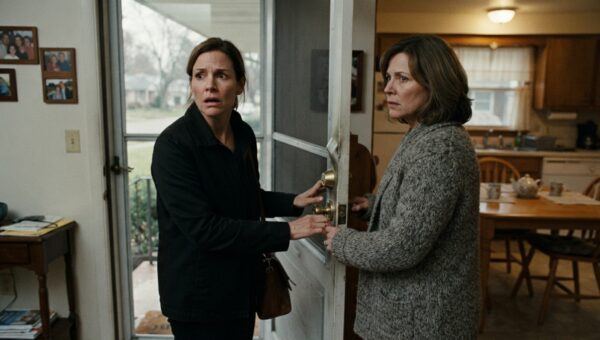
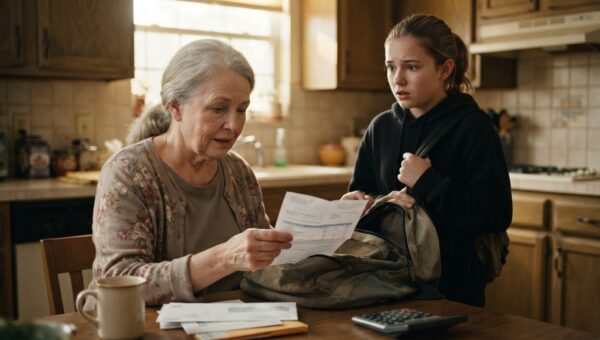
The morning sun was hitting the kitchen linoleum just right, throwing warm little squares of light across the floor while I waited for the kettle to whistle. Brenda was leaning against the counter with her travel mug, her car keys already jingling in her pocket because she always had somewhere else to be. She had come over to help me clear out the last of Arthur’s things from the spare closet, or at least that was what she called it.
“I went ahead and tossed those old cassette tapes from Dad,” Brenda said, her voice entirely too casual as she rinsed her spoon. “The deck stopped working years ago anyway. They were just taking up space in the back of the wardrobe, Mom. Nobody listens to tapes anymore.”
I stopped wiping the laminate. My hand stayed right where it was, the damp sponge growing cold against my palm. Arthur had spent hours recording those tapes during his last six months, propped up against the pillows with his old Sony handheld recorder, talking about the parish, the garden, and the way the cypress trees looked after a heavy rain. He always said he wanted Brenda to hear his voice plain someday when she was older, long after he was gone and the house was quiet.
“You threw them out?” I asked. “The whole box?”
“Every last one,” she said, not even looking up from her mug. “And the player too. It was rusted out. Honestly, Mom, you have to let go of the shrines or you are never going to move forward.”
She kissed the top of my head on her way out the screen door, her sneakers crunching on the gravel driveway before her sedan backed out toward the highway. I stood there in the empty kitchen for a long time, listening to the refrigerator hum, feeling that cold little knot settle right behind my ribs. Brenda was twenty-nine years old, sharp as a tack, and efficient enough to scare you, but she had always had this restless streak, like she was running from something she thought was chasing her.
That was two hours ago. The kettle had long since gone cold on the burner before I finally realized I needed her ice scraper out of the trunk because the weather report was calling for a hard freeze by nightfall.
The garage smelled of old lawnmower oil and sweet bay leaves drying in the rafters. Brenda’s silver sedan was parked halfway out on the concrete pad, the passenger door unlocked the way she always left it when she was in a rush. I pulled the latch on the glove compartment because her spare napkins and tire pressure gauge were always rolling around in there, and I figured I could shove the scraper underneath them.
The glove box dropped open with a dull thud.
There were no napkins. There was no tire gauge. The compartment was completely empty except for one single object sitting right in the middle of the black plastic lining.
It was an old Maxell 90-minute cassette tape, the kind with the paper label yellowing at the edges. My thumb went cold the second I touched the plastic. Arthur’s handwriting was unmistakable, blocky and slanted slightly to the left the way it always did when he was writing in a hurry. He had used a black Sharpie to write the date of our wedding right across the top edge. Below that, in smaller letters that looked like he had pressed down hard enough to tear the paper, were seven words.
Play only if she asks about the money.
I just stood there in the dim garage for a solid minute because my brain kind of stopped working. The silence in the house was nothing compared to the silence in that car. Brenda hadn’t thrown out the tapes at all. She had kept this one, hidden it away under her registration papers and insurance cards, because something on it had scared her or cornered her or made her feel the weight of her father’s eyes from the grave.
I didn’t carry the tape back inside to the kitchen. I slipped it right into my apron pocket, my fingers shaking so bad I dropped the glove box latch twice before it finally clicked shut.
***
We had lived in that house on the bayou for thirty-four years. Back when Arthur was still hauling cypress timber and working the parish roads, we didn’t have two nickels to rub together, but we had a pantry full of home-canned figs and a porch that caught the evening breeze. Brenda grew up watching us pinch every penny until it screamed. She swore up and down by the time she was sixteen that she was never going to live like that, worrying over tractor repairs and property taxes that came due right when the river flooded.
She went off to Baton Rouge for college on a partial scholarship and never really came back, not in the ways that mattered. She got her degree in accounting, started working for a firm that handled commercial real estate, and learned how to talk in terms of equity and liquidity and portfolio diversification.
“You and Dad lived too small,” she told me over Thanksgiving dinner three years ago, her fork hovering over the ham. “You worked yourselves into the ground for dirt that doesn’t even appreciate.”
Arthur hadn’t said a word at the table, just cut his turkey slow and deliberate, but I saw the way his jaw tightened. He didn’t care about appreciation or portfolios. He cared about the land staying in the family and knowing his girls were secure if the bottom ever fell out of the market.
When he got sick in the spring, Brenda was the one who took charge of the paperwork. She sat at our kitchen table with her laptop open, her glasses sliding down her nose, going through insurance riders and bank statements while Arthur lay in the hospital bed we had set up in the front parlor.
“I’ve got it all handled, Mom,” she told me one night when I was half-blind with exhaustion trying to get him to swallow his broth. “The probate stuff is straightforward. You won’t have to deal with any of the headache.”
I trusted her then. I would have trusted her with my life. But looking at that cassette in my apron pocket now, I remembered the way her eyes had darted toward the hallway closet every time Arthur mentioned the old safe in the study during his last week.
“The papers are where they need to be,” Arthur had whispered to me just three days before he passed, his hand dry and paper-light against mine. “Don’t let her rush the closing, Clara. Some things take time to grow roots.”
I didn’t know what he meant back then. I thought he was just wandering in his mind the way the dying sometimes do, mixing up his timber contracts with his worries about the farm. But standing in the cold garage with Brenda’s car keys in my hand, I understood that Arthur had seen something coming that I had been too blind to notice.
***
I didn’t have a working cassette player in the house anymore. Brenda was right about that much; the old stereo in the living room had eaten a tape back when George Bush was in office and we never replaced it. But down at the end of the road, old Mr. Henderson still ran his radio and television repair shop out of a converted tin shed behind his house, surrounded by stacked television tubes and radios that looked like wooden breadboxes.
Cal Henderson was eighty-one and moved like he was wading through molasses, but his ears were still sharp as tacks.
“Well now, Mrs. Landry,” he said, wiping his grease-stained hands on a yellow rag as I laid the Maxell tape on his scarred wooden workbench. “That’s an old one. Where’d you dig this up?”
“It was in Brenda’s car,” I said, keeping my voice level. “Cal, do you have something I can listen to this on just for five minutes? I need to know what’s on it.”
He didn’t ask any questions. People in our parish didn’t pry unless they had a reason, and Cal had known Arthur since they were boys running trotlines in the swamp. He walked over to a shelf stacked with old Panasonic boomboxes from the nineties, selected one with a dusty chrome handle, and plugged it into the wall outlet by his soldering station.
The tape made a dry, mechanical clatter as he pushed the plastic door shut and hit play.
For a second there was just the hiss of old magnetic ribbon rubbing against the head, that familiar white noise of a Sunday afternoon in the nineties. Then Arthur’s voice came out of the tinny little speaker, sounding so close and real I almost turned around to see if he was standing behind me by the door.
“Clara, if you’re hearing this, it means I’m gone and Brenda’s already started asking about the timber trust,” Arthur’s voice said. He sounded tired, but steady, the way he always did when he was explaining why we had to patch the roof ourselves instead of hiring it out. “I didn’t leave her out of the will, you know that. But I put a five-year hold on the primary distribution. Not because I don’t trust her intelligence. I trust her brain too much. She thinks money is just numbers on a screen that you can move around to make a problem go away.”
Cal kept his eyes fixed down on his workbench, pretending very hard to inspect a vacuum tube he was holding, but his knuckles went white against the glass.
“She found the second lockbox behind the cedar chest last Tuesday,” the tape continued, Arthur pausing to catch his breath, a faint wet rattle in his chest that made my throat close up. “Tried to get me to sign the release early so she could buy into some commercial strip in Lafayette. When I said no, she looked at me like I was a stranger. If she’s listening to this now, it means she went looking for the rest of it behind my back. Don’t let her take the homestead, Clara. That land was my father’s and his father’s before him. It’s the only thing we got that can’t be bought off with a wire transfer.”
The tape clicked off with a sharp metallic snap.
The tin shed was so quiet I could hear the compressor on Cal’s drink cooler humming in the corner. Cal slowly set the vacuum tube down on a folded piece of flannel.
“Arthur always was a stubborn man about the land,” Cal said softly, not looking up. “And Brenda, well. She’s got her grandfather’s ambition, for better or worse. That man on her mother’s side lost everything in the oil crash back in eighty-six. I reckon Brenda’s spent her whole life terrified of ending up back where we started.”
“She didn’t inherit the land, Cal,” I said, and my own voice sounded small and strange in my ears. “The trust was supposed to be split between us for the maintenance, but she had the papers drawn up three weeks ago for my signature. She told me it was just a routine tax waiver.”
Cal reached out and tapped the stop button on the player with one finger. “Well, Clara. Sounds like you got some talking to do before the sun goes down.”
***
I drove back home with the cassette sitting in the passenger seat right on top of my purse, staring up at me like a small black brick. By the time I pulled into the driveway, Brenda’s silver car was back in its spot, her driver-side door standing open as she carried a box of old tax folders up the porch steps.
She stopped when she saw me get out of the Buick. She didn’t look mad; she looked cornered, the way she used to look when she was twelve and we caught her sneaking out to go to the parish fair after she was told no.
“Mom,” she said, her voice dropping down into that professional register she used at the firm. “Where were you? I came back to finish the filing and you were gone.”
I walked up the steps past her, carrying my purse with the tape inside, and pushed the front door open. “Come inside, Brenda. Close the door behind you.”
She followed me into the kitchen, dropping the cardboard box onto the laminate table with a hollow thud. “What is this about? I have a conference call with the Lafayette developers in an hour, Mom. I really don’t have time for a lecture about the closets.”
I didn’t answer right away. I walked over to the counter, pulled the portable cassette player Cal had lent me out of my bag, and set it right next to her box of folders. Then I reached into my apron pocket, took out the Maxell tape, and laid it down beside the machine.
Brenda stopped breathing. I could see it in the way her chest stayed frozen under her linen blouse, her eyes fixed on that faded yellow label with Arthur’s handwriting.
“You said you threw them all out,” I said, my voice barely above a whisper. “You said the player was rusted out and the tapes were just junk.”
“Mom, I, “
“You lied to me, Brenda.”
“They *were* junk,” she said, her voice rising that sharp, defensive octave she used whenever she felt like she was losing control of a room. “Dad was living in the past! He didn’t understand how the modern world works. That trust fund is sitting there doing nothing while real opportunities are passing us by. Inflation is eating that money alive every single day while you sit here canning figs in a kitchen that hasn’t been updated since 1994!”
“He knew you were going to try to take it,” I said.
The words just hung there between us in the warm kitchen air, heavy and solid as a sack of feed.
Brenda’s face went very still. All the practiced corporate confidence drained right out of her, leaving her looking small and tired, the way she used to look when she scraped her knee riding her bike down the gravel road.
“He didn’t trust me,” she whispered, and for the first time in years, I heard the little girl underneath all the accounting degrees and the smart clothes. “He thought I was just like her grandfather. He thought I’d sell the place off the second his eyes closed.”
“He knew you loved shortcuts,” I said softly, stepping closer to the table. “He loved you enough to put a lock on the door so you wouldn’t run right off the edge of the cliff before you learned how to stand on your own two feet.”
She reached out with one trembling hand and touched the edge of the cassette, her finger tracing the wedding date Arthur had written down thirty-odd years ago. “He wouldn’t even talk to me about the Lafayette property,” she said, her voice cracking just a little bit at the end. “He just kept saying roots mattered more than branches.”
“And he was right,” I said.
Nobody said anything for a second after that, and honestly that felt worse than the shouting. The refrigerator clicked on, filling the kitchen with its low, steady rumble. Brenda looked down at the tape, then over at the framed photograph of our wedding day hanging by the pantry door, the one where Arthur looked so young in his narrow wool suit, with me holding a bouquet of wild sweet peas we picked ourselves down by the creek.
She didn’t pick up her phone. She didn’t mention her conference call with the developers in Lafayette. She just pulled out one of the metal kitchen chairs and sat down slow, her hands folded in her lap, looking at the little black box on the table between us.
“I didn’t throw the rest of them out,” she admitted finally, her voice so quiet I almost missed it. “They’re in the back of my storage unit in town. I couldn’t bring myself to put them in the dumpster. I just… I didn’t want to hear him being right.”
“He’s still right, honey,” I said, pulling out the chair across from her and sitting down so our eyes were level. “And we’re going to go down to the lawyer’s office tomorrow morning and fix those papers you had me sign. Not because we’re going to fight, but because we’re going to do it the way your father wanted it done.”
Brenda let out a long, ragged breath that sounded like she had been holding it since the day her father died. She reached across the corner of the table and touched my hand, her fingers cold against my skin.
“Okay,” she whispered. “Okay, Mom.”
The cassette stayed right there on the table between us, resting beside the salt shaker and the napkin holder, its warning message accepted not as a threat, but as a final act of paternal guidance that cleared the air at last.