We kept our money separate after Arthur lost fourteen thousand two hundred dollars in a timber venture that went under down in Forsyth County, and I thought we were just being sensible. After that kind of hit, you don’t argue with caution. We set up our own checking accounts, split the grocery bills down the middle with a green ledger book that stayed on the corner of the microwave, and stopped talking about retirement portfolios like they were something we shared.
I thought that meant we were protecting ourselves. I thought we were just being careful.
Then our daughter called on a rainy Thursday afternoon while I was wiping down the kitchen counters with a damp sponge. “Mom, did something happen with Dad’s account?” she asked, her voice sounding thin through the speakerphone while she drove her truck back from the feed store. “He stopped paying the electric bill at the little house I rent from you guys, and the power company sent a pink slip to my box.” I stopped wiping, the sponge dripping soapy water onto the laminate. Arthur managed the rental property accounts because he liked handling the small details of our properties, or so he had always told me. “That’s not right,” I said, looking out the kitchen window at the wet cedar branches hitting the glass. “He should have transferred it on the first like always.”
I called him on his cell phone while the rain picked up against the panes, drumming a steady, heavy beat that matched the little knot tightening right behind my ribs. Arthur answered on the third ring, sounding distracted over the roar of his truck engine as he drove back from the lumber yard. I asked him straight out why the electric payment hadn’t gone through for our daughter’s place. “Don’t worry about it, Martha,” he said, his voice flat and dismissive in that way that usually meant he didn’t want me asking questions. “I’ve been covering it from my own account for months anyway.” I stood there holding the phone, staring at the little green ledger book by the microwave. “Your account?” I asked. “Why would you pay her rent utilities out of your personal side instead of the joint rental fund?” He didn’t answer right away, just made some noise about being busy in traffic and hung up before I could ask another thing.
That evening, the mail carrier dropped off the usual handful of circulars and bills while Arthur was still out at the hardware store. I was standing by the kitchen island sorting through the envelopes when I saw it. It was a second utility notice, but the name on the service line wasn’t our daughter’s name, and it wasn’t our home address on County Road 12 either. It was addressed to Arthur, c/o a street number on Industrial Avenue down by the old rail spur, a rundown brick block near the grain elevators where nobody lived anymore. I turned the blue paper over in my hand, running my thumb along the perforated edge. I didn’t even know we owned anything down on Industrial Avenue.
Arthur came home twenty minutes later, shaking the rain off his canvas jacket and setting a bag of galvanized nails on the floor by the door. He looked tired in that gray, worn-out way men get when they’ve spent all day lifting heavy timber in the damp air. “The hardware store was out of the three-inch ones,” he muttered, hanging his coat on the peg by the basement door.
I didn’t say anything about the nails. I just laid the blue utility notice flat on the laminate table right under the pendant light, smoothing it out with the palm of my hand so the address stared right up at him. “What’s Industrial Avenue, Arthur?” I asked. My voice sounded smaller than I wanted it to, quiet and flat in the empty kitchen.
He stopped taking off his work boots, one hand still gripping the heel of his left boot. He didn’t look at the paper at first. He just looked at the wall above the toaster, his jaw working slowly from side to side the way it always did when he was trying to figure out how to lie his way out of a corner. “Where did you get that?” he asked. “It came in the mail today,” I told him, not moving my hand from the table. “Along with the call from our daughter about her electric bill that you claim you’ve been covering from your personal account for months. Except your personal account shouldn’t have enough spare cash to cover two different properties unless you’ve been hiding something from me ever since the Forsyth County loss.”
He let go of his boot and stood up straight, his shoulders rounding under his flannel shirt. “It’s an investment, Martha,” he said, and his voice had that defensive edge that always made my stomach turn over. “It’s a little commercial workshop with an old loft apartment upstairs. I bought it last spring using some savings I had put aside and a small private note.” I stared at him across the table, the kitchen suddenly feeling very quiet except for the hum of the refrigerator in the corner. “You bought a commercial building?” I asked. “On Industrial Avenue? With what money, Arthur? You told me every cent of your savings went down when that timber mill failed.”
He walked over to the counter and reached for the coffee pot, but it was empty, just a few dark drops left in the bottom of the glass carafe. “I didn’t lose everything in Forsyth County,” he said, keeping his back to me. “I kept back a small buffer. And I took out a high-interest private loan using our old machinery as collateral. I wanted to prove I could still build something, okay? I wanted a place of my own where I didn’t have to answer to anyone about every dollar I spent.” I looked at his back, at the way his gray hair was thinning at the crown, and I thought about the green ledger book sitting right beside the microwave. We had agreed to keep our finances separate to keep the peace, to keep from tearing each other apart over past mistakes, and all the while he had been siphoning household operational funds, including the small bills from our daughter’s rental, into a rotting brick building down by the tracks.
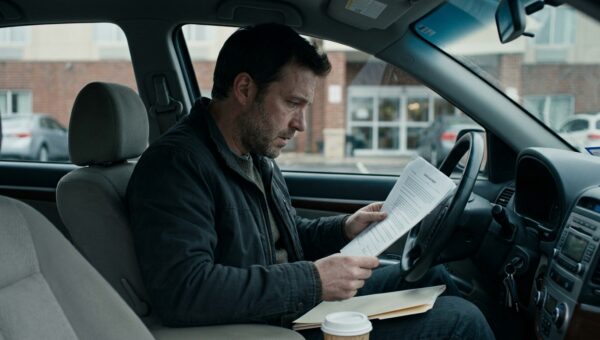
“You took out a loan against our machinery?” I asked, and my voice finally broke through the quiet. “You put our livelihood at risk for a junk building on the industrial edge of town?” He turned around then, his face red and tight with stubborn pride. “It’s not junk,” he said. “It’s an asset. It’s for our future.” I reached into my apron pocket and pulled out the printout I had pulled from the county online property portal while I waited for him to come home, showing the deed transfer date matching the exact month he claimed we needed to tighten our belts and separate our accounts. I laid it right on top of the utility notice. “You lied to me every single day for seven months,” I said. “You let me think we were barely scraping by on groceries while you were paying off a secret mortgage behind my back.”
He didn’t try to pick up the papers. He just looked down at them, his hands shoved deep into his front pockets, his shoulders dropping another inch. The anger went out of him all at once, leaving just that tired, heavy defeat that looked older than our marriage. We didn’t scream at each other. There was no shouting, no throwing things across the room. We just sat down at opposite sides of the laminate table as the kitchen grew dark outside the window, the rain finally turning to a cold, steady drizzle against the glass. He knew he had crossed a line he couldn’t talk his way back across. He knew the separate accounts weren’t about safety anymore; they were about walls he built to keep me out.
The next morning, the sun came up pale and cold over the wet grass, throwing long thin stripes of light across the kitchen floor. Arthur didn’t make coffee. He sat at the table with a pen in his hand and the real estate listing agreement spread out in front of him, the papers crinkling every time his hand shook. The unknown property was going on the market to clear the hidden loan and protect our joint retirement before it dragged us both under. He signed his name at the bottom of the page, the ink scratching loud and sharp in the quiet room, and then he stood up without a word to go meet the agent down at the office. The empty, signed listing agreement rested on the kitchen table beside two cups of cold coffee, while the morning sun hit the front door as he left.