PART 1
My sister, Elaine, took our mother’s three-bedroom brick house, her low-mileage Buick sedan, and the entire $260,000 balance in her primary savings account. When the probate forms were signed and the front door locks were rekeyed, Elaine pointed to an old high-back rocking chair sitting on the porch gravel.
“You can take that with you, Nora,” Elaine said, tossing her hair over her shoulder. “You always liked old junk anyway.”
The chair was a scarred maple rocker with worn varnish along the arms and a split in the left back spindle. Mother had sat in that exact chair every single evening for fourteen years, ever since our father died of a heart attack in 2010. She would sit by the side window knitting wool blankets, watching the evening doves peck at the gravel driveway.
I took the chair. I loaded it into the back of my small hatchback, tied the trunk down with a piece of yellow rope, and drove it home to my small apartment across the county line. I didn’t keep it out of spite. I kept it because the faded calico seat cushion still smelled faintly of her lavender soap.
For three months, the rocker sat in the corner of my small dining room. Whenever I walked past it, I felt that dull, hollow ache of being pushed out. While Mother had grown frail over her last two years, I was the one who drove the forty miles twice a week to clean her bathroom, scrub her stove, and bring her groceries. Elaine lived ten minutes down the state highway, but she only dropped by when Mother needed papers taken to the bank. Yet, three weeks before Mother passed away in hospice, Elaine produced a signed power of attorney and a revised transfer-on-death deed that gave her every stick of real property and the full $260,000 bank ledger.
Last Tuesday, the front right rocker rail gave a loud pop when I sat down to read the morning paper.
I didn’t want to throw the chair away, so I called an elderly woodworker named Thomas who ran a small furniture repair shop in an alley behind the feed mill. Thomas took one look at the split wood, ran his calloused thumb over the joint, and said the main seat frame had pulled loose from the dowels.
He laid the rocker upside down across two padded sawhorses, unscrewed the worn corner brackets, and tapped the bottom crossbar with a rubber mallet.
The heavy pine bottom panel didn’t just slide off; it dropped two inches, revealing a hollow cavity gouged into the thick maple seat block.
Thomas stopped his mallet mid-air. He looked at me, then pointed his screwdriver toward the opening.
Tucked neatly inside the hidden recess were four thick bundles of hundred-dollar bills bound with postal rubber bands, and a folded sheet of blue lined writing paper.
We counted the cash right on his clean workbench while the shop radio hummed in the background. Exactly $82,000 in clean, sequential hundred-dollar bills.
The folded blue paper was dated October 18, exactly six days before Mother drew her last breath in room 204 at the county care center.
I took the money and the letter home, spread the blue paper out on my kitchen table under the overhead bulb, and dialed Elaine’s number.
She picked up on the third ring, her voice clipped and impatient.
“Nora? What is it? I’m in the middle of meeting with the painter for Mom’s hallway.”
“Elaine,” I said, my voice shaking so hard I had to rest my forearm on the table. “I found something inside Mother’s rocking chair.”
Elaine let out a short, dry laugh through the receiver.
“Don’t start with me, Nora,” she said. “The estate is closed. Mom didn’t leave you anything.”
I looked down at the letter. Mother’s handwriting was uneven from her arthritis, but every single letter was sharp and deliberate.
“I’m reading the letter right now, Elaine,” I told her.
“Go ahead and read your little fantasy,” she snapped.
“The first line says: ‘Elaine, if your sister is reading this, she has already taken what she thought was left, and you are holding an empty house.'”
Elaine went dead quiet on the line.
I read the next two lines aloud: “‘The $260,000 in my First Valley savings was not my money to give; it was pledged as collateral against the commercial warehouse loan your father signed in 2008. If you want the truth about what you stole, Elaine, look behind the chair’s back cushion.'”
PART 2
The phone line stayed so quiet for six seconds that I thought Elaine had hung up.
“What warehouse loan?” Elaine’s voice came back, thin and shrill, stripped of all that easy arrogance she had carried since the funeral. “Dad’s equipment business closed twelve years ago. The bank cleared everything.”
“Mother wrote the account number right here on line four,” I said, reading the numbers off the blue paper. “First Valley Commercial, note ending in 4109. She says the bank renewal had a mandatory payoff provision upon her death. The $260,000 you swept into your personal checking three weeks ago was encumbered by a registered commercial lien.”
“You’re lying to get money out of me!” Elaine shouted, her breath rattling against the receiver. “You’re sitting in your apartment making up stories because you got stuck with an old chair!”
“Come over and look at the paper yourself, Elaine,” I told her. “Or call First Valley tomorrow morning. But before you do that, you might want to know what was hidden behind the seat cushion.”
I hung up the phone.
Thomas had already helped me examine the rest of the chair before I left his shop. Tucked flat between the horsehair stuffing and the back burlap lining was an official manila envelope from the county recorder’s office, sealed with red wax tape.
Inside that envelope was a certified title search and a second promissory note dated four months before Mother passed away.
Thirty minutes later, gravel sprayed against the side of my apartment building. A car door slammed with enough force to rattle my living room window.
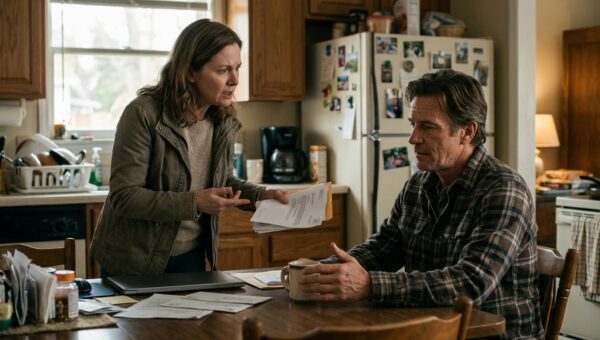
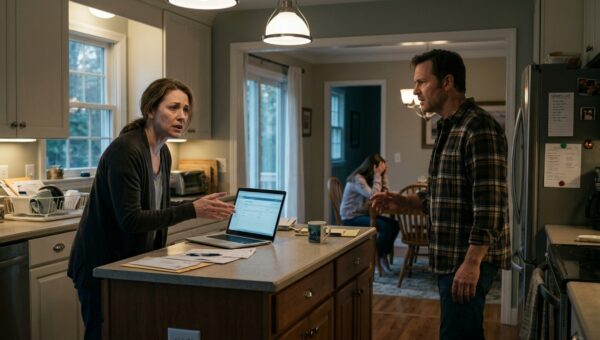
Elaine didn’t bother knocking. She twisted my front doorknob, found it unlocked, and marched straight into my kitchen with her coat unbuttoned and her purse swinging from her elbow.
“Where is it?” she demanded, her eyes darting across my counter, stopping on the four stacks of banded cash sitting next to the blue letter.
Her mouth fell open. Her fingers reached out toward the money like a magnet, but I stepped in front of the table, placing both hands flat on the wood.
“Don’t touch it, Elaine,” I said.
“That’s Mom’s money!” she gasped, her face flushing dark red. “That came out of her house! Everything in that house was deeded to me under the transfer agreement! That is my eighty-two thousand dollars!”
“This money was never in the house,” I told her. “This was Mother’s private survivor settlement from Dad’s union life policy in 2011. She cashed the check at the downtown branch, brought the bills home, and had Thomas’s father build this false bottom into her rocker thirteen years ago. She lived on her social security check and left this untouched for one reason.”
“Give it to me, Nora,” Elaine hissed, taking a step closer, her voice shaking with rage. “I have a contractor putting twelve thousand dollars of hardwood into the living room right now. The property taxes on the brick house are due on Friday, and the bank called me this afternoon saying my personal account has an administrative freeze!”
The puzzle pieces fell into line right in front of me.
Elaine had not called the bank out of curiosity. The bank had already found her.
PART 3
“The freeze isn’t an error, is it, Elaine?” I asked, looking her dead in the eye.
Elaine backed up half an inch, her fingers clutching the leather strap of her purse until her knuckles turned white.
“First Valley sent a notice yesterday,” she muttered, looking away toward my kitchen sink. “They said the $260,000 was flagged under an outstanding commercial cross-collateralization clause. They gave me five business days to either surrender the funds or they would place an immediate foreclosure lien against the brick house to satisfy the remaining balance on Dad’s old machine shop.”
“And you thought the house was free and clear,” I said.
“Mom told me it was!” Elaine cried out, tears of frustration finally cutting through her makeup. “She told me she had enough in savings to cover everything! She signed the papers! She looked at me from that hospice bed and signed the deed transfer right in front of the notary!”
“She signed it because you stood over her bed every single day for two weeks, telling her that if she didn’t put your name on the deed, you would put her in the county ward,” I said.
Elaine flinched as if I had raised a hand to her.
“I read Mother’s letter, Elaine,” I said. I picked up the blue lined sheet from the table and held it up between us.
“Listen to what she wrote on the back page,” I continued.
“‘To my daughter Elaine: You spent two years treating my home like a showroom and my savings like your private wage. You brought legal forms to my bedside when I was too weak to lift my water glass, and you told the nurses your sister was trying to rob me. I gave you the house and the bank account because I knew your greed would blind you to the liens your father left behind. You wanted the shell, Elaine. So I gave you the shell. The pearl belongs to the daughter who washed my feet and sat with me in the dark.'”
Elaine stared at the letter, her chest heaving under her wool coat.
“She set me up,” Elaine whispered, her voice dropping into pure disbelief. “My own mother laid a trap for me.”
“Mother didn’t set you up, Elaine,” I told her. “Mother just let you have exactly what you demanded. You wanted everything you could see. You took the brick, the car, and the bank ledger. You didn’t care about the woman who sat in this chair every evening for fourteen years. You thought the chair was junk because it had worn arms and a chipped spindle.”
Elaine lunged forward, grabbing the corner of the top cash bundle.
“I need forty thousand dollars of this, Nora!” she screamed, her voice cracking. “If I don’t give the bank forty thousand dollars by Friday, they will file the lis pendens on Maple Street! I will lose the house, my credit will be destroyed, and the contractor will sue me for breach!”
I grabbed her wrist, not hard, but firm enough that she stopped pulling.
“Let go of the money, Elaine,” I said.
She looked at my face. For thirty years, I had been the sister who gave in, the one who took the smaller bedroom, the one who took the night shifts so Elaine could go to her social dinners. But the woman standing in my kitchen was not the timid girl who backed down to keep the peace.
Elaine’s fingers slowly slipped off the green paper band.
“You’re going to let them take the family home?” she whispered.
“It stopped being our family home the day you locked me out of it,” I said.
ENDING
Elaine left my apartment without another word, her heels clicking fast and erratic