PART 1
The package arrived on a Friday afternoon in a battered cardboard box padded with crumpled supermarket flyers. Inside was a heavy oval stoneware casserole dish with blue cornflowers painted along the rim. It was the exact dish my mother used for Sunday potluck scalloped potatoes thirty years ago, right down to the tiny chip on the left handle where my brother dropped it when he was ten.
My brother, Nathan, had married Claire six months ago in a small courthouse ceremony, followed by an anniversary celebration last weekend that I intentionally skipped. Nathan and I had not spoken since Thanksgiving. The last time we sat in the same room, he asked me to cosign a $25,000 personal signature loan so he could consolidate his credit cards, and he walked out of my kitchen when I told him my postal clerk pension could not take the risk.
I set the dish on my kitchen counter, thinking Claire had sent it as a quiet peace offering to smooth things over after I sent my regrets for their party.
Then I lifted the glass lid.
Taped flat against the inside rim was a yellow index card with neat, cramped handwriting in pencil: *Please tell him what you promised. The sheriff came by yesterday.*
I stared at the pencil marks. I had not promised Nathan a single dime.
I had not promised him a phone call, a loan, or a favor. I had not laid eyes on my brother in five months.
I picked up my phone and dialed the cell number Claire had written on their wedding announcement last fall. It rang six times before someone picked up with a sharp intake of breath.
“Claire?” I said. “This is Nathan’s sister, Laura. I got the box you mailed.”
The line went dead silent for four seconds. When she spoke, her voice was so low and thin I had to press the receiver hard against my ear.
“I cannot talk on this line, Laura,” she whispered. Her voice trembled like she was shivering in the dark. “He has the phone account linked to his work tablet. Please, you have to come out here before he finishes his shift at five.”
“Claire, what is this note about?” I asked. “I never made Nathan any promise.”
“He told me you did,” she said, her breath catching. “He told me you had the papers from your parents.
If you do not come, the county is going to lock the gate on Monday morning.”
“Where are you living?” I asked. “Nathan never gave me your new address.”
She rattled off a street number and a road name: 412 Sycamore Creek Road.
My knuckles tightened around the phone until the plastic creaked. 412 Sycamore Creek Road was not an apartment complex or a rented duplex on the bypass. It was the white split-level house on two acres where Nathan and I grew up.
Our parents had sold that property seven years ago to pay for Dad’s final rounds of chemotherapy before he passed in 2019. Mom had moved into a small senior cottage in town, and a retired couple named the Hendersons had bought the place for cash at the county title office.
“Claire, that is impossible,” I told her. “Our family does not own that house. My parents sold Sycamore Creek years ago.”
“We live here, Laura,” she whispered, her voice cracking into tears. “We have been here since November. Please hurry. The porch light is on.”
The line went dead.
I stood in my hallway for two minutes with my car keys already in my hand. I told myself it was another one of Nathan’s elaborate traps, another scheme to get me in a room where he could wear me down until I wrote a check to make the shouting stop. But Claire had sounded genuinely terrified, and the chip on that blue casserole lid was real.
I put on my denim jacket, got into my ten-year-old sedan, and drove the twelve miles out toward the county line.
The sun was dropping behind the ridge when I turned down the narrow gravel lane. The old gravel was just as I remembered it, washed out by the spring rains and shaded by the same heavy white oaks Dad had trimmed every autumn.
At the end of the lane sat the house.
The wooden front porch sagged two inches to the left, the white clapboard siding was peeling near the gutters, and in the front yard, where Mom used to grow her prize marigolds, the grass was knee-high and choked with yellow dandelion heads.
Parked beside the rusted swing set was Claire’s little green compact car.
Above the front steps, glowing faint and amber against the evening gray, the yellow bug light my father installed in 1984 was burning bright.
PART 2
I climbed the three wooden steps. The porch boards groaned under my shoes with the same low, hollow squeak I had known since childhood.
Before I could reach for the brass knocker, the storm door unlatched from the inside.
Claire stood in the doorway. She was thirty-two, thin, with dark circles under her eyes that made her look ten years older than she had on her wedding day. She was wearing an oversized wool cardigan with frayed cuffs, clutching a manila file folder against her stomach.
“Come in quickly,” she said, pulling me by the sleeve into the living room. “He gets off at the distribution warehouse at four-thirty. If traffic is light, he will be in the driveway in twenty-five minutes.”
The front room felt freezing. The radiator in the corner was cold to the touch, and the room smelled like damp wood, old wallpaper, and kerosene. There was almost no furniture, just a faded corduroy sofa, a milk crate holding a small lamp, and three cardboard moving boxes taped shut against the wall.
“Claire, what is happening here?” I asked. “How are you living in this house?”
She opened the manila folder on top of the milk crate.
“Nathan told me this was his family inheritance,” Claire said, her voice shaking. “When we started dating last year, he drove me out here. He told me his parents left the property to both of you in equal shares, but that you lived in town because you hated the country.”
“Our parents died with nothing, Claire,” I said, looking around the bare room. “Dad’s cancer bills wiped out his union pension. Mom lived on Social Security until her stroke four years ago. We sold this house to Mr. and Mrs. Henderson in 2017 for $160,000 to keep Dad out of county welfare debt.”
“I know that now,” Claire whispered.
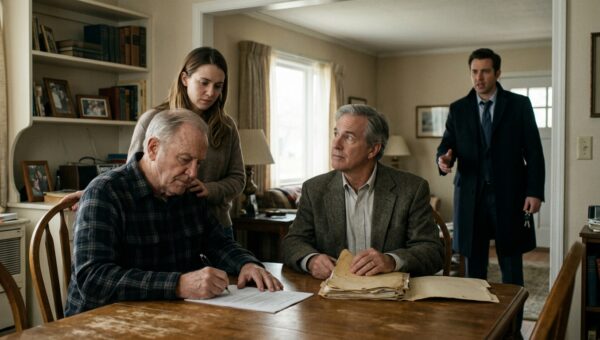
She pulled a folded legal document from the folder and handed it to me.
It was a five-year contract for deed, dated October 14 of last year, between Harold Henderson and Nathan Vance.
Nathan had not inherited the house. He had tracked down Mr. Henderson after Mrs. Henderson passed away in a nursing facility last fall. Harold Henderson was eighty-four, living with his daughter in Florida, and eager to unload the maintenance on the empty rural property. Nathan had talked the old man into a private land installment contract: five thousand dollars down, with monthly payments of $1,200, and a mandatory balloon payoff of $110,000 due exactly six months later, on April 15.
Last Monday. The day of their anniversary party.
Stapled to the back of the land contract was a formal notice of forfeiture and immediate eviction from the county sheriff, dated three days ago.
“He told me you had the family trust money, Laura,” Claire said, tears spilling over her cheeks. “He said your mother set aside $110,000 in a municipal bond fund specifically to buy this house back for him when he got married. He swore to me that the only reason you didn’t pay it at Christmas was because you wanted to hand him the deed as an anniversary gift.”
The sickness hit my stomach. Nathan had spent six months playing the proud country landowner for his new bride, promising her a family legacy, while sitting on a ticking financial clock he had no way of stopping.
“Did you give him money for this, Claire?” I asked.
Claire dropped her head into her hands. “Ten thousand dollars. It was every dollar my grandmother left me in her credit union account. Nathan told me he needed it for the closing fees and the county property tax transfer. He promised me on our wedding day that we would own this land free and clear by spring.”
I turned the page over. Tucked into the back of the sheriff’s notice was an application for a commercial bridge loan from a private hard-money lender in the county seat.
On page four, under the secondary guarantor line, was my name: Laura Vance.
Beneath it was my forged signature, written in dark blue ballpoint pen, along with my home address on Elm Street and my Social Security number, which Nathan had pulled from our mother’s old probate files.
Nathan had submitted the loan packet last week, trying to borrow $110,000 against my name to pay off Harold Henderson before Claire found out the house was never his.
“The lender called our house yesterday morning,” Claire whispered. “A man named Miller. He asked to speak with Laura Vance to verify her municipal pension income. Nathan was at work, so I answered the phone. When Mr. Miller told me what the loan was for, the whole floor fell out from under me.”
Just then, the crunch of heavy tires on gravel echoed down the lane.
Twin beams of headlights swept across the living room ceiling through the bare front windows.
“He’s here,” Claire gasped, grabbing my arm. “Laura, please don’t leave me alone with him.”
PART 3
A truck door slammed outside. Heavy boots came up the wooden steps, fast and uneven.
The front storm door flew open with a bang against the siding.
Nathan walked in wearing his reflective warehouse jacket, his ballcap pulled low, carrying a plastic grocery bag with two frozen dinners.
When his eyes hit me standing beside Claire in the center of the bare living room, he stopped dead in his tracks. The grocery bag slipped from his fingers, hitting the floorboards with a dull thud.
“Laura?” he said. His voice was rough, defensive right out of the gate. “What are you doing in my house?”
“This isn’t your house, Nathan,” I said. My voice was completely steady. “It never was.”
Nathan’s eyes darted from my face down to the manila folder in my hands, then over to Claire, who was backed against the wall by the cold radiator.
The defensive posture he always used when he was cornered flared across his face. He took off his cap and pointed it directly at Claire.
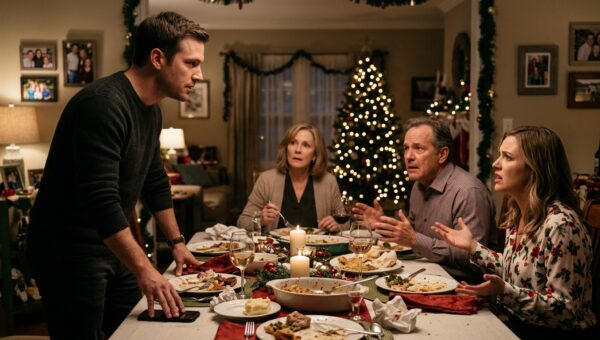
“You called her?” Nathan yelled, his face turning an ugly, mottled red. “After I told you to stay out of my business? I told you I was handling the paperwork with the bank!”
“You didn’t handle anything, Nathan!” Claire shouted back, her voice breaking through the room. “You forged your sister’s name on a hundred-and-ten-thousand-dollar loan! You stole my grandmother’s ten thousand dollars! The sheriff is coming back on Monday to padlocked the doors!”
“Shut up, Claire!” Nathan roared, taking two steps toward her. “You don’t understand how real estate works! You have to leverage assets to build equity! I was protecting our future!”
“Take your hands off her, Nathan,” I said, stepping directly between them.
Nathan stopped. He looked at me, his chest heaving under his work jacket. He was forty-six years old, but in the dim yellow light of our childhood living room, he looked like the same sullen, entitled boy who used to kick holes in the drywall whenever Dad told him he had to earn his own truck payments.
“You always had to ruin everything, Laura,” Nathan sneered, leaning his face close to mine. “You got Mom’s good jewelry. You got her silver tea set. You got the easy desk job at the post office while I’ve been breaking my back on concrete floors for twenty years. Mom and Dad owed me this house! They gave you everything, and they sold my birthright to pay for Dad’s hospital beds!”
“Mom and Dad gave me their debts, Nathan,” I told him, looking him straight in the eyes. “I spent four years paying off the balance on Mom’s hospice care out of my postal pay. You didn’t even show up to help carry her cedar chest out of the cottage because you said the drive from the city was too long.”
“You have the credit score, Laura!” he pleaded, his voice shifting in a single second from rage to that whiny, desperate tone he used whenever the repo man was in his yard. “The lender is ready to fund the $110,000 on Monday morning. All they need is your verbal confirmation on the phone! You don’t even have to write a check! The house has equity! Harold Henderson will sign the deed over to us, and I’ll pay the monthly note from my warehouse checks! We can keep the family home!”
“You haven’t paid Harold Henderson since January, Nathan,” I said, holding up the sheriff’s forfeiture notice. “The balance on this contract isn’t just $110,000. There are seven thousand dollars in unpaid property taxes, four thousand dollars in late penalties, and Harold Henderson’s daughter has already retained an attorney to clear the title.”
Nathan swallowed hard. His jaw twitched, but he had run out of lies.
“If that lender calls me on Monday, Nathan, I am telling them the truth,” I said. “I am telling them that my signature was forged, that I am not a guarantor on this property, and that you do not own the land you are trying to pledge as collateral.”
“They will arrest me, Laura!” Nathan screamed, his hands grabbing his hair. “That is felony wire fraud! You would send your own brother to prison over an old house?”
“You sent your own wife a fake life,” I said. “You brought her out to this cold, empty shell, took her savings, and told her that your dead parents left her a home. You did this to yourself.”
I turned to Claire.
“Claire, go get your suitcase,” I told her.