Seven months. That was how long Gene and I had been putting away twenty dollars here and fifty dollars there into the old tin coffee can in the pantry, just so we could drive our little sedan out to Bakersfield and hold our first grandchild for the very first time.
We weren’t rich people. Gene worked thirty-eight years down at the municipal water yard before his knees finally gave out, and I spent my mornings cleaning rooms at the Best Western off Highway 99 until my shoulder started clicking like a cheap watch.
Every time we got close to our target, though, Chloe would find some reason to move the goalposts. First it was a pediatrician appointment that got rescheduled, then it was a plumbing leak in her laundry room, and then she just stopped answering Gene’s texts for three whole weeks until he was nearly sick with worry.
Dad used to let us stay after closing and pick one small item from shelves, Gene would always say whenever he talked about his old man’s hardware store downtown before it went under. He meant it as a way to remind himself that family was supposed to feel safe, like a brass bolt sliding into a well-oiled plate.
Chloe and I had never seen eye to eye on anything since the day Gene and I got married at the courthouse back in ninety-four. She had been twenty-two then, full of sharp edges and a quiet kind of resentment that never quite burned out, and over the years we had clashed over everything from baby names to nap schedules.
I’d never once asked Gene to choose between us, because you just don’t do that to a man who loves his kid, no matter how much salt she throws in your coffee. But when her name lit up the kitchen landline at 8:14 on a Tuesday morning, I knew right away this wasn’t about nap schedules or baby monitors.
Gene picked up the receiver while I was wiping down the laminate counter with a damp sponge. I didn’t mean to listen, but the kitchen is small and his voice went flat right after she started talking.
“She wants you to come alone,” Gene said a minute later, holding his hand over the mouthpiece while he looked at me like he was waiting for me to hit him.
“What do you mean, alone?” I asked, my rag dripping dirty water right onto the linoleum.
“She just said she needs me down there for a few days,” he mumbled, looking down at his boots. “Just Dad. For a private conversation.”
That was the exact phrase she used. Just Dad.
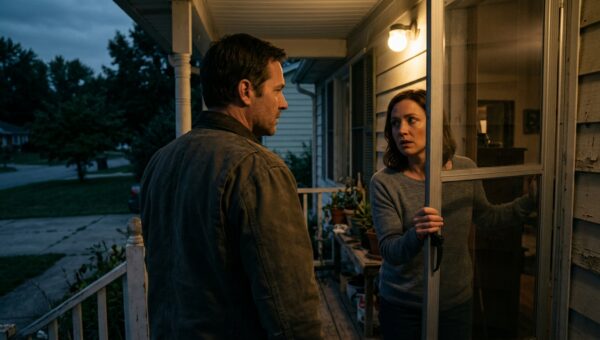
I felt the blood drain right out of my face, but I didn’t raise my voice. I had lived through enough porch storms to know that screaming at a man about his own blood only makes him dig his heels in.
“Go on then,” I told him, turning back to the sink so he wouldn’t have to look at my eyes. “Pack your gray duffel bag. The one with the broken zipper on the side pocket.”
He stood there for a second, probably waiting for me to throw a dish towel or start crying about all those months we clipped coupons and skipped Sunday pot roast. “Evelyn, I can tell her no. We can go together next month like we planned.”
“No,” I said, and my voice sounded steadier than I felt. “You go see your grandbaby. You’ve waited long enough.”
While Gene was upstairs pulling his flannel shirts out of the cedar chest, I walked quietly down the narrow hall toward the spare bedroom we called the nursery whenever we pretended Chloe was going to let us visit. We had driven out there three weeks ago to drop off a hand-quilted crib blanket I spent twenty nights stitching under the floor lamp.
While Gene was outside arguing with the insurance man on his cell phone, I had gone looking for extra hangers in the closet and found a heavy cardboard box shoved way back behind a stack of old diaper cartons. Inside that box sat something Chloe had no business having in her possession: her grandfather’s old brass store key and the thick ledger book with the marbled black cover where he used to log every consignment of galvanized pipe and brass fittings that came into the shop before he passed.
I didn’t ask her about it then. I just slid it under my sweater and carried it home, wondering why she had gone through her father’s old keepsakes while we were out getting lunch.
Now, standing in the dim quiet of our hallway, I reached into the back of my own wardrobe where I’d hidden the ledger inside an old pillowcase. It felt heavy in my hand, smelling faintly of cellar dust and dry paper.
I walked back into the bedroom where Gene was tossing his electric razor into the side pouch of his duffel bag. He didn’t see me standing in the doorway for a second.
“Did you find my blue socks?” he asked, his forehead all wrinkled up with that worried look he always got whenever Chloe called him in a panic.
“In the bottom drawer,” I said softly.
I walked over to the bed and set his suitcase upright. Without saying another word, I unzipped the outside pocket, the one with the broken zipper track that always stuck halfway, and slid the heavy black ledger and the small brass key right down to the bottom. I tucked a spare wool sock over the top so the corners wouldn’t poke through the canvas.
“What’s that?” Gene asked, pausing with a pair of rolled-up socks in his hand.
“Just some extra paperwork for the car insurance in case you get stopped on the grapevine,” I lied, and I hated the way it tasted in my mouth. “Don’t open it unless you need to.”
He gave me a funny look, his gray eyebrows bunching together, but he didn’t ask twice. Gene was a simple man who believed that if you didn’t go looking for trouble, trouble usually left you alone.
“I’ll call you as soon as I hit Grapevine,” he said, pulling me into a quick, stiff hug that smelled like Old Spice and clean cotton.
“Drive safe,” I told him, resting my chin against his shoulder while the front door clicked shut behind him.
I stood by the front window for five minutes, watching his little blue truck back out of the gravel drive and turn toward the highway until the tail lights flickered out behind the rows of dead cornstalks. Then the house went dead silent, the kind of silence where you can hear the pilot light on the stove clicking every few seconds.
The next two days dragged like a wet wool blanket. I didn’t call him, and he didn’t call me until Thursday evening at 9:12 pm, right when I was sitting at the kitchen table with a cold cup of instant coffee and the radio turned down low so I wouldn’t have to listen to the weather report.
“Evelyn?” his voice sounded thin, tinny through the kitchen landline, like he was speaking from the bottom of a dry well.
“I’m here, Gene,” I said, my fingers gripping the edge of the laminate table so hard my knuckles went white. “Did you get there okay?”
“I’m at the diner down on Oak Street,” he said, and I could hear the hum of a commercial refrigerator buzzing in the background. “I haven’t even been to Chloe’s house yet. I stopped to check my oil and the bag fell sideways on the passenger seat.”
My breath caught in my throat. “And?”
“The zipper was open an inch,” he said, his voice dropping down to a low, rough rumble that scared me more than if he’d been shouting. “Evelyn, why did you put my dad’s old ledger in my bag?”
“Because you needed to read it,” I whispered.
“She told me she was selling some old junk from the garage to pay for the baby’s formula,” Gene said, and I heard him take a long, shaky breath that sounded like a man who had just taken a punch to the gut. “She had these three pages of bills of sale sitting on her kitchen table when I walked in tonight. She wanted me to sign over the deed to the old storage lot behind the hardware store building so some developer from Fresno could put up a tire shop.”
“Did you sign it?” I asked, and the seconds ticked by on the wall clock like heavy stones dropping into a bucket.
“I didn’t even take my coat off,” he said. “I opened that book you packed. I found the page where my dad wrote down every single brass display rack and vintage cash register in that store back in sixty-two. Chloe told me those items were donated to the historical society six months ago.”
“They weren’t donated, Gene,” I said softly.
“No,” he muttered, and I could hear the bitter anger starting to rise in his chest. “They weren’t. She’s been hauling them off to some antique buyer in Bakersfield four pieces at a time while telling everyone she’s just cleaning out my dad’s old junk.”
“She’s scared, Gene,” I said, trying to find some small piece of grace for the girl, even though my hands were shaking. “And she’s got nobody else to lean on, so she figured she could twist your arm because you’d do anything for that grandbaby.”
“That’s not love,” Gene said, his voice hard as iron. “That’s using people.”
Nobody said anything for a second, and honestly that felt worse than all the months of waiting.
“Where are you staying tonight?” I asked finally.
“I’m sleeping in the truck,” he said. “Then I’m driving straight back home. I told Chloe she has until Monday to call a lawyer and straighten out whatever mess she made with those sale papers, or I’m walking into the county courthouse myself.”
“Don’t do anything rash with her, Gene,” I pleaded. “Just come home.”
“I’m coming home, Ev,” he said, and I heard the gravel shift under his boots through the receiver as he stood up from the diner booth. “I’ll be there by morning.”
He hung up before I could say goodbye, but the click wasn’t angry. It was the sound of a man turning around after walking down the wrong road for too long.
When he walked through our front door at 6:45 the next morning, his face looked ten years older and his eyes were bloodshot from driving all night without stopping for coffee. He didn’t say a word about the miles or the cold weather. He just walked straight into the kitchen, pulled his leather wallet out of his back pocket, and set something down right in the middle of the laminate table.
It was the small brass key with the jagged notch on the side, catching the early morning sunlight that streamed through the kitchen window.
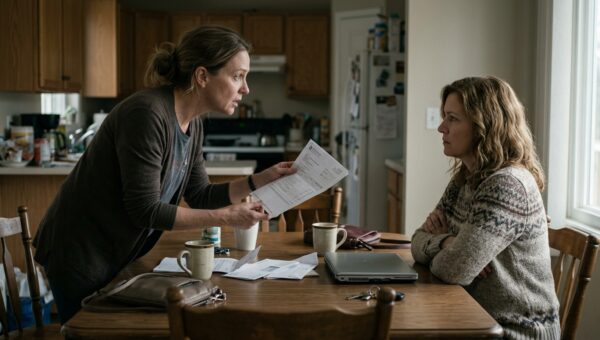
Gene didn’t put it in a drawer or hide it behind the sugar canister. He just left it sitting right there beside two clean ceramic mugs of coffee I had already poured while waiting for his truck to pull into the drive.
“She called while I was on the overpass,” Gene said, pulling out a chair and sitting down with a heavy sigh that sounded like he was finally putting down a sack he’d been carrying across the desert. “She said she was sorry. Really sorry, for once.”
“Did she mean it?” I asked, sliding his coffee mug a little closer to his hand.
“I guess we’ll find out when she calls her accountant,” Gene said, looking down at the brass key between us. “Right now, I just want a cup of coffee with my wife.”
I sat down across from him, wrapping my fingers around my warm mug, and watched the morning light stretch all the way across the kitchen floor where the empty chair finally had someone sitting in it again.