PART 1
The argument started in the oncologist’s waiting room over a box of mints, but it was really about how my husband, Robert, was going to spend whatever days he had left.
Robert was sixty-one when the scans came back showing the mass in his bile duct. I was fifty-eight. We had been married thirty-four years, through two mortgage refinances and thirty seasons of county road work.
I wanted Dr. Miller to tell us the plain facts: the months, the percentages, the exact point when hospice would need to deliver the hospital bed to our den. Robert had worked concrete all his life. He was a man who measured twice, and I believed he deserved to know the exact ground under his boots.
Our daughter, Chloe, saw it completely differently. She was twenty-nine, an elementary school speech therapist, and she could not bear the sound of medical truth in that small room. Whenever Dr. Miller began to explain how the liver enzymes would climb, Chloe would jump in with questions about clinical trials in Cleveland or ask if a different vitamin blend would help his appetite.
“Don’t give him dates, Mom,” Chloe told me in the clinic hallway while Robert was in the restroom. Her face was tight, her fingers shredding a paper napkin. “You act like you’re planning a retirement budget.
He needs hope. If you talk about hospice, he’ll give up before summer.”
“He isn’t a child, Chloe,” I said. “He is your father, and he has a right to know what is coming so we can prepare.”
Neither of us backed down. And because we couldn’t agree, the house on Oak Creek became a quiet battlefield. Whenever Chloe and I walked into Robert’s bedroom together, carrying his clean laundry or his medicine tray, he stopped talking. He would lean back against his pillows, pull his blanket up to his ribs, and close his eyes until one of us found an excuse to leave the room. He had spent thirty years avoiding family squabbles, and even with the cancer pressing against his spine, he was still retreating from the tension between his wife and his daughter.
On a rainy Thursday in late March, I drove down to the corner deli on 4th Street to pick up a roast beef sandwich on rye with extra brown mustard. It was the only food Robert had asked for all week.
I came through the back kitchen door, slipped off my wet shoes, and walked down the carpeted hallway holding the paper deli bag.
Robert’s bedroom door was cracked open two inches.
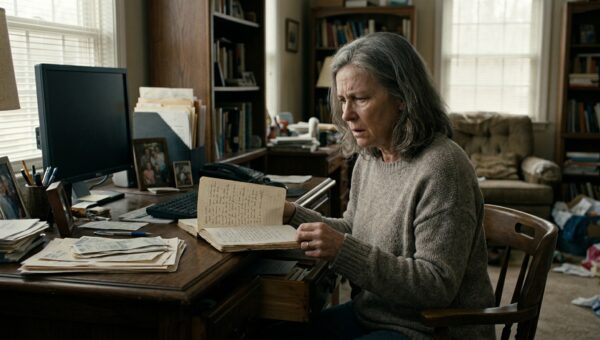
I paused by the doorframe. Chloe was sitting on the low wooden stool beside his mattress, holding a small black spiral notebook in her lap. She was reading aloud in a gentle, hushed voice, her pen tracing along the lines. Robert was awake, looking at her with a calm, attentive look on his pale face that I hadn’t seen in months.
The second the floorboard under my foot gave a tiny squeak, Chloe’s head snapped up.
She slammed the black notebook shut with a sharp slap against her jeans and shoved it behind her lower back on the stool.
“Mom,” she said, her voice jumping. “You’re back.”
Robert looked toward the doorway, then looked down at his quilt, his hands resting loose over his stomach.
I walked into the room and set the paper bag on the nightstand beside his water tumbler. “What are you hiding, Chloe?”
“Nothing,” she said, standing up quickly and keeping her left hand behind her hip. “It’s just notes.”
“Notes about what?” I asked. “Dr. Miller’s office called this morning about adjusting his steroids.
If you’re keeping a medication log, it belongs on the kitchen counter where I can see the dosages.”
“It isn’t a medical log,” Chloe said, backing toward the hallway. Her jaw had that hard, stubborn set she had inherited straight from Robert’s side of the family. “It’s Dad’s list. A list of things he wants to do while he still has the strength to sit up.”
I looked over at Robert. “You made a bucket list, Robert? Why didn’t you tell me?”
Robert cleared his throat, his breath coming a little thin through his nose. “I was getting to it, Sarah. Chloe was just writing down the words for me.”
We had both promised to keep him comfortable. Chloe had sworn it at the hospital, and I had sworn it at his bedside the night he came home. But we had never agreed on what comfort actually looked like. To Chloe, comfort meant keeping the sun shining and pretending the shadow wasn’t growing across the wall. To me, comfort meant making sure his affairs were settled and nothing was left unsaid.
Chloe slipped out into the kitchen. I followed her, leaving Robert with his sandwich.
“Give me the notebook, Chloe,” I said, stopping by the kitchen sink.
Chloe stood by the refrigerator, holding the black spiral pad against her ribs with both arms.
“There’s something written beside your name, Mom,” Chloe said, her voice dropping into a shaky whisper. “Dad asked me to put it down three days ago. And I haven’t decided whether you have the right to read it yet.”
PART 2
“Whether I have the right?”
The words came out of me before I could stop them. The house was dead quiet except for the hum of the refrigerator.
“I have been his wife for thirty-four years, Chloe,” I told her, keeping my voice down so the sound wouldn’t carry back to the bedroom. “I am the one who gets up at two in the morning when his catheter bag leaks. I am the one who washes his bedding and gives him his liquid morphine. You don’t get to stand in my kitchen and decide what I am allowed to know about my own husband.”
“You don’t listen to him, Mom!” Chloe said, her eyes flashing behind her wire-rimmed glasses. She didn’t drop the notebook; she gripped the cardboard cover until the spiral wire bent against her palm. “Every time you walk into that bedroom, you have a clipboard or a schedule. You talk about the burial plot on Route 9. You ask him if he wants the mortgage balance transferred to your sole name before May. You treat him like he’s already a memory that needs filing away!”
“Because nobody else will do it!” I said, stepping closer to the counter. “Your father has three weeks left, Chloe. Dr. Miller told me on Tuesday that the jaundice is spreading into his chest. If we don’t sign the power of attorney and get the deed recorded, the county will freeze our accounts the day his heart stops, and I will be fighting probate court while I’m trying to buy his casket! That isn’t being cold. That is keeping a roof over our heads!”
“He isn’t thinking about deeds, Mom,” Chloe whispered. Her chin began to tremble, but her eyes stayed fixed on mine. “He’s thinking about thirty years of things he never said because he was too busy working sixty hours a week to keep us fed.”
She turned the black notebook in her hands.
“Dad gave me four things to write down on Tuesday,” she said, looking down at the black plastic cover. “First was having Uncle Ray bring over that 1978 shop radio from the garage so he could hear the ballgame on the back porch one last time. We did that yesterday while you were at the pharmacy.”
A small, sharp ache hit my ribs. I had noticed the old gray radio sitting on the porch bench yesterday evening, but I assumed Ray had just dropped it off after cleaning out his truck.
“Second,” Chloe continued, “he wanted me to find the photo album from the summer we rented that cabin on Lake Erie when I was ten. He wanted to see the picture of the boat he built out of driftwood. I found it in the attic this morning.”
She paused. Her thumb rested against the edge of the third lined page.
“What was the third thing, Chloe?” I asked.
“The third was making sure I promised not to let you sell his work shed behind the garage until the fall,” she said. “Because he knew you’d want to clear it out to save property taxes, and he wanted me to have the summer to take his wood chisels.”
“And the request beside my name?”
Chloe looked toward the dark hallway leading to Robert’s room. For a long moment, she didn’t answer.
“He wrote: *Tell Sarah I am sorry about the bank in 2004, and ask her to give me the blue tackle box before she calls the church.*”
I froze by the kitchen table.
The year 2004. Twenty-two years ago.
It was the year the concrete plant had laid Robert off for seven months during the winter recession. We had almost lost the house. We had survived on eighty dollars a week from my part-time shift at the dry cleaner’s, and Robert had spent every morning at the kitchen table with his head in his hands, staring at a stack of pink utility shut-off notices.
Then, one Friday in April, Robert had walked into the kitchen with three thousand dollars in cash, paid the back mortgage, and told me his brother had lent him the money against his tax refund.
We had never spoken of it again. But Robert had carried a quiet, brooding distance for two years after that winter, a shadow that had lived between our pillows until Chloe started high school.
“What does the bank have to do with anything now?” I asked, my voice barely audible. “Why would he bring that up when he’s dying?”
“Because of what’s inside the blue tackle box, Mom,” Chloe said quietly. “It isn’t fishing lures. He told me yesterday where he keeps it hidden under the workbench floorboards. And he made me swear that if I showed it to you, I had to promise not to let you leave the house.”
PART 3
I didn’t wait for Chloe to explain.
I turned around, walked out the mudroom door, and went straight across the wet grass to Robert’s workshop behind the two-car garage.
The air inside the shed smelled of old sawdust, two-cycle engine oil, and damp cedar. Robert had kept his tools on pegboards, outlined in black marker so every wrench had its exact place.
In the back corner, beneath his heavy steel vise, was a loose piece of three-quarter-inch plywood set into the gravel floor.
I knelt down on the cold floor, pulled up the edge of the plywood, and reached into the dark space between the foundation blocks.
My fingers hit cold metal.
I lifted out an old blue Plano tackle box, its plastic latches coated in yellow dust.
Chloe was standing in the doorway of the shed, wearing only her sweater in the drizzle, watching me with her arms folded tight.
I unhooked the brass latches and opened the lid.
The top cantilever tray didn’t have hooks or plastic worms.
Lying in the compartments were three rolled packets of papers, held together with thick rubber bands, and an old brown leather passbook from First Valley Savings, an institution that had gone out of business fifteen years ago.
I unrolled the top packet.
It was a personal loan contract from April 14, 2004.
The borrower was not Robert’s brother. The borrower was Robert. The principal amount was $3,200.
Attached to the loan note was the collateral agreement.
Robert had not borrowed that money from his family. He had taken out a high-interest signature note against his personal pension reserve from the concrete workers’ local union, a fund he had spent eighteen years paying into. Because he had pledged the pension as emergency collateral during a layoff period, the union had frozen his supplemental death benefit, a thirty-thousand-dollar life policy that was meant to pay off our mortgage if he passed before retirement age.
Tucked behind the loan contract were two hundred and forty monthly money order receipts.
Every single month, from May of 2004 until December of last year, Robert had walked down to the Western Union desk at the grocery store and bought a fifty-dollar money order to pay back the pension fund’s reserve account.
He had taken money from his personal lunch allowance. He had skipped his annual hunting trips with his brothers. He had worn the same winter boots with the cracked rubber soles for five seasons, telling me he was just fond of the leather.
He had spent twenty years quietly paying back every single dollar he had secretly borrowed to keep the roof over our heads during that terrible winter, trying to restore the death benefit before I ever found out we had almost lost it.
Tucked into the front pocket of the leather passbook was a handwritten letter folded into a small square, addressed to me in his slow, heavy handwriting:
*Sarah. If you are reading this, I didn’t get the union benefit cleared in time. In 2004, I told you Ray lent me that money because I couldn’t bear to let you know that the man you married couldn’t keep a job or protect his family without risking our old age. I was ashamed to look you in the eye. I know you like things orderly, and I know you like the bills stamped paid. I spent twenty years trying to fix that mistake before you had to see it. If there is a debt left on the mortgage, use the sale of my truck to cover the balance. Don’t be mad at Chloe for holding this. I asked her to give it to you after the church service so you wouldn’t spend my last days looking at me like a failure.*
The paper shook in my hand.
The rain drummed against the tin roof of the shed, a loud, steady roar in the gray afternoon.
I had spent six months thinking Robert was pulling away from me because he couldn’t handle my questions, because he was tired of my practical talk about deeds and bank accounts.
He wasn’t pulling away because of my questions. He was pulling away because he thought the practical truth would make me stop loving him. He thought that if I saw the flaw in the foundation he had built for thirty-four years, I would look at him and see a man who had let me down.
“Mom,” Chloe whispered from the door.
I didn’t answer her right away. I held that old paper against my coat, smelling the dust and the pine shavings, feeling the deep, crushing weight of a secret an ordinary man had carried on his back for twenty years just to keep his pride whole.
I wiped my face with the sleeve of my sweater, closed the blue tackle box, and picked it up by the handle.
“Come inside, Chloe,” I told her. “We have to talk to your father.”
ENDING
We walked back into the house together through the mudroom.
I didn’t take the notebook. I carried the blue tackle box straight down the hall into Robert’s bedroom and set it on the small table at the foot of his bed, right where he could see it.
Robert was lying on his side, his face turned toward the window where the rain was running down the glass. When the plastic box hit the wood, his shoulders went rigid under the blanket. He didn’t turn around.
“I found the receipts, Robert,” I said.
My voice was thick, but it was steady. I walked around to his side of the bed, sat down on the low wooden stool, and took his right hand between both of mine. His fingers were cold, the skin paper-thin over his knuckles.
“Sarah,” he whispered, his eyes still fixed on the curtain. “I was going to have it cleared by June. The union rep told me two more payments would release the lien.”
“Robert, look at me,” I told him.
He turned his head slowly, his jaw clenched, waiting for the lecture, waiting for the anger he had spent twenty years running from.
“You kept the roof over our heads,” I said, leaning down until my forehead touched his knuckles. “You put food on our table when the plant went dark. You gave thirty-four years of your back to this house, and you think I care about a thirty-thousand-dollar union policy?”
Robert let out a long, ragged breath that sounded like a tire losing air. A single tear slipped down the gray stubble on his cheek.
“I didn’t want you to think less of me,” he croaked.
“You foolish man,” I whispered, smiling through my own tears as I squeezed his hand. “There isn’t a ledger in this county that could make me think less of you.”
Chloe came into the room a minute later. She didn’t stay by the door this time. She sat on the edge of the mattress on his other side, took his left hand, and opened the black spiral notebook on her lap.
We didn’t talk about funeral plots that afternoon. We didn’t talk about deeds or transfer taxes.
I had Chloe read every single item on Robert’s list out loud.
We sat there in the fading gray light while the rain washed the bedroom windows, listening to Robert tell stories about the driftwood boat on Lake Erie and the old radio that had survived twenty years of garage dust. When we reached the bottom of the fourth page, I took Chloe’s pen, crossed out the line about the bank in 2004, and wrote: *Paid in full.*
Robert lived another twelve days.
They were not easy days, but the silence