PART 1
My late mother worked thirty-two years as an elementary school librarian, saving every spare dollar from summer tutoring into a dedicated educational savings bond and trust. When she passed away four years ago, she left behind a separate $50,000 inheritance account designated specifically for my daughter Chloe’s college tuition. Chloe was thirteen back then, and Grandma had sat her on the sofa, held her hand, and told her that no matter what happened, she would never have to worry about tuition bills for nursing school.
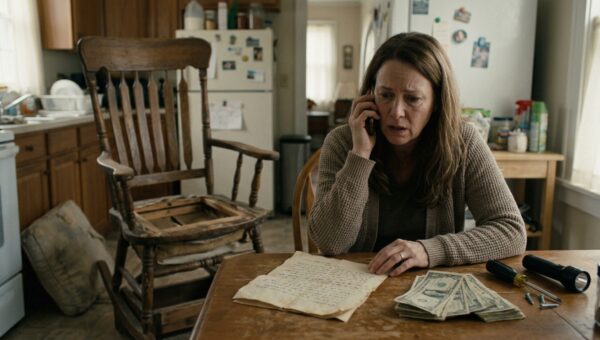
Yesterday afternoon, I sat down at my laptop to verify our spring state tax return. When I glanced at the bank dashboard, my breath caught. The educational account balance was not $50,000. It sat at $20,000.
A single withdrawal had cleared twenty-four hours earlier: an external wire transfer of exactly $30,000 to an auto dealership thirty miles down the highway.
My hands trembled on the keyboard as I clicked the transfer receipt. The transaction had been initiated from our home IP address. The authorization had my name typed into the electronic signature box, but the contact phone number attached to the wire confirmation was my husband Dan’s cell.
I confronted Dan the second his boots hit the linoleum after his shift at the municipal water plant.
He didn’t flinch. He didn’t even drop his eyes. He set his aluminum lunchbox on the counter, grabbed a cold can of soda from the fridge, and leaned back against the sink with his arms crossed.
“I transferred it yesterday morning,” Dan said, his voice flat and unapologetic. “Tyler has been driving that rusted-out 2004 sedan with the bad head gasket for two years. He starts his apprentice program next month. He needs a reliable, late-model four-wheel drive pickup to haul equipment to job sites.”
“That was Chloe’s inheritance from my mother, Dan!” I yelled, my voice cracking with disbelief. “My mother set aside that fifty thousand dollars specifically for her granddaughter. Tyler has his own mother, and you have your own wages.”
“Tyler is my son, and we are married,” Dan fired back, stepping toward me. “In a real marriage, you combine all the money equally. There is no ‘yours’ and ‘mine’ under this roof. It is completely unfair for your seventeen-year-old daughter to sit on a pile of cash for a four-year free ride while my boy has to nurse a junker to an honest trade job every morning.”
Right then, Chloe walked through the front door, carrying her backpack and track shoes. She had heard Dan’s voice from the driveway.
She dropped her bag on the hall floor, looked at my computer screen still open on the dining room table, and saw the missing $30,000. She looked at Dan, then at me, her eyes filling with tears.
“Mom?” Chloe whispered, her chin shaking. “Is Grandma’s money gone?”
Dan pointed his finger toward the hall. “Chloe, go to your bedroom. This is grown-up business.”
“Do not talk to my daughter like that,” I said, stepping directly between them. “You are calling the dealership right now, Dan. You are canceling that sale and putting every single dollar back into that account.”
Dan’s face hardened into a stubborn, ugly sneer. He reached into his pocket, tossed his truck keys onto the table, and glared at me.
“That check already cleared at the dealer, and Tyler is picking the truck up on Friday,” Dan said, his voice dropping into a cold threat. “If you try to undo that sale or take my boy’s truck away, I’m packing my things and walking out of this house tonight.
You decide right now what matters more to you: your daughter’s pride, or your marriage.”
PART 2
Chloe let out a choked sob, turned around, and ran up the stairs to her bedroom. The sound of her door slamming shut shook the picture frames along the hallway wall.
I stood there in the kitchen, staring at Dan. For six years, I had bent over backward to make our blended family work. When Dan came into the marriage with fourteen thousand dollars in credit card debt and child support arrears from his first wife, I helped him pay it off using my bonus checks from the medical billing office. Whenever Tyler needed trade tools, dental crowns, or insurance money, I never complained. I believed in being a team. I told myself that Dan was just a proud, protective father who had carried a hard load.
Now, looking at his cold, unyielding face across the kitchen table, the truth was as clear as glass. Dan didn’t believe in combining everything equally. He only believed in combining what was mine whenever his side of the family wanted something they hadn’t earned.
“I am not asking you again, Dan,” I said, keeping my voice lower this time, though every muscle in my neck was tight. “You forged my name on a wire transfer to take money left by a dead woman to her granddaughter. That is not community property. That is theft.”
“Call it whatever you want,” Dan sneered, snatching his keys off the table. “You try to file a report or undo that wire, and see how fast I serve you with divorce papers. In this state, marital assets get split straight down the middle. You’ll lose half of whatever you have left anyway. Think about that before you make a scene.”
He grabbed his jacket from the coat rack, slammed the back door, and drove off in his work car.
I didn’t waste time crying. I went straight up to Chloe’s room, sat on the edge of her mattress, and held her while she wept into my shoulder.
“Grandma promised me, Mom,” Chloe cried, clutching her pillow. “I worked so hard for my early admission. I didn’t want you to have to take out parent loans.”
“You aren’t taking out loans, honey,” I told her, kissing the top of her head. “Grandma’s money was protected. I am going to handle this.”
After Chloe calmed down, I went down to the basement where I kept my mother’s estate files in an old fireproof metal lockbox. I unlocked the box and pulled out the original blue-backed trust document drafted by my mother’s attorney in 2020: *The Ruth M. Anderson Irrevocable Education Trust.*
I had served as the trustee since Mom died. Because Chloe was a minor when the trust was funded, the funds were held in a fiduciary custodial account at First Community Bank.
Then I saw the mistake that had opened the door for Dan.
Two years ago, when First Community Bank merged with Horizon National, the branch manager had updated all my accounts into a single online banking portal. Because Dan and I had opened a joint household checking line at Horizon, the bank had linked the custodial trust account to my primary login profile. Dan had simply looked over my shoulder while I checked our mortgage, memorized my master password, and executed the wire transfer using my credentials.
I opened the folder further and found the specific bank signature card from the merger. Dan’s name was nowhere on that trust document. He was not a trustee. He was not a beneficiary. He had zero legal authority to touch a single penny of that principal.
At seven-thirty the next morning, I sat outside the doors of Horizon National Bank forty minutes before they opened.
When the branch manager, Mr. Henderson, unlocked the glass doors, I walked straight into his office, placed the blue-backed trust agreement on his desk, and laid down the printout of the $30,000 unauthorized wire transfer.
“Mr. Henderson,” I said, “your bank allowed a thirty-thousand-dollar wire transfer out of an irrevocable minor trust account without verifying the trustee’s identity or requiring dual authorization. That transfer was executed by my husband without my knowledge or consent.”
Mr. Henderson put on his reading glasses, pulled up the transaction log, and began typing. Within ninety seconds, the polite smile vanished from his face.
“Mrs. Miller,” he said, clearing his throat nervously. “The wire request was completed online through the primary credentials, but I see here that the recipient account is a commercial dealer escrow. More importantly, this was categorized as a restricted fiduciary account on our old platform. It should have had an automated administrative block requiring an in-person branch signature before any third-party wire could be released.”
“Then Horizon made a critical error,” I said. “And I need that money recalled before that vehicle leaves the lot.”
PART 3
Mr. Henderson did not argue. Banks know when their own system failures leave them exposed to legal liability.
He immediately picked up his desk phone, dialed the bank’s regional fraud and wire recovery department, and initiated an emergency indemnity recall on the $30,000 transfer. Because the transfer had gone through as an automated clearinghouse commercial wire to the dealership’s floorplan escrow account, the funds were frozen in pending settlement status.
“The funds have been flagged for unauthorized release and fraudulent representation,” Mr. Henderson told me, printing out an official notice with the bank’s gold seal. “The receiving bank has placed an immediate administrative hold on the dealer’s escrow line. The funds will be reversed and returned to the trust ledger within forty-eight hours.”
He had me sign a formal affidavit of unauthorized withdrawal, set up a brand-new restricted account that could only be accessed with physical identification at the teller counter, and permanently separated it from my home online portal.
I took the certified recall notice, walked out to my car, and drove directly to Miller Creek Auto Sales on Route 4.
The dealership lot was crowded with shiny new pickups and SUVs. Parked right in the front delivery bay, detailed and polished with a temporary drive-away tag taped inside the rear window, was a brand-new dark gray crew-cab pickup.
Standing by the driver’s side door with the sales manager was Dan and his twenty-one-year-old son, Tyler.
Tyler was grinning, holding the keys in his palm, running his hand over the clean black trim of the side mirror. Dan stood beside him, chest puffed out, beaming with that proud, generous look of a father who had just delivered the world to his son.
I stepped out of my car and walked straight toward the delivery bay.
The moment Dan saw me, his smile vanished. He handed his paper cup to Tyler and took three fast steps toward me, trying to cut me off before I reached the showroom entrance.
“What are you doing here, Laura?” Dan hissed, his voice low and furious. “I told you to stay out of this. You’re embarrassing me in front of my boy.”
“Hey, Laura,” Tyler called out, still holding the keys, looking somewhat confused. “Look at the suspension on this thing! Dad really hooked me up.”
“Tyler,” I said, looking right at the boy. “Hand those keys back to the sales manager.”
“What?” Tyler blinked, his smile dropping away. “Why?”
“Because your father bought that truck with money he stole from your stepsister’s college trust,” I said clearly, so the sales manager could hear every syllable.
Dan lunged forward, grabbing my forearm. “Shut your mouth, Laura!”
“Take your hands off me, Dan,” I said, looking down at his grip until he let go.
I pulled the certified document from Horizon National Bank and handed it directly to the sales manager.
“My name is Laura Miller. That thirty-thousand-dollar down payment came from an irrevocable minor trust account where I am the sole trustee. My husband forged my electronic authorization yesterday morning. Horizon National has already issued an emergency fraud recall on the wire. Those funds are frozen and will be reversed to the trust account by tomorrow afternoon.”
The sales manager’s face went completely rigid. He looked at the bank seal on the document, then turned toward Dan.
“Mr. Miller,” the manager said, his voice instantly cold and professional. “Is this true? Is this account subject to an unauthorized wire claim?”
“It’s a marital dispute!” Dan stammered, his face turning an angry, blotchy red. “We are married! That money is joint household funds! The check cleared your bank yesterday!”
“The wire was flagged under federal banking fraud protocols twenty minutes ago, sir,” the sales manager replied, pulling a tablet from his back pocket and checking his screen. He looked up, his jaw set tight. “The settlement deposit was just rejected by our floorplan lender. The truck does not leave this lot.”
The manager reached out his hand toward Tyler. “Keys, son. Right now.”
Tyler looked at his father, then down at the shiny brass key in his hand. The excitement that had filled his face twenty minutes earlier collapsed into utter, humiliating shame. He dropped the keys into the manager’s open palm.
“Dad,” Tyler whispered, his voice cracking with embarrassment as two mechanics in the next bay turned to watch. “You told me you got an early payout from your municipal pension. You told me this was your money.”
Dan couldn’t look his son in the eye. He stood on the asphalt with his fists clenched, his shoulders hunched, completely exposed in front of the people he had tried to impress with someone else’s sacrifice.
“You ruined this family, Laura,” Dan snarled at me, his teeth gritted. “We are done. I’m taking my clothes and getting out of your house today.”
“I packed your bags two hours ago, Dan,” I told him, my voice completely steady. “They are sitting on the front porch. Leave your key on the kitchen counter, because the locks will be changed before five o’clock.”
ENDING
Dan moved into a rented duplex near the water treatment plant that evening.
He tried to file for divorce two weeks later, demanding half the equity in our home and an equal distribution of our accounts. But when my attorney presented the family court judge with the sworn bank fraud affidavits, the forged wire documentation, and the certified terms of my mother’s irrevocable trust, Dan’s lawyer advised him to settle immediately.
Under state law, separate inherited property held in trust for a minor child is strictly non-marital. Furthermore, Dan’s fraudulent diversion of fiduciary funds gave me the leverage to protect the full equity of our house in exchange for wa