PART 1
My husband, Greg, and I had been married for thirty years when he asked me to come down to the county high school gym on a Tuesday night.
I was at the kitchen counter folding dish towels when he put on his windbreaker. He told me the athletic booster committee needed a couple of longtime residents to look over old team trophies before the district reunion next month.
I didn’t question it. Greg had run track there in the late seventies, and his family had lived three blocks from the athletic field for two generations.
The gym smelled the same as it had when I graduated in 1984: floor wax, sweet varnish, and cold radiator iron.
A dozen girls from the junior varsity team were running layup drills on the far side of the hardwood, their sneakers squeaking against the polished pine. At midcourt stood Coach Miller, a man in his sixties who had taken over the girls’ program when my own children were still in grade school.
When Greg and I walked through the double doors, Coach Miller stopped tossing a basketball between his palms. He didn’t have an armful of trophies or reunion flyers.
He walked over to the bleachers, picked up a folded mesh jersey, and held it out toward me with both hands.
“Ruth,” Coach Miller said, his voice quiet above the bounce of the balls. “Your husband brought this by the athletic office yesterday afternoon. He thought it was time it came home.”
I took the fabric into my hands. It was the heavy, scratchy cotton-polyester blend they used back when Carter was in the White House. The blue dye had faded to a dusty navy, and the white number 14 on the front was cracked along the seams. I flipped it over. Stitched across the shoulders in thick white felt letters was my maiden name: CALLAHAN.
I hadn’t played basketball since I was seventeen years old.
In the winter of 1983, halfway through my senior season, I quit the varsity team on a Friday night without telling my parents or my teammates why. I turned in my warmups, cleaned out my locker, and never touched a basketball again. When my father asked me about it at breakfast that weekend, I told him my knees couldn’t handle the running anymore and that I needed more hours at the dry cleaner’s to save for community college.
I looked at Greg, confused. “Where did you get this? I thought the school threw these old uniforms out decades ago.”
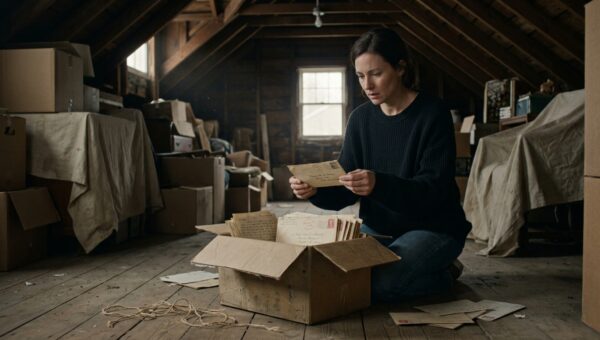
“I found it two weeks ago in my mother’s attic,” Greg said. He had his hands jammed into his windbreaker pockets, looking down at the yellow boundary line on the court. “She had it wrapped in tissue paper at the bottom of a cedar chest behind my dad’s old toolboxes.”
His mother, Evelyn, had passed away four years ago. She was a stern, tidy woman who kept every utility receipt from 1968 in shoe boxes, but she had never attended a single girls’ basketball game in her life. She had never even liked me very much when Greg and I first started dating in our twenties.
Before I could ask Greg why his mother would keep my old high school jersey in her cedar chest for forty years, one of the junior varsity forwards jogged over to the sideline to grab a plastic water bottle from the bench.
The girl looked at the blue number 14 in my hands, then glanced up at my face.
“Wait,” the girl said, wiping sweat from her forehead with her wrist. “Are you Ruth Callahan?
The one who used to leave the notes in the equipment closet?”
The gym suddenly felt cold.
“I never left a note in an equipment closet,” I said. “You have the wrong person.”
The girl looked at Coach Miller, then back at me, her brow furrowing. “Coach showed our captains the metal locker behind the ball racks last week before the renovation started. There were four envelopes taped to the back of the shelf with Callahan written on them in red pencil. He said they’d been sitting back there since the state playoffs in eighty-four.”
PART 2
Coach Miller took a step back toward the equipment cage near the corner of the bleachers. He pulled a brass master key from his whistle lanyard and unlocked the wire mesh door.
“Ruth,” Coach Miller said, gesturing for me to follow. “When we started packing up the storage room for the floor resurfacing last week, the maintenance crew had to pry open the old padlocked locker behind the ball bins. It had your name stenciled on the masking tape inside the door.”
Greg didn’t move. He stood on the free-throw line with his head down, watching his shoes.
“Greg,” I said, turning to him. “Did you know about this?”
“Just go look at the envelopes, Ruth,” Greg muttered. His voice sounded thin, stripped of the easy humor he usually had around people from town.
I walked into the equipment room. The air was stale, smelling of leather, damp canvas, and dust. Sitting on the low wooden bench beneath the uniform racks was a gray metal lockbox with the lid open. Inside were four yellowed legal-sized envelopes, postmarked from the winter of 1983 and the spring of 1984.
On the front of each envelope, written in faded red grease pencil, was my maiden name: *Ruth Callahan.*
None of them were in my handwriting. The strokes were heavy, jagged, and familiar.
I picked up the first envelope, postmarked December 8, 1983. Inside was an official letter from the women’s athletic department at the state university forty miles north, addressed to Coach Danvers, the man who had coached our team back when I was seventeen.
The letter was a formal invitation for a full four-year athletic scholarship.
It offered full tuition, room, board, and books for their nursing program, beginning the fall semester of 1984. Attached to the letter was a signed scouting report from their head scout, praising my lateral quickness, my free-throw percentage, and my ability to lead the floor.
My breath caught in my throat. I sat down hard on the wooden bench, holding the thin paper between my fingers.
In the winter of 1983, my family was drowning. My father had lost his third-shift maintenance job at the foundry when the plant reduced operations, and my mother was taking in sewing from the neighbors just to keep heating oil in our tank. I had dreamed of going to college for nursing, but our local branch was nine hundred dollars a semester, and we didn’t have nine dollars to spare.
I remembered Coach Danvers calling me into his office the first week of December that year. He had looked at me across his metal desk with a strange, guilty expression and told me that the state university scout had decided not to come to our game against Oak Ridge after all. He told me they had given their final scholarship slot to a girl from the city league, and that I should focus on finding steady factory work after graduation because girls from our county rarely made it out on sports.
That conversation was the reason I quit the team three days later.
I felt so ashamed, so convinced that I was simply not good enough, that I couldn’t bear to run up and down that court while my father was clipping coupons at the kitchen table.
I opened the second envelope.
It wasn’t from the university. It was a handwritten letter on personalized stationery with the initials *E.V.* embossed in gold at the top.
Evelyn Vance. Greg’s mother.
The letter was addressed to Coach Danvers, dated December 6, 1983:
*Coach: As president of the athletic booster committee, I must remind you of our discussion regarding the memorial equipment grant. The foundation’s five-thousand-dollar allocation for the new scoreboard and uniforms depends on our community presenting the right image. A girl like Ruth Callahan, whose family owes back taxes on their property and whose father cannot maintain employment, does not represent the values this program stands for. If that scholarship offer is delivered to her, I will withdraw the booster grant and ensure the school board reviews your coaching tenure.*
PART 3
I walked out of the equipment cage with the papers in my hand.
The junior varsity girls had moved to the far end of the court, but the gym had gone dead quiet. Coach Miller stayed by the bleachers, looking down at his clipboard, giving us whatever privacy an open gym could offer.
Greg was still standing near midcourt. When he saw the university seal and his mother’s embossed stationery in my hands, he didn’t try to look away anymore.
“How long have you known about this, Greg?” I asked.
My voice didn’t rise. It came out flat and dry, like dry corn stalks in November.
“I found the jersey two weeks ago, Ruth,” Greg whispered, his eyes filling with tears. “I was clearing out Mom’s cedar chest to get the house ready for the probate sale. The jersey was wrapped in tissue at the bottom, and inside the fold was Coach Danvers’ old receipt for the team uniforms. When I asked Coach Miller if there was any record of Mom buying back school gear in 1984, he checked the archives and found that gray box in the old locker.”
“Your mother bought off my coach for five thousand dollars,” I said.
“Coach Danvers took the booster money to buy the electronic scoreboard,” Greg said, wiping his face with the back of his sleeve. “And he buried the scholarship letter in that metal box so nobody would ever ask why you stopped playing. Mom took your jersey from the laundry bin after you turned it in, so Danvers couldn’t reissue it to anyone else.”
“Why did she do it,