PART 1
My brother, Greg, and I were both asked by Mom to help her downsize into a smaller cottage across town. We had agreed over the phone on Tuesday that we would take our time, go through the attic on Saturday morning, and decide together what stayed and what went. Mom had lived in that yellow two-story house on Maple Lane for forty-six years.
Dad had laid the flagstone walk with his own hands before he passed in 2011, and neither Greg nor I was truly ready to let the place go.
I pulled into the gravel drive at eight o’clock on Saturday, carrying two cardboard coffee cups and a dozen blueberry muffins from the bakery. A twenty-foot rental truck was already backed over Mom’s flowerbed edge, its rear roll-up door open to the sky.
Greg was already carrying two taped wardrobe boxes down the porch stairs, his shirt soaked across the back with sweat.
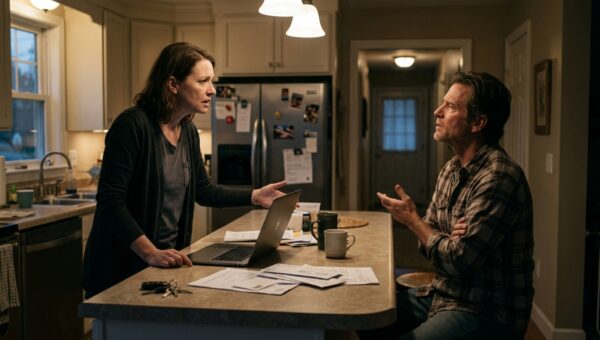
“You’re late, Dan,” Greg called out, dropping the boxes onto the metal tailgate with a heavy thump. “I hired two neighborhood guys to clear the bedrooms. Mom wants everything done quickly. If we don’t have the house cleared by noon, we lose the deposit on the truck.”
“We said nine o’clock, Greg,” I said, setting the coffee on the hood of my car. “And we were supposed to sort the cedar chest and Dad’s tools together. You haven’t even opened the kitchen cupboards.”
“There is nothing in there worth keeping,” he snapped, wiping his forehead with his forearm. “It is just forty years of mismatched plates. The new place has built-in cabinets.”
I walked up the front steps. Mom was sitting on the wooden porch swing. She wasn’t wearing her usual denim gardening apron. She had on her dark navy Sunday dress, her pearl clip earrings, and her good black leather shoes. Resting on the porch boards right beside her ankles was a single hard-sided blue suitcase, latched shut. Her purse was sitting on her lap, both hands folded flat over the vinyl clasp.
She looked small against the high wooden slats of the swing. Her eyes were completely clear, watching Greg haul a sofa cushion down the ramp.
I knelt down on one knee in front of her. “Mom, what’s going on? Where do you plan to go with one suitcase?”
Mom didn’t look at the truck. She looked right at Greg as he walked back up the porch stairs with empty hands.
“I told him I’d move if he answered one question,” Mom said. Her voice was steady, but there was a quiet, brittle tightness around her mouth.
Greg stopped on the top step, gripping the wooden handrail. “I already answered you, Mom. We went over this three times this morning. The county property tax reassessment came back high, the furnace is twenty years old, and you can’t manage these stairs anymore. That’s the answer. Now please get in the car so Dan can take you over to the cottage.”
Mom shook her head slowly. She reached down with two fingers and tapped the weathered pine slat beneath her knees.
“Reach your hand under the center brace, Dan,” Mom told me. “Read the note taped beneath the porch swing.”
I reached under the wood. My fingertips brushed a square of stiff brown paper taped to the raw underside of the pine seat. I peeled the dried masking tape away.
The folded paper was yellowed at the edges. I opened it under the morning sun. The first line was written in blue ink, in my own neat, twelve-year-old cursive handwriting.
PART 2
The ink was faded, but every letter was mine.
It was a lined sheet torn from a school spiral notebook, dated June 14, 1988:
*I promise I will never let anyone sell this house until Greg and I both sign the paper, because Dad built the porch for Mom’s birthday.*
Beneath my childhood pledge was a second line, written in Greg’s messy scrawl from the same summer:
*Me too. We keep the house for Mom.*
Dad had made us write that note and tape it under the swing the summer we built the porch together. Greg had dropped the hammer into the hydrangea bushes, and Dad had laughed, sat us down on the raw pine slats, and told us that a house wasn’t just lumber and plaster; it was the promise a man made to keep his family safe from the weather.
I looked up from the yellow paper. Greg was staring at the sheet in my hand, his mouth slightly parted.
“That was thirty-eight years ago, Dan,” Greg said, his voice dropping into a defensive, irritated mutter. “We were kids. Dad was playing a game with us. What does a note from 1988 have to do with Mom’s heating bills?”
“It has everything to do with the question I asked you at seven this morning, Gregory,” Mom said.
She opened her black purse. She didn’t pull out a compact or a handkerchief. She pulled out an official letter on legal stationery from First Valley Title & Escrow, postmarked three days ago.
She handed it to me.
“What is this, Mom?” I asked.
“Ask your brother,” Mom replied.
I scanned the first page. It was a preliminary closing disclosure for the private sale of 412 Maple Lane.
The seller was listed as The Vance Family Irrevocable Trust.
The buyer was an investment company called Ridge Line Developments LLC.
The agreed purchase price was $310,000 in cleared funds, with closing set for Monday afternoon at two o’clock.
Tucked behind the closing statement was a certified copy of the power of attorney Dad had drafted before he went into hospice in 2011. Dad had named Mom as primary trustee, with Greg and me as secondary co-agents. But on the back page of the disclosure, on the line marked *Authorized Seller Signature*, was one name: Gregory Vance.
My name wasn’t on the seller line. My signature was nowhere on the release.
“You sold the house, Greg?” I asked. The words came out flat and dry. “Without telling me? Without bringing the paperwork to Mom?”
“The roof needs eighteen thousand dollars of work, Dan!” Greg yelled, throwing his hands in the air. The two neighborhood movers paused at the truck gate, looking up at the porch. Greg waved them away with a sharp flick of his wrist. “The foundation on the north wall has a three-inch crack. A developer came to my office last month and offered cash, as-is, no inspections, no contingencies. Do you know what kind of miracle that is in this neighborhood?”
“You told Mom the cottage was a rental,” I said, reading the bottom of the escrow distribution sheet.
“It is a rental,” Greg said. “A five-year lease in a senior community. She gets her meals prepared, she has a nurse on call, and she doesn’t have to worry about shoveling snow.”
“And where does the $310,000 go, Greg?” Mom asked from the swing.
Her voice wasn’t loud. She didn’t raise her hands. But the question stopped him cold.
PART 3
Greg’s jaw worked silently. He looked at the floorboards, then over the railing toward the road where a county road crew truck was rumbling past.
“The money goes into the trust account, Mom,” he mumbled. “To pay your monthly facility fees.”
“I called First Valley Title yesterday afternoon, Greg,” Mom said. She reached into her handbag again and pulled out a second sheet of paper: a wire transfer instruction form that had been submitted with the purchase agreement.
She held it up between two fingers so the morning light caught the black print.
“The title officer was a young woman named Brenda,” Mom continued. “Her mother taught fifth grade with me for twenty years. Brenda called me because she thought it was strange that the proceeds from a family trust sale were being wired into a commercial equipment account in Franklin County under the name Vance Hauling & Excavating.”
The truth sat right there on the pine porch.
Greg’s commercial excavating business had been struggling for two years. He had mentioned at Thanksgiving that fuel costs and equipment leases were cutting into his margins, but he had brushed it off as normal business friction.
He hadn’t just arranged a convenient move for an aging mother. He had leveraged the roof over her head to save his own balance sheet.
“I was going to pay it back into the trust, Mom!” Greg shouted, stepping toward the swing with his hands open, his face red and wet. “My backhoe was repossessed three weeks ago! The bank gave me until next Friday to clear the floor-plan note or they take the two dump trucks and the yard! If I lose the equipment, I lose everything! I was going to pay the trust eighteen hundred dollars every month for your cottage rent out of my haul contracts! I swear on Dad’s grave I wasn’t going to let you go without!”
“You swore on this porch in 1988, Gregory,” Mom said, pointing down at the note in my hand. “And you swore when your father was dying that you would protect this family with honesty. You didn’t tell your brother. You didn’t ask your mother. You packed my bedroom into cardboard boxes while I was eating my breakfast, thinking you could rush me into a rental before Dan saw the title papers.”
I stood up from the porch floor. I was forty-eight years old, and my hands were shaking, not from fear, but from the realization that my own brother had viewed our mother’s home as his personal bailout fund.
“The title company can’t close on Monday, Greg,” I told him.
“What are you talking about?” he snapped, rounding on me. “I have Dad’s power of attorney on file!”
“Dad’s power of attorney required dual authorization for any conveyance of real property exceeding twenty-five thousand dollars,” I said, pointing to paragraph twelve on Dad’s original trust document, which was attached to the disclosure packet. “Dad wrote that clause specifically so neither one of us could ever sell this land without the other signing the deed. Brenda at First Valley knew that. That’s why she called Mom instead of sending the wire.”
Greg stopped. His eyes darted down to the paper in my hand, reading the clause he had clearly ignored or forgotten.
The anger drained out of him all at once. He sank down onto the second porch step, put his elbows on his knees, and buried his face in his rough, calloused hands.
“I’m going to lose the business, Dan,” he whispered into his palms. “The bank is coming on Friday.”
ENDING
The yard was dead quiet. The morning breeze moved through the high branches of the silver maple tree Dad had planted when Greg was born.
Mom didn’t yell. She stood up from the swing, smoothing the navy fabric of her dress. She walked over to where Greg was sitting on the steps, reached down, and rested her hand gently on the back of his neck.
“You should have told us, Gregory,” she said softly. “Your father failed twice before he built the lumberyard that fed you boys. He lost a sawmill in 1974, and he lost a gravel pit in 1982. But he never lied to his family, and he never stole a shingle to save his pride.”
“I was ashamed, Mom,” Greg choked out, tears running between his fingers onto the dusty porch wood. “You worked so hard. Dan has his pension at the water district. I was the one who was supposed to be the success.”
“You are my son,” Mom told him. “That is the only thing you were supposed to be.”
We didn’t load another box that morning.
I paid the two neighborhood movers fifty dollars each out of my wallet for their time and sent them home. Then Greg and I spent two hours carrying the taped wardrobe cartons back up the stairs, returning Mom’s coats to her closet and putting her mismatched china back into the kitchen cupboards where they belonged.
On Monday morning, Mom, Greg, and I walked into First Valley Title together.
Mom officially canceled the pending purchase contract with Ridge Line Developments. Then we went across the square to the agricultural credit union where Dad had kept our family accounts.
We didn’t give Greg three hundred thousand dollars, and we didn’t let him sell the house. Instead, Mom took out a modest thirty-five thousand dollar home equity line against Maple Lane at four percent interest.
The funds were used to pay off the immediate floor-plan note on Greg’s primary dump truck, keeping his business doors open. In exchange, Greg signed a formal, recorded promissory note to the family trust, along with a secondary lien against his equipment yard. Every month on the first, Greg brings an eight-hundred-dollar cashier’s check to Mom’s kitchen table. He doesn’t mail it. He walks up the porch steps, sits down with a cup of coffee, and hands it to her himself.
Mom stayed in the yellow house.
I hired a local carpenter to install a sturdy double handrail on the interior stairs, and we converted the downstairs sewing room into a bright master bedroom so she doesn’t have to climb to the second floor unless she wants to look at old photo albums.
Yesterday was Sunday.
I drove over to Maple Lane after church to check the oil in Mom’s lawnmower. Greg’s pickup was already parked in the drive, his tools spread out on the grass as he tightened the loose hinges on the front screen door.
Mom was sitting on the porch swing in her gardening apron, holding a glass of iced tea, watching us work in the afternoon sun.
Before I got in my truck to head home, I walked up the steps, reached into my pocket, and pulled out that old piece of spiral notebook paper from 1988.
I knelt down beside the swing, took a fresh strip of heavy duct tape from Greg’s toolbox, and taped the note right back where Dad had put it thirty-eight years ago, firm against the raw pine brace beneath the seat.