Why did I keep the old machine when everyone else wanted the silver and the mahogany dining set? That was the question Julian asked me three days after the funeral, his voice sharp and thin like a torn envelope, standing right in the middle of Aunt Clara’s front room while the cardboard boxes were still half-packed. I did not have a good answer for him then, and honestly, I do not have a fancy one now.
I kept it because Clara sat beside it for forty years, mending trousers for the hardware store men and stitching denim patches onto coats for pennies an hour, her foot tapping that iron treadle in a steady rhythm that could put a crying baby to sleep.
The movers arrived at 8:40 on a Tuesday morning, their boots tracking gray mud across the porch boards because the rain had started up again around dawn. Julian pulled his Buick right up behind their truck, blocking them in completely, just like he used to park when he wanted to make sure nobody left without listening to his complaints first. He was wearing that expensive leather jacket he only brought out for funerals and tax meetings, his jaw set so tight his whole face looked pinched and sour. Clara had been gone just under two weeks, and already the house felt hollow, the air inside tasting stale and heavy with the scent of lavender furniture polish she had bought in bulk back in ninety-eight.
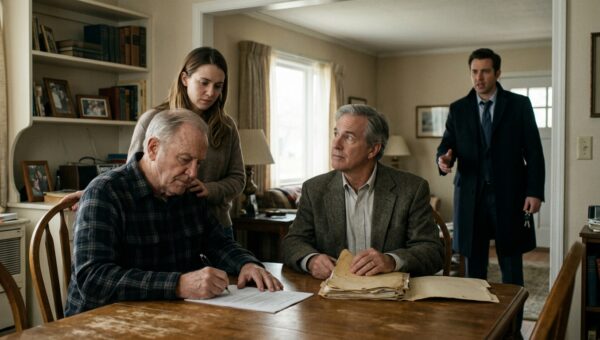
Julian did not even bother to knock on the screen door. He just shoved it open until the latch rattled in its frame and marched straight into the parlor where the two burly movers were wrestling the heavy Singer machine toward the front door. “Hold on right there,” Julian barked, holding his hand up like a traffic cop at a busy intersection. The younger mover, a kid with a crew cut and a sweat-stained gray t-shirt, stopped dead and looked over his shoulder at me. “Is there a problem here, ma’am?” he asked, wiping his forehead with the back of a thick wrist.
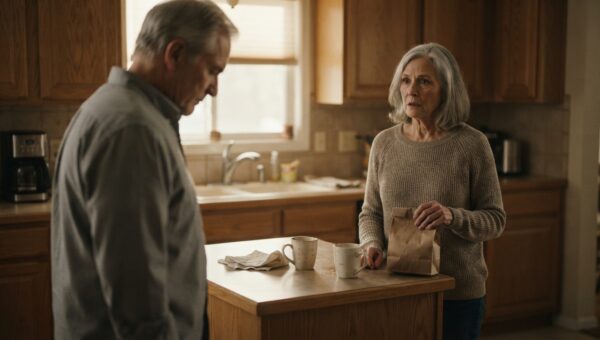
I stepped out from the tiny kitchen hallway, wiping my hands on a dish towel I had forgotten I was holding. “There is no problem, boys,” I said, keeping my voice level because I knew how Julian liked to turn a simple disagreement into a three-act neighborhood play. “Aunt Clara left this machine to me in the paperwork.
It is signed, witnessed, and filed down at the county courthouse.” Julian let out a short, ugly bark of laughter that had zero humor in it. “Signed by an old woman whose mind was halfway out the door,” he snapped, taking two long strides across the rug until he was standing right in front of me, smelling faintly of stale pipe tobacco and wintergreen mints. “You spent six months bringing her soup and sitting in this drafty room just to work your way into her good graces, didn’t you? You knew this machine was worth money to a collector. You always were calculating when it came down to what you could get out of people.”
I did not fight him; I was tired of arguing over furniture. My right hip was aching from sleeping on Clara’s narrow spare-room cot, and the rain was still tapping a dull, relentless rhythm against the glass of the front window. “Take your jacket off, Julian, you are tracking mud on the wool,” I said quietly, which seemed to make him even madder because it completely ignored his speech about my greed.
He opened his mouth to say something sharper, something about my mother or the way I handled my own finances back when the mill closed down, but before the words could come out, the movers shifted their grip to clear the raised threshold of the front door.
The heavy iron frame gave a sharp groan as it tilted over the rug edge. With a dry, rattling snap, a hidden wooden latch on the lower side panel gave way under the sudden shift in weight. A tiny paper label slid out from the hollow interior cavity where the spare bobbins used to live, fluttering in the draft before landing face-up on the polished hardwood floor right between Julian’s shiny loafers.
Julian snatched it up before I could even bend my knees, his fingers closing over the slip of paper with a speed that surprised me. He pulled it back toward his chest, his eyes darting across the faded purple ink scribbled in Clara’s unmistakable handwriting. The red color in his cheeks drained away in a matter of seconds, leaving his skin the color of skim milk. He looked at me then, not with anger anymore, but with a wide-eyed, hollow sort of horror, as if he had just understood why she chose me to inherit her only real possession.
“What is that?” I asked, taking one slow step forward. Julian did not answer. His lips were parted slightly, and his chest rose and fell in a shallow, rapid rhythm that made his expensive leather jacket creak. He tried to fold the paper into a tiny square, his fingers trembling so badly he dropped it again, letting it rest right by my left shoe. I did not rush to pick it up. I just looked down at it, seeing the neat, precise rows of figures and the old bank stamp in the corner that dated back twelve full years to the summer Julian swore he was going to lose his first house down in the bottoms.
The faded ink spelled out a total of $3,840 paid directly to the county credit union, signed with Clara’s initials and a brief, blunt note in the margin that I did not even need to squint to read. “For Julian’s back taxes,” it said in that familiar schoolteacher cursive she had practiced until the day she died. “So he can keep the roof over his kids.” Julian had spent twenty years telling everyone at Thanksgiving dinner that he was a self-made man who pulled himself out of debt through sheer grit and long hours at the auto auction, never once mentioning the old woman who sat in the dark sewing custom denim until her fingers bled so the sheriff would not padlock his front door.
Nobody said anything for a second, and honestly that felt worse than all his shouting. The two movers stood awkwardly by the screen door, holding the heavy Singer between them like an uncomfortable secret they wanted to set down on the porch and forget. Julian swallowed hard, his throat working visibly beneath his collar. “I didn’t know she kept the slip,” he whispered, his voice losing all that big courthouse bluster until it sounded small and thin, like a child caught stealing apples from an orchard. “I thought she burned all those old papers when she cleared out the back room.”
“She kept a lot of things people thought she forgot,” I said, my voice barely louder than the hum of the refrigerator in the next room. Julian looked at the machine, then down at the paper on the floor, and finally at me, his eyes begging for something he knew he had no right to ask for. He reached out one hand as if he might touch the wooden cabinet, then let it drop back to his side with a dull slap against his thigh. He did not try to stuff it into his pocket or make up a lie about checking for spare needles. The proof was right there in black and purple ink, undeniable and heavy as the iron it came from.
“Keep it,” Julian muttered, staring at the floorboards near my shoes. “Just… take it wherever you are going.” He turned around without another word, his shoulders hunched inside the leather jacket, and walked out the screen door without even pulling it shut behind him. I heard his Buick engine turn over on the third try, the starter dragging a little before catching, and then the gravel crunched as he backed out into the rain and drove away down the lane without looking back once.
The movers set the machine down carefully by the front window where the afternoon light was starting to break through the gray clouds. I paid them their cash, added a ten-dollar bill for the trouble of the heavy lifting, and watched from the porch as their truck rolled down the road and turned the corner by the feed store. The house was finally quiet, the kind of quiet that feels like an empty church after the Sunday crowd has cleared out.
I walked back into the parlor, picked up the small yellowed label from the floor, and slid it back into the secret wooden slot inside the machine’s base where Clara had tucked it away all those years ago. Then I sat down on the cane-bottomed chair, ran my hand over the smooth black iron of the handwheel, and listened to the rain finally stop dripping from the eaves.