Eighty-one is a hard age to keep secrets, but Mom managed it for eleven years right under our noses. It started with a Tuesday afternoon phone call that didn’t make any sense. The specialty pharmacy downtown left a message on my landline about a biological prescription sitting in their mini-fridge that Clara wouldn’t come get. I figured it was her blood pressure meds again, or maybe those potassium pills her doctor kept nagging her about.
When I drove over with groceries the next morning, I asked her about it while I was putting the milk away in her tiny white refrigerator. She just waved a dish towel at me and didn’t look up from the sink. They mixed me up with somebody else, she said, her voice too bright and too fast. I dropped it because Mom was eighty-one and stubborn as a mule, and arguing with her usually just meant three days of cold shoulders.
Then came the second call ten days later. The pharmacist sounded annoyed this time, reading off an automated script about signature verification and cold-chain compliance. He said the medication had finally been collected on Thursday morning by a family member. My stomach did a slow, heavy turn. I don’t live with her, and my brother Gerald lives clear across the parish down in Houma working the shrimp docks, and neither of us had set foot in that pharmacy.
I called Gerald right from my truck in the grocery store parking lot. He didn’t pick up on the first ring, and when he called back, he sounded like he’d just woken up from a hard nap. He hadn’t touched the place. He hadn’t even been north of the bayou in three weeks.
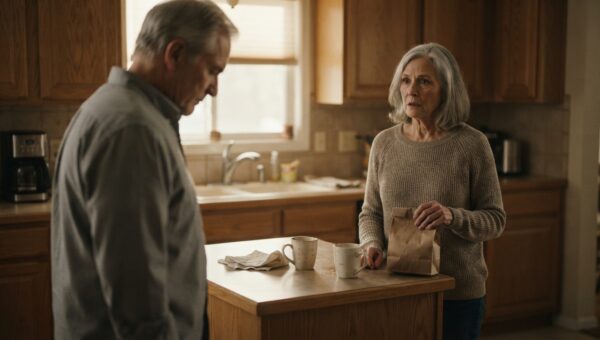
I didn’t bother calling Mom back. I just turned my car around and drove straight to her apartment on Hawthorne Street. The air was thick and gray, that heavy Gulf Coast damp that makes your clothes stick to your skin before you even reach the front step. When I let myself in with my spare key, the smell of lemon floor wax and boiled coffee hit me like it always did. Mom was sitting right there at the Formica kitchen table, perfectly still, with a small royal blue soft-sided cooler bag tucked against the table leg by her left shoe.
She looked up when the door clicked shut, and her face went tight and small in a way I hadn’t seen since Dad died. She knew before I even opened my mouth. I walked across the linoleum, pulled out the metal-framed chair opposite her, and set my keys down with a sharp clatter. I pointed right down at the floor. Whose is that, Mom? I asked. She didn’t move for a long second, her hands folded in her lap like she was waiting for mass to start. She just looked at the blue nylon zipper.
She reached down, unzipped the lid herself, and pulled out a cardboard box with a pharmacy label printed in bright red ink. The name on the sticker wasn’t ours. It said Leo Vance, and the storage instructions called for continuous refrigeration between thirty-six and forty-six degrees. Inside were three small glass vials of expensive biological fluid that cost more than my monthly car payment.
I looked at the name and then back up at her wrinkled face, waiting for her to laugh it off or tell me some rambling story about a neighbor. But she just stared at the salt shaker in the middle of the table. Your father asked me to keep helping after he was gone, she whispered. Dad had been dead eleven years. He died of a sudden stroke in his sleep on a rainy Tuesday morning, leaving behind a stack of unfinished tax forms, a half-repaired outboard motor in the shed, and a reputation as a man who could talk the salt out of the sea.
I asked her what my father had to do with a stranger’s prescription drugs arriving at a downtown pharmacy every month. Mom didn’t yell or get defensive like she usually did when I pried into her business. She just reached into the pocket of her floral cardigan and pulled out a scrap of lined yellow paper with a string of numbers and a street name written in Arthur’s heavy, sloping handwriting. He had a debt, she told me, and it wasn’t the kind you settle with a checkbook. She didn’t want to explain the whole thing, but she gave me the address on the edge of town, right where the suburban tract houses gave way to the overgrown marsh grass and the drainage canals. Go see for yourself if you have to, she muttered, pushing the yellow scrap across the laminate toward my hand.
I left her sitting there in the quiet apartment with the blue cooler at her feet. Driving out to the edge of the parish, my mind was racing through every old story Dad used to tell over Sunday pot roast, trying to find a name that matched Leo Vance. The address turned out to be a low-slung brick duplex with peeling white paint on the trim and a wheelchair ramp bolted clumsily over the front steps. A rusted Honda civic with a flat rear tire sat in the gravel drive. When I knocked on the wooden screen door, I could hear the faint, steady hum of an oxygen concentrator running inside, rhythmically breathing in the dim hallway.
A man in his fifties with gray hair sticking out in every direction opened the door an inch, holding onto the frame with one white-knuckled hand. His legs had that stiff, awkward angle to them that comes from advanced nerve damage, and his eyes darted around nervously before locking onto my face. I’m looking for Leo Vance, I said, keeping my voice low so I wouldn’t scare him. He stared at me for a long beat, his jaw twitching slightly. You’re not Clara, he said, his voice raspy and thin from disuse. I told him who I was, and the tension in his shoulders didn’t drop, but he pulled the door open a little wider and let me step inside out of the heavy humidity.
The front room smelled faintly of rubbing alcohol and old carpet. On a small side table next to a worn-out recliner sat a mini dorm fridge with a digital thermometer taped to the door, glowing a steady thirty-eight degrees. That was where the coolers went. That was where Clara’s secret had been ending up twice a month for over a decade. Leo didn’t make me ask twice. He sat down heavily in his chair, gesturing for me to take the straight-backed wooden seat near the window. Arthur didn’t owe me anything legally, Leo said, looking down at his own trembling hands. Back in the seventies, when the old chemical plant down by the river was still running three shifts, my dad worked the night line with him. There was an accident. Nothing the company took blame for, but Arthur was the shift boss. He could have pushed harder for the safety review. Instead, he kept his head down to protect his promotion, and my old man ended up with a lung full of solvent vapors that cut his working years in half.
Leo looked up at me, his eyes tired but entirely without malice. When your dad retired, he felt it. He started showing up here once a month with grocery money, and when my legs started giving out ten years ago, he found out about these experimental treatments. He paid out of pocket through some specialty account he set up before he died. When he passed away, I figured that was the end of it. I figured I’d have to give up the apartment and move into the state facility down on highway ninety. But then Clara showed up on my porch two weeks after the funeral. She had the first cooler bag in her hand, and she told me Arthur left a ledger with instructions, and she wasn’t about to let his word turn into garbage. She’s been driving out here every single month, rain or shine, through floods and summer heat, hauling that heavy bag because she thought a promise made by a dead man was still a contract written in iron.
I sat there in that quiet, dim room listening to the oxygen machine hum, feeling like the floor had dropped out from under my shoes. I thought about my mother driving herself across town at eighty-one years old, hiding the expense from her own kids because she was too proud to let us question Dad’s legacy, and too loyal to let a sick man suffer for a mistake made forty years ago. She had been carrying the weight of two dead men on her frail shoulders, treating a stranger’s medical care like a sacred duty she couldn’t drop without failing Arthur one last time.
When I drove back to Hawthorne Street later that afternoon, the sun was dipping low below the horizon, painting the sky the color of a bruised plum. Mom was still sitting at the kitchen table, exactly where I had left her hours before, though she had turned on the little brass desk lamp next to the calendar. She didn’t look up when I walked in. I didn’t yell, and I didn’t lecture her about safety or tell her she was crazy. I just walked over, pulled the empty blue cooler bag out from under the table, and folded the nylon sides flat so it could fit neatly into the hall closet out of sight.
I poured two cups of instant coffee from the glass pot on the counter and set one down right in front of her. She looked at the steam rising from the mug, then up at my face, her lower lip trembling just a fraction before she set her jaw. We’re going to call the pharmacy tomorrow, I said quietly, pulling out the chair and sitting down across from her in the warm yellow light. We are going to set up a proper courier account with the medical supply house so nobody has to drive across town in the rain anymore, and we are going to split the scheduling with Gerald whether he likes it or not.
Mom stared at her coffee for a long time, her thin shoulders dropping about two inches as the tight knot of tension finally left her back. She didn’t say thank you, because people like Clara don’t talk that way when they’re rescued from their own stubbornness. She just reached out, wrapped her cold fingers around the warm ceramic mug, and took a slow sip while the kitchen grew quiet around us.