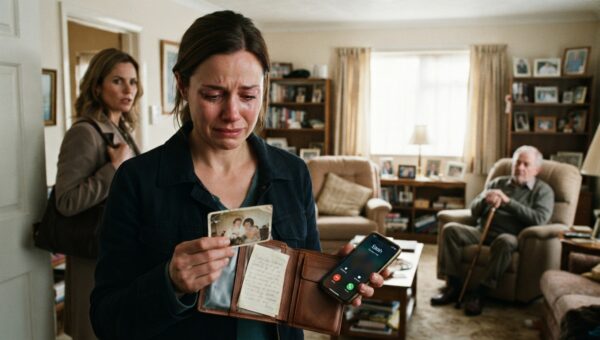
Forty-one years. I had spent exactly forty-one years believing I knew the shape of my own life. I thought my history started with Arthur and Martha Vance in a drafty Victorian on the edge of Salem. I thought my story was a simple one of love and steady, middle-class normalcy. I was wrong.
I started clearing the house on a Thursday. It was supposed to be a quick job.
Just pull the wallpaper, paint the rooms, and put the place on the market. The air in the upstairs bedroom was stale, smelling of old cedar and the dust of a life lived in quiet repetition. I was working on the far wall, the one behind where my mother’s dresser had stood since I was a child. The scraper snagged on something behind a loose seam of floral paper.
I didn’t think much of it at first. I assumed it was just a piece of loose lath. But when I pulled the paper back, the wood underneath didn’t look right. It was hollow. I pried the board away, expecting maybe a dead mouse or some old insulation, but my fingers brushed against thick, textured paper.
I pulled out a yellowed envelope. It was sealed with heavy wax that had long since turned brittle. My name was written on the front in a sharp, hurried script. To Clara. If you are reading this, I am gone.
I sat down on the floor right there. The silence in the room was heavy, the kind that makes your ears ring. I broke the seal with my thumbnail. The paper inside was thin and smelled of age. My hands were shaking so bad the pages rattled.
The letter began with a date from 1984. It said that when I was six weeks old, a woman came to the Vances’ door. She was crying. She begged them to take me. Your father was dangerous, the letter read. He was capable of things that would have destroyed us both.
My brain sort of stopped working. I read the words again, but they didn’t make any sense. Arthur and Martha were my parents. They were the ones who taught me to draw botanical illustrations, the ones who drove me to every piano lesson.
The letter went on to explain that this woman had made a deal with them. She would give me up to save me, but she couldn’t leave me entirely.
She visits every birthday. Sits in a car across the street, watching you grow.
My birthday had been three days ago. I stood up, my legs feeling like lead. I didn’t even pack up my tools. I just went downstairs to the office where I kept my laptop. My heart was hammering against my ribs so hard I could feel it in my throat. I logged into the home security system. We had installed those cameras a few years back, and they kept a cloud archive. I filtered for the morning of my birthday.
I scrubbed the timeline back to 8:00 AM. There it was. A modest, older-model blue Honda, parked perfectly still across the street. I watched the footage for an hour.
Nobody got out. The car just sat there, idling in the morning light. I checked the logs for the year before, and the year before that. Every single year, on my birthday, that same blue Honda appeared. It was always there for two hours.
Then I remembered the porch. Last year, on my fortieth birthday, I had opened the front door to find a small, velvet box. There was no card, no note. Just a simple gold bracelet inside. It had cost me $180 when I checked the value later, thinking it might have been a gift from a friend who forgot to sign it. I felt sick.
I didn’t think. I just moved. I grabbed my coat and walked out the front door. I didn’t care that I was still wearing my dusty work clothes. I marched down the driveway, and as I reached the sidewalk, the blue Honda turned the corner. It slowed down when it saw me.
The car crawled toward the curb and stopped. The engine cut out. The silence that followed was louder than any noise I had ever heard. The driver’s side door clicked open, and an elderly woman stepped out. She looked like she had been carved out of winter. Her hair was silver, streaked with white, and her coat was worn at the cuffs.
She looked up. Her eyes caught mine, and I felt the air leave my lungs. They were my eyes. The same amber flecks, the same stubborn set of the jaw. She looked like a ghost of who I might become in thirty years.
“You found the letter,” she whispered. Her voice was thin, like paper tearing. She was clutching her handbag so hard her knuckles were white.
I couldn’t breathe. “Who are you?”
She didn’t try to lie. She didn’t try to run. She reached into her pocket and pulled out a small, faded photograph. I recognized the yellow knit blanket in the picture instantly because it was still tucked away in my baby box upstairs.
“I’m Evelyn,” she said. “I’m your mother.”
We didn’t go inside right away. We stood on the sidewalk while the afternoon wind picked up. I felt like I was standing in the middle of a dream where everything I knew was being dismantled. She looked at me, not with hunger, but with a kind of desperate, guarded relief.
“I didn’t want to leave you,” she said. Her hands were trembling. “I had to.”
I wanted to scream. I wanted to ask her why she didn’t just walk up to the door and knock instead of sitting in a car like a stalker for forty-one years. But when I looked at her, I saw the fear still etched into her face. This wasn’t a choice she had made out of cruelty. It was a choice made out of survival.
“Arthur and Martha,” I said. “They were my parents.”
“They were my best friends,” she replied. “They were the only people I trusted to keep you away from him. He was a violent man, Clara. He wouldn’t have let you go.”
I thought about Arthur. He had been a quiet, gentle man. He never raised his voice. He had loved me with a fierce, steady intensity that I had always taken for granted. To think he had been guarding me from a shadow for all those years, that he had been the wall between me and someone dangerous, felt like a physical weight on my chest.
“Every year,” I said, my voice barely a whisper. “You were watching.”
“I promised I would stay away until you were safe,” she said. “I didn’t want to complicate your life. You were happy. I saw that you were happy. That was all I needed.”
The escalation of the day felt like it was peaking. My reality was spinning, but I felt a strange, cold clarity forming. I realized that my entire life had been a carefully constructed sanctuary, built by three people who loved me enough to keep a secret for over four decades.
“Come inside,” I said.
She hesitated. “I don’t want to intrude.”
“Come inside,” I repeated.
We walked into the kitchen. It was the same room where I had learned to bake, where I had done my homework, where I had sat through countless dinners. I felt like an intruder in my own home. We sat at the kitchen table. I went to the closet and pulled out the box where I kept my jewelry. I took out the $180 gold bracelet and laid it on the table between us. Then I went upstairs and grabbed the yellow knit blanket from the box.
I placed them both on the table. Evelyn reached out, her fingers hovering just above the fabric. She didn’t touch it. She looked at me, and I saw the forty-one years of distance in her eyes.
“I never stopped counting,” she said. “Not a single day.”
I asked her about everything. She told me about the man she had fled, a man who had left a trail of wreckage behind him. She told me how she had moved three towns over and started a life of her own, a life defined by the distance she kept from me. She had worked in a warehouse, lived in a small apartment, and spent every penny she could spare on making sure she had a reliable car to make the trip on my birthday.
“I didn’t have much,” she said, looking at the bracelet. “But I wanted you to have something from me. Just once. So you would know you weren’t forgotten.”
I felt the anger I had been carrying, the confusion, the sense of betrayal, start to dissolve. It was replaced by a hollow, aching empathy. She hadn’t been watching me as a stranger. She had been watching me as a mother who had surrendered her own life so that I could have mine.
I realized then that I had been looking for a villain in this story, but there wasn’t one. There was only a mother who had lost everything, and a daughter who had been given the gift of a life that was never supposed to be hers.
“Stay for dinner,” I said.
The silence that followed was different now. It wasn’t the heavy, suffocating silence of an empty house. It was the quiet of two people trying to bridge a lifetime in a single afternoon. We spent the next two days talking. We looked at old family photographs, and I showed her the drawings I had done for my illustrations. She told me about her life, about the things she had missed, and the things she had kept hidden.
We didn’t fix everything. You can’t fix forty-one years in a weekend. But we started. We moved the ghosts out of the corners and into the light.
On Sunday evening, it was time for her to go. She walked out to the blue Honda parked in the driveway. The sun was dipping low, casting long, orange shadows across the lawn. I stood on the porch, my arms wrapped around myself. The air was crisp, smelling of late spring and damp earth.
She got into the car and rolled down the window. She looked at me, and for the first time, she didn’t look haunted. She looked tired, but it was the kind of tired that comes after a long, hard climb.
“I’ll see you next Sunday?” she asked.
I looked at the car, then back at her. “Yes,” I said. “I’ll have dinner ready.”
She smiled, and it was the most genuine thing I had ever seen. She started the engine, and the car hummed to life. I stayed on the porch, watching the taillights fade into the dusk, feeling the weight of the last three days settle into something I could actually carry. I wasn’t just Clara Vance anymore. I was a person with a history, a person with a mother who had waited forty-one years to finally come home.
I turned back to the house. The wallpaper was still stripped, the floor was covered in dust, and my life was completely different than it had been three days ago. But as I walked back inside, I didn’t feel like I was clearing out a house to sell it. I felt like I was finally moving in.