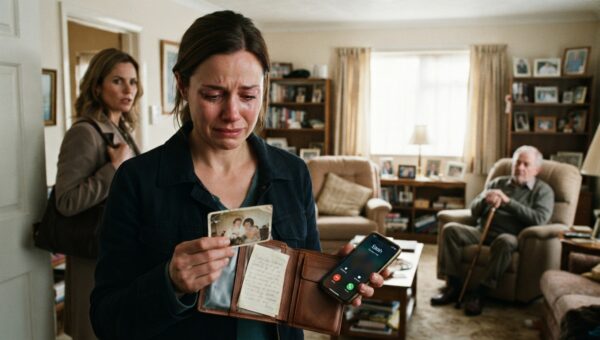
The photograph was a tiny square of fading colors, tucked behind a print of a fern I had been restoring for three weeks. I kept it there because it felt safe, a relic of a life I had packed away in cardboard boxes and buried under the weight of a quiet, coastal existence. I was fifty-four, and my life in Portland was measured in the steady, rhythmic scratching of my pens against heavy-weight paper.
I liked the silence. Silence didn’t have the high-pitched, jagged shriek of a hospital monitor, and it certainly didn’t have the smell of antiseptic and old grief. I liked my life exactly the way it was: predictable, lonely, and untouched by the past.
Then came the knock. It was 8:14 on a Tuesday morning, a time I usually spent waiting for my tea to steep. I didn’t get many visitors, and the sound of knuckles against wood was so out of place that I actually walked to the door with my tea mug still in my hand, steam curling into the crisp Maine air. When I pulled the door open, the woman standing there took my breath away. She was thirty-two, maybe thirty-three, with eyes that seemed to look right through my walls and into the corners of my heart. She didn’t say hello. She just held out a hand, a small piece of paper fluttering slightly in the breeze.
It was the Polaroid. The edges were soft and worn, the colors shifted toward that sickly, familiar orange of 1994. In the grainy focus, I saw my own hands. They were younger, the skin smooth, the knuckles not yet aching from the damp winters of the North. I was cradling a tiny, fragile bundle, my thumb resting against a scrap of gauze that served as a diaper. I knew the ward ID stamped on the back before she even turned it over. I felt my stomach drop, that cold, heavy sensation of a secret finally catching up.
She looked from the photo to my face, her voice low and steady. “You were twenty-two, you worked the night shift, and you sang ‘You Are My Sunshine’ for six hours straight when nobody else would touch me.”
I didn’t answer. I couldn’t. I felt the tea mug tremble in my grip, and I set it down on the hallway table with a sharp, ceramic clack.
My brain felt like it had stalled, the gears grinding against years of careful suppression. I remembered the night. The October rain had been lashing against the hospital windows in Boston, the wind howling like a wounded animal. A mother had been rushed in, bleeding out, and the baby had been born too early, too small, and too quiet. The doctors had labeled her a lost cause. They said the oxygen saturation was too low to sustain life, that the equipment was needed for others, that the protocol was to let nature take its course.
I had been the only one on the floor who refused to look away. I had spent that entire, endless shift with my arms inside the isolette, my fingers curled around her tiny, translucent chest. I sang. I sang until my throat was raw, until the sound of my own voice was the only thing keeping the world from collapsing.
I sang that song because it was the only one I knew that didn’t have a funeral dirge attached to it. I didn’t care about the rules. I didn’t care about the shift supervisor’s warnings about burnout or detachment. I just held on.
“Come inside,” I whispered. My voice sounded thin, like a page turning.
She stepped into the entryway, and I saw the way she looked at the house. She wasn’t just looking at the furniture or the paintings; she was looking for a home, a place where she belonged. I led her to the kitchen, the sunlight hitting the oak floor in long, amber slats. I put the kettle back on, my hands shaking so hard I had to grip the counter to keep from dropping the tea leaves. I needed to know. I needed to know how she had found me, how she had carried that photo through thirty years of a life I knew nothing about.
“I found the files last month,” she said. She sat at my small pine table, her hands folded tightly in her lap. “My adoptive parents were wonderful, but they didn’t know the specifics. They just knew I was a miracle.”
She told me about the archives, the way she had spent months digging through basement boxes in the city, searching for the name of the nurse who had logged the stabilization event. She had tracked the hospital badges, the old ward shifts, the microscopic, handwritten notes that were never meant to see the light of day. She told me about the discharge summary, that one sterile paragraph that described her survival as an anomaly, a fluke of medical record-keeping. I listened to her talk, and it felt like the floorboards beneath my feet were finally settling after years of shifting.
“I needed to know if it was real,” she said. “I needed to know if someone actually cared.”
I didn’t say a word. I walked over to the corner of the room, to the cedar chest that I hadn’t opened since I moved to Maine. I lifted the heavy lid, the scent of lavender and dust rising up to meet me. Tucked deep beneath my old scrubs and a pile of letters I never sent was a small, leather-bound notebook. It was my logbook. Not the official one, that had been shredded decades ago, but the one I kept for myself. I brought it to the table and flipped the pages, the paper dry and brittle.
I found the entry. October 14, 1994. My handwriting was frantic, sprawling across the blue lines. *Baby Girl Lin. Stable after extended tactile and vocal stimulation. Singing works. Please, just don’t let her go.*
I pushed the book across the table. Her eyes welled up, and she traced the ink with a trembling finger. She didn’t cry, not yet, but I saw the way her shoulders finally dropped, the tension of thirty years leaving her frame. She looked at me then, really looked at me, and I saw the woman she had grown into. She was strong, resilient, and she had survived the darkness that I had fought to keep away from her all those years ago.
“You didn’t let me go,” she whispered.
I sat down across from her, the silence between us shifting from something I feared to something that was finally, finally warm. We talked for hours. We talked about the life she had lived, the architectural preservation work she did in Boston, the way she liked the smell of old stone and wood. I told her about my life here, about the restoration of the prints, the quiet solitude I had built like a fortress. I realized then that my fortress wasn’t protecting me at all. It was just keeping me in a cage of my own making, a cage built on the fear that if I ever looked back, I wouldn’t be able to handle the weight of what I had seen.
But I was handling it. I was sitting there, drinking tea with the life I had saved, and the world hadn’t ended. The sky was still blue, the tide was still coming in, and the hurt wasn’t a sharp pain anymore. It was just a part of the story. It was the cost of being human.
“I’m not leaving tomorrow,” she said, looking out at the garden. “I have a few weeks. I want to see how you do the work.”
I smiled, a real smile that felt stiff after so long. “I’d like that.”
The next few days were a blur of shared history and new beginnings. She helped me with the botanical prints, her steady hands mirroring the ones I remembered from the photo. We found a rhythm, an easy, quiet companionship that I hadn’t realized I was starving for. I stopped worrying about the silence. I stopped worrying about the past. I realized that the secret wasn’t a burden anymore; it was a bridge.
It was late in the afternoon on her last day in Maine. We were sitting on the sun porch, the golden light of October spilling over the flowerbeds. I had found an old cassette player in the attic, the kind with the chunky plastic buttons and the hiss of tape. I put in the tape I had kept for all these years, the one with the song recorded off the radio. The music was scratchy, the notes thin and tinny, but it filled the room with a kind of grace that I hadn’t heard in three decades.
“You Are My Sunshine” played, and we both sat there, listening to the melody that had changed the course of both our lives. I didn’t look at her. I just looked out at the garden, at the way the light caught the leaves of the trees. I finally said the thing I had avoided for thirty years.
“I never thought you’d grow up to be so kind.”
She reached out and took my hand, her grip warm and solid. “I had a good start.”
I sat there, listening to the music, and for the first time in my life, I wasn’t afraid of the future. I had spent so long holding my breath, waiting for the monitors to alarm, waiting for the worst to happen. But the worst had already happened, and we had made it through. We were here. And for now, that was enough. I let the song play out until the tape clicked into silence, the only sound left the steady, peaceful rhythm of the ocean against the rocks.