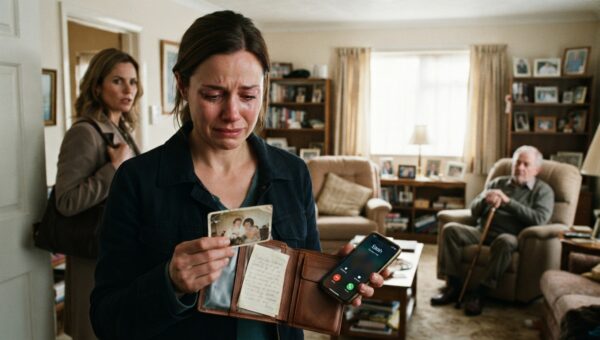
The air in the salon always smelled like hot rollers and that specific, sharp brand of hairspray that Mom used for thirty years. I stood in the doorway, my boots feeling heavy against the linoleum. It had been nearly a year since the dirt hit the casket, and honestly, I had avoided this place like the plague. I didn’t want to talk about her, and I definitely didn’t want to explain why I had kept her standing appointment active on my credit card for ten months.
It was just one of those things I kept paying for, like a ghost still getting her roots touched up every Friday at 9:00 a.m. sharp.
I saw Renee walking toward the front desk. She looked tired, the way people do when they’ve spent their whole lives standing on concrete floors. When she saw me, her entire face changed. She didn’t offer a polite greeting. She just reached out and took both of my hands in hers. Her palms were calloused from years of holding shears and spray bottles.
“We never gave away your mother’s appointment,” she said, and her voice barely rose above the hum of the overhead lights. “Every Friday at nine, we just left her chair empty.”
Nobody said anything for a second, and the silence in the room felt heavier than the grief I had been carrying. I just stood there because my brain kind of stopped working.
I expected a bill. I expected a lecture on why I was wasting money on a dead woman’s schedule. But Renee just turned around and walked over to a heavy oak cabinet behind the reception counter. She pulled out a drawer that looked like it hadn’t been touched in a decade.
She brought back an envelope that was thick and yellowed at the edges. It felt like it had been sitting in that drawer, waiting for the exact moment I finally cracked. She held it out to me.
“Your mom left this with her two summers ago,” she said, her eyes searching mine for some sign of recognition. “She told me to give it to you when you were finally ready to come.”
My hands started shaking as I looked down at the envelope. I knew that handwriting better than my own. It was loopy, slanted, and always a little impatient.
But as I traced the name written on the front, my pulse kicked up a notch. It wasn’t my name. It was the name of the man who had walked out on us in 1994, the man she told me had died in a car accident in another state.
I didn’t open it there. I couldn’t. I shoved the envelope into my purse, muttered something about needing to get to work, and practically ran to my truck. I drove until the town turned into cornfields, pulled over onto the shoulder, and finally tore the paper open.
Inside, there wasn’t a letter. There was a stack of legal documents and a bank book. The bank book was for an account in a city I hadn’t visited since I was seven years old. The balance was $87,412.00. That was more money than Mom had ever made in a year as a school secretary.
I started flipping through the pages, my breath coming in short, jagged gasps. Every month, for twenty-seven years, a deposit of $269.00 had been made. The sender name was listed simply as Trust 402.
I thought about the years we spent eating chipped beef on toast and wearing hand-me-down clothes. I remembered the arguments about the electric bill and the way she’d cry silently in the kitchen when she thought I was asleep. She had been sitting on almost a hundred thousand dollars while I worked three jobs to put myself through nursing school.
I didn’t go home. I turned the truck around and drove toward the only place that made sense, the law office of an old friend of hers who had passed away shortly after she did. I spent the next three hours sitting in a waiting room that smelled like old paper and lemon polish, waiting for the junior partner to show up. When he finally walked out, he looked at me like I was a ghost.
“I need to know who Trust 402 is,” I said, holding the bank book out like a weapon.
He looked at the papers, then looked at me, and sighed. “Your mother was a very private woman, but she was also a very frightened one.”
“She told me my father was dead,” I said, my voice rising. “She told me he died in a wreck.”
“He didn’t die,” the lawyer said, leaning back in his creaky leather chair. “He just went to prison, and he had a very lucrative business that wasn’t exactly legal. Your mother took the money to ensure you never had to live like he did. She was terrified that if you knew where the money came from, you’d try to find him. She wanted you to have a life that wasn’t tainted by his choices.”
I sat there, feeling the room tilt. All those years of struggle, all those nights of her working double shifts, it was all a performance. She wasn’t broke. She was building a firewall between me and a man I had spent my entire adult life mourning. She had taken the role of the impoverished single mother to keep me safe from the truth of a criminal father.
“She kept the account secret because she knew you’d never touch it if you knew,” he added, his voice low. “She said you were too much like your father. Too headstrong. She was right.”
I walked out of that office into the harsh afternoon sunlight, the bank book feeling like a lead weight in my pocket. I went back to the salon, not because I needed a haircut, but because I needed to see that empty chair again. The shop was closed, but Renee was still inside, wiping down the mirrors. She looked up, saw me, and walked to the door, unlocking it just a crack.
“I found out,” I said, my voice flat. “Everything.”
Renee just nodded. “She was the bravest woman I ever knew. She spent her whole life trying to rewrite the ending of a story she didn’t choose.”
“She lied to me,” I said, and for the first time in a year, the tears finally started to fall. “She lied to me for thirty years.”
“She didn’t lie to you,” Renee said, her voice soft but firm. “She chose you. She chose you over the comfort of that money, and she chose you over the truth every single Friday for three decades.”
I looked at the empty chair. I saw her sitting there, week after week, staring at her reflection in the mirror, wondering if I was safe, wondering if I was happy, and wondering if I would ever understand what she had sacrificed to keep me away from him. I had spent years resenting her for her poverty, for her struggles, and for the way she seemed to hold herself back from the world. I thought she was small, but she was just being quiet. She was the anchor that kept me from drifting into a storm I didn’t even know existed.
I left the salon and drove to the cemetery. It was a long walk through the grass, and the wind was picking up, tugging at my coat. I stood over her headstone, the grass wet with early evening dew. I didn’t feel angry anymore. I didn’t feel betrayed. I just felt a deep, hollow exhaustion.
I pulled the bank book out of my purse and set it on the grass. The numbers were just digits, but the weight of them was immense. I thought about the house, the bills, and the life I had built on the assumption that we had nothing. I realized then that everything I had, the education, the career, the way I stood on my own two feet, was bought with her silence. She had paid for my independence with her own misery.
I sat down on the cold ground and traced the letters of her name. I didn’t say a prayer. I didn’t even cry. I just sat there, listening to the trees rustle in the dark. It was a strange kind of peace, the kind that only comes when you realize that the person you thought you knew was actually a stranger, and yet, they loved you more than you could ever possibly deserve.
The sun started to dip below the horizon, painting the sky in colors of bruised purple and gold. I stood up, brushed the grass off my knees, and left the bank book right there on the grave. It wasn’t mine. It never had been. It was the price of a life she had decided I needed to have, and I was finally starting to understand why she had paid it.
I walked back to my truck, my steps lighter than they had been in years. I didn’t look back. I had the empty space where my life used to be, and for the first time, I felt like I could finally start filling it with something that was actually mine. The truth didn’t set me free, but it did make the weight of the silence a lot easier to carry. I drove home, leaving the money, the secrets, and the ghost of the woman she pretended to be behind in the dark.
I don’t know what I’ll do tomorrow. I don’t know if I’ll ever go back to that salon, or if I’ll ever speak of this again. But as I pulled into my driveway and turned off the engine, I looked at the house and realized it wasn’t a prison anymore. It was just a house. And for the first time in my life, I was the only one living in it.