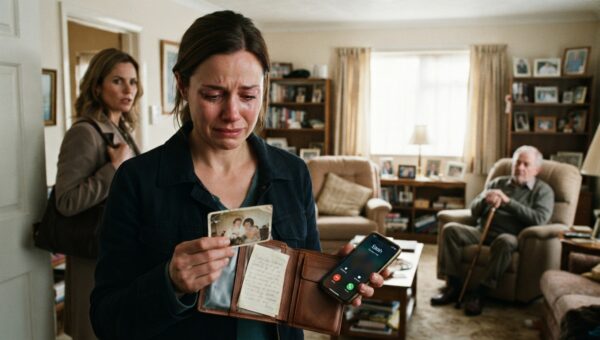
The afternoon light in my Knoxville home was thin and gray, the kind of light that makes you feel like you are standing inside a photograph that is slowly fading away. I had spent three days packing up my mother’s life, filling cardboard boxes with books, linens, and the sort of kitchen clutter that gathers over seventy-one years of existence.
Margaret Higgins was a librarian, a woman who lived by the Dewey Decimal System and believed in the sanctity of a quiet, orderly life. I was her only child, and I had spent my entire life thinking I was the only witness to that life.
I was working on her heavy mahogany writing desk, the one she had brought with her from Georgia decades before I was even a thought. The bottom drawer had always been locked, a small, stubborn brass keyhole that she swore was broken whenever I asked about it as a kid. I had a flat-head screwdriver and a heavy dose of grief-fueled frustration that afternoon. I didn’t care about the wood anymore. I just wanted to be done. The lock gave way with a sharp, sickening snap of metal, and the drawer slid open with a protest of dust and age.
It wasn’t a diary. It wasn’t a stash of hidden love letters or old jewelry.
It was just a thin, blue-bound yearbook from 1974 and a metal tin filled with hundreds of small, brittle slips of paper.
I pulled the yearbook out first. It smelled like cedar and time. I knew Mom had grown up in a coastal town near Savannah, but she never talked about it. I flipped to the back, to the pages meant for signatures and well-wishes. There, stretching across the entire bottom margin in a bold, sweeping script that looked like it had been written by a boy who believed he was immortal, was the note. To Margaret. I will find you again. I promise. Love, James.
I sat there on the hardwood floor for a long time. My father was Robert, a man who had died in a car accident when I was three. My life was built on that story. I turned to the senior portraits. There he was: James Fuller.
Class president, varsity debate, the kind of kid who looked like he was already practicing his graduation speech in the mirror. He looked like the world belonged to him.
I went back to the metal tin. I started sorting through the slips. They weren’t just receipts. They were bank transfer confirmations. Monthly deposits. Every single month for thirty-eight years. The amounts were steady, enough to cover rent or tuition, enough to keep a single mother and her daughter from ever hitting rock bottom. They were all routed through a blind trust in Atlanta, addressed to a post office box in Knoxville that I hadn’t even known existed.
My hands felt cold. I didn’t call my friends. I didn’t pour a drink. I went to my laptop and searched his name. The first hit was a directory for the Superior Court of Georgia. James Fuller, retired Judge. He looked exactly how you would expect a man like that to look.
Silver hair, eyes that looked like they were tired of seeing the world’s mistakes, a home in a gated neighborhood in Savannah.
I found the number for his private office, back when he still practiced. I didn’t think. I just pressed the buttons.
The line rang three times. A deep, gravelly voice answered. “Fuller residence.”
I held my breath. “Is this Judge James Fuller?”
“Speaking,” he said.
He waited. I waited. The silence stretched out, thick and heavy, until it felt like the line itself was humming with the weight of thirty-eight years. It lasted eight seconds. My heart was thumping against my ribs so hard I thought he might be able to hear it through the receiver.
“Margaret’s daughter,” he whispered.
The air left my chest. “How do you know who I am?”
“Six hundred dollars a month,” he said. His voice was different now. It sounded like something brittle was cracking inside of him. “For thirty-eight years. To a post office box in your mother’s name. I never missed a payment. Because you are my…”
He stopped. The line went dead. He didn’t hang up, but the connection was severed by the sudden, suffocating weight of what he couldn’t bring himself to finish saying.
I didn’t sleep that night. I spent the hours packing a single suitcase. I needed to see him. I needed to know why a man with that much power had decided that a post office box and a monthly check were enough to keep his conscience clear while my mother spent her life working in a library, keeping her head down and her secrets tucked into a locked drawer.
The flight to Savannah was quiet. The city itself felt like a graveyard of old promises. When I reached his house, it was everything I expected, a massive, sprawling place with an oak tree in the front that had probably been there since the Civil War. He opened the door himself. He looked smaller than his photograph. His shoulders were hunched, and his eyes were watery behind heavy glasses.
He led me into his study. The walls were lined with books, just like Mom’s, but his were leather-bound and expensive. He tried to offer me water. He tried to talk about the weather. I just looked at him until he stopped. I put the yearbook and the tin of bank slips on his desk.
“Tell me,” I said. My voice was steadier than I felt.
He started to talk, and he didn’t stop for an hour. He told me about his father, a man who had been a political powerhouse and who had threatened to destroy everything Margaret’s family owned if James didn’t walk away when he found out she was pregnant. He talked about the pressure, the fear, and the cowardice that had defined his youth. He talked about how he had set up the trust in secret, using a shell company, terrified that his father would find out he was still funneling money to the girl he had been forced to abandon.
“I loved her,” he said. “I never stopped loving her. Every month, I thought it would be the month I would finally drive to Knoxville and tell her I was ready to face them. And every month, I stayed here. I was a judge who couldn’t even judge his own life.”
I listened to him, but I didn’t feel the catharsis I had expected. I didn’t feel like a girl who had finally found her father. I felt like a witness to a crime that had been committed in slow motion for four decades. He reached into his desk drawer and pulled out a checkbook. He started talking about restitution, about setting up a new trust, about making sure I was taken care of for the rest of my life.
He looked at me like he was trying to buy back the decades he’d thrown away. It was offensive. It was the same cowardice he’d shown in 1978, just in a more expensive suit.
I waited for him to finish his pitch. When he reached for his pen, I stood up and pushed the tin of bank slips back toward him. The metal made a harsh, scraping sound against the mahogany.
“You think this is a ledger, James?” I asked. “You think you can just balance the books on my life?”
He stopped, his hand hovering over the checkbook.
“My mother worked until her joints ached to make sure I had what I needed,” I said. “She didn’t need your conscience insurance. She needed a man who wouldn’t hide behind a blind trust while she raised his child in silence. You didn’t buy my life. You just bought yourself a way to sleep at night.”
I told him I didn’t want a dime of his money. I didn’t want his estate, and I didn’t want his name added to mine. I was a Higgins. I had been a Higgins my whole life, and I didn’t need the validation of a man who hadn’t been there for a single birthday or a single scraped knee.
His face went gray. He looked like he was about to fall over. But then I looked at the framed photos on his desk. There were pictures of a woman I assumed was his wife, and two children, both around my age, who had grown up in this house, surrounded by privilege and safety.
“They don’t know, do they?” I asked.
He looked down at the floor. “No. They don’t.”
I told him I wasn’t going to destroy his life. I wasn’t going to go to the press or show up at his family’s front door to cause a scene. I had more dignity than that, and more importantly, I had more respect for my mother’s privacy than he had ever shown her. But I set one condition.
“You are going to tell them,” I said. “Not today. Not tomorrow. But you are going to tell them that I exist. You are going to tell them that you had a child and that you chose to keep her a secret for thirty-eight years. You are going to give them the truth, and then you have to live with the fact that they know exactly who you are.”
He didn’t argue. He just nodded, his face buried in his hands.
I didn’t stay for dinner. I didn’t stay for another glass of water. I walked out of that house and into the humid Savannah air, feeling lighter than I had in years. I had come looking for a father, and I had found a broken, frightened old man. But I had also found something else: I had found my mother again. I understood now that her silence hadn’t been weakness. It had been a wall she built to protect me from the messiness of his cowardice. She had done the hard part. She had raised me without his help, without his money, and without his recognition.
I flew back to Knoxville that night. The house was quiet when I got home, but it didn’t feel empty anymore. I sat down at the kitchen table, the one place where Mom and I had spent so many nights talking about nothing and everything. I took the 1974 yearbook out of my bag. I opened it to the back page, where he had written his promise.
I didn’t trace the words with anger anymore. I traced them with a kind of pity. It was just ink on paper, a ghost of a boy who never grew up. I set the book down next to a branch of autumn leaves I’d picked up from the front porch, the colors a brilliant, dying orange. I felt steady. I felt like the person I was before I’d unlocked that drawer, only now, I knew the whole story. And for the first time in my life, I knew that the story wasn’t about him at all. It was about her. And that was enough.