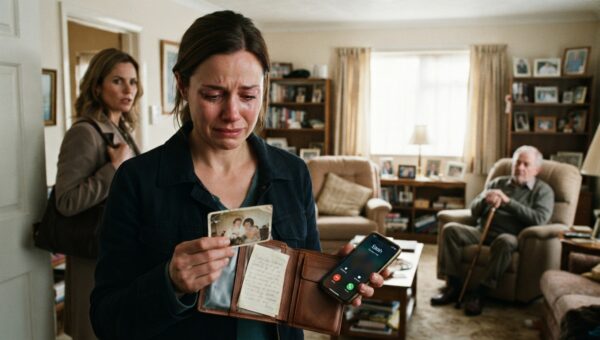
The notification was just a small, buzzing vibration against my hip. I was elbow-deep in flour, trying to finish an order of lemon tartlets, when the screen lit up with a text from Vivian. It was 10:42 in the morning. She wanted me to come over to the house by 2:00 to finalize the distribution of the remaining estate assets.
My father had been dead for exactly forty-one days. The grief was still a raw, jagged thing that caught me off guard whenever I walked past the bakery supply shop where we used to grab coffee. I wiped my hands on my apron, the white powder dusting my skin like snow, and stared at the phone. I knew I should have said no. I knew every time I interacted with her, I came away feeling diminished. But it was my father’s house. It was where I grew up. And I had this stupid, persistent hope that maybe, just maybe, she would finally stop treating me like an intruder in my own bloodline.
I arrived at 2:05. The house in the quiet, coastal Oregon town still looked the same, though the air inside felt different. It was colder. Leo and Todd were already there, sprawled out on the sofa like they owned the place, nursing beers and watching a game on the big screen.
They were twenty-eight and twenty-six, but they had the maturity of teenagers who had never been told no. Vivian walked into the kitchen, clicking her heels on the hardwood, her smile as tight and perfect as a plastic surgeon’s stitches. She was fifty-eight, dressed in linen, and she moved with the practiced ease of someone who had spent decades waiting for the main house to be hers alone.
“Glad you could make it, Clara,” she said, her voice dropping into that syrupy, patronizing tone that always made the hair on my arms stand up. She gestured toward the kitchen table, where three thick, sealed envelopes sat waiting. “I’ve been going through the probate files all week. It’s been exhausting, honestly, but I want to make sure we’re all taken care of.”
Leo snorted, taking a long pull from his bottle. “Yeah, thanks for the hard work, Mom.”
Vivian handed the envelopes to her sons, and they tore them open with zero hesitation.
They didn’t even look at the contents before shoving the checks into their pockets. Then, she turned to me. She didn’t hand me a thick, heavy envelope. Instead, she slid a wooden recipe box across the laminate surface. It was the box my mother had kept on the stove since I was a toddler. It was worn, the brass handle tarnished, and the wood was darkened from years of kitchen steam and spilled extracts.
“I figured you’d want your mother’s cards since you’re always messing around in the kitchen anyway,” she said, leaning back against the counter and sipping her mimosa. “The house and the property are tied up in legal, obviously, but this is yours. Keep it. Or toss it.”
I felt my jaw tighten. I reached out and rested my hand on the box. I could feel the familiar grain of the cedar. My mother had taught me to bake bread using the cards in that box.
I remembered the grease stain on the peach cobbler recipe, the one we used every single August when the harvest came in. I looked at Vivian. She was watching me, her eyes unblinking, waiting for me to react, waiting for me to crumble or to argue. I didn’t give her the satisfaction. I just tucked the box under my arm. “Thanks,” I said, my voice thin. “I’ll see myself out.”
I drove home in silence, the box sitting on the passenger seat like a heavy, wooden heart. When I got back to my apartment, I set it on my small kitchen counter. I didn’t want to look at it at first. The grief was hitting me in waves, and the sight of the box just made the hole in my chest ache harder. But later that night, I couldn’t sleep. I felt a weird, nagging urge to check the cards, maybe pick something to bake that would make the place smell like my childhood. I opened the lid. The cards were all there, organized alphabetically, the smell of vanilla and dry paper wafting up to meet me.
But then I went to pull out the card for the peach cobbler, and something felt wrong. The stack didn’t sit flush against the back wall. It was tilted, the right side sitting nearly a quarter-inch higher than the left. I frowned, pulling out all the cards until the box was empty. I ran my fingers over the bottom. It felt solid, but there was a faint, hairline seam near the back. I grabbed a pairing knife from the drawer and pried at the edge. A thin, false cedar panel popped up, revealing a hidden compartment I had never known existed.
Underneath, taped to the floor of the box, was a folded, legal-sized document. My hands started to shake. I didn’t recognize the paper at first, but when I unfolded it, the air left the room. It was a quitclaim deed. It transferred 100% of the family home and the entire coastal acreage to Vivian. It was dated three days before my father died. I stared at the signature line. It was my father’s name, but the handwriting was erratic, the letters shaky and distorted, a jagged shadow of the man who had signed my high school diploma with a firm, steady hand.
I didn’t scream. I just stood there because my brain kind of stopped working for a second. I realized then that Vivian hadn’t given me the box because she was feeling nostalgic. She had used it as a safe deposit box for her forgery, banking on the fact that I would be too blinded by grief to ever look underneath the cards. She thought I was just a sentimental baker who would cherish the box, never thinking to inspect its guts. I looked at the notary stamp at the bottom. The name was unfamiliar, a clerk from a firm in another county, and the stamp was faint, like it had been pressed by someone who wasn’t sure how it worked.
Panic hit me first, followed by a cold, sharp clarity. I realized my father hadn’t signed that. He was on heavy medication in hospice three days before he died, barely able to lift a glass of water, let alone sign away his legacy. This was a theft. It was a calculated, cold-blooded maneuver to leave me with nothing but a box of recipes.
I didn’t call Vivian. I didn’t post on social media. I grabbed the box and the document, threw them into a bag, and drove to the house of a local attorney I’d known since childhood. Mr. Henderson was retired, but he was good, and he hated bullies. He looked at the deed, looked at the forensic markers, and his face turned to stone.
“Clara,” he said softly, “this isn’t just a forgery. This is a crime.”
He sent me to a forensic document examiner in Portland the next morning. It cost me $2,400 out of my savings, but I didn’t care. By Thursday, I had the report in my hands. The signature was traced. The notary stamp was fraudulent. And I had a list of the properties Vivian was already putting up for sale. The grand finale was planned for Saturday night at the local country club, a gala for the land developers who were buying the coastal acreage.
Saturday night arrived. I wore a black dress, the one I used for funerals and serious meetings. I had a USB drive in my pocket with high-resolution scans of the forged deed and the examiner’s certification. When I walked into the ballroom of the country club, the air smelled like expensive lilies and chilled champagne. I saw Vivian near the podium, looking radiant in a silk gown, laughing with the lead developer. She looked like she had already won.
I walked toward the A/V station. The technician looked at me, confused, but I flashed a firm smile and said, “I’m with the estate lawyers. We have a brief correction for the presentation.”
I plugged the drive into the console. As Vivian stepped up to the microphone, her voice echoing through the hall as she thanked everyone for their support, I hit enter. The projector screen behind her flickered, then displayed the forged deed in massive, undeniable detail. The forensic certification, highlighted in red ink, was right next to it.
“I am so proud to see this legacy move forward,” Vivian said, oblivious, before she turned around and saw the room.
The murmurs started first, then a loud, collective gasp. I walked to the microphone, my heart hammering against my ribs, but my hands were steady. “That document is a forgery,” I said, my voice ringing out, cutting through the silence. “I have the forensic report to prove it. Any contract signed tonight is legally void because the title is currently under a felony cloud.”
Vivian turned a chalky, mottled white. She dropped her champagne flute, and it shattered loudly on the hardwood, the sound like a gunshot. Leo and Todd were already moving toward the side exit, their faces pale and panicked. The lead developer stood up, looked at the giant image of the forged signature, and then turned back to Vivian.
“Is this true?” he asked, his voice icy.
Vivian opened her mouth, then closed it. She tried to say something, but nothing came out. The developer shook his head, pulled out his phone, and walked out of the room. The gala effectively ended right there. Within twenty minutes, the ballroom was clearing out, the guests whispering as they hurried to their cars.
I didn’t stay to watch her crumble. I didn’t need to. I walked out into the cool, damp night air of coastal Oregon, the weight of the box under my arm finally starting to lift. The legal process took another two weeks, but it was brutal and fast. Vivian’s counsel, seeing the mountain of evidence, advised her to settle. She signed away the house and the acreage, paid all the fees, and she and her sons were gone within the month.
I stood in my kitchen on a crisp November afternoon. The house was mine again. The silence wasn’t cold anymore; it was peaceful. I opened the vintage wooden recipe box. I took my mother’s peach cobbler card, the one with the grease stain and the familiar handwriting, and I slid it back into its proper place. I pressed the brass clasp shut. It clicked with a sharp, echoing snap. It was done.