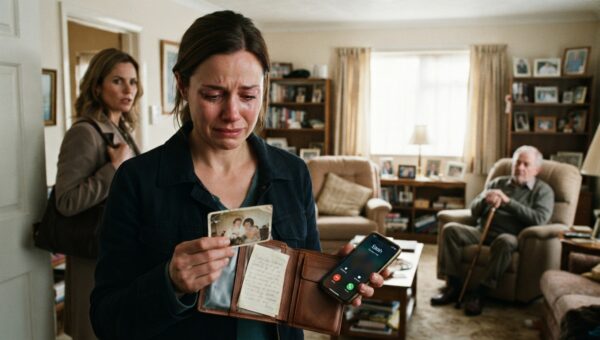
My father’s funeral felt like a long, dull ache that wouldn’t let up. I spent three weeks moving through the house like a ghost, touching the surfaces he used to touch, waiting for a grief that felt heavy enough to actually settle in my bones. It didn’t come. Instead, I just felt a hollow sort of irritation. Vivian, his second wife, had moved with a speed that was almost clinical.
Within days of the service, she had professional cleaners scouring the house and appraisers cataloging every piece of furniture like they were preparing for an estate sale at a flea market.
She finally invited me over on a Tuesday evening to talk about the final distribution of assets. I walked into the kitchen and found my stepbrothers, Leo and Todd, sprawling across the stools at the island. They were drinking expensive scotch and laughing about some real estate seminar they’d attended in Portland. They didn’t even look up when I walked in. They were too busy checking their phones and scrolling through stock tickers. Vivian sat at the head of the table, looking perfectly put-together in a silk blouse that cost more than my entire kitchen renovation. She had a bottle of chilled Chardonnay sitting on the marble counter, sweating in the coastal humidity.
She gestured for me to sit. “Clara, dear, we’ve made some decisions to streamline the estate,” she said, her voice smooth and polished like river stone.
She slid a thick, white envelope toward me. Inside were checks for five thousand dollars, labeled as funeral expenses. Then, she pulled a small, battered object from under her chair and placed it in the center of the table. It was my mother’s old recipe box. The wood was dark with years of use, the brass handle tarnished almost black. “I figured you’d want your mother’s cards, since you’re always baking,” she added with a thin, tight smile. Leo snorted, his glass clinking against the counter. “Don’t burn the house down with your flour, Clara,” he muttered. I didn’t say a word. I just reached out and took the box. My fingers felt the weight of it, the way it had always sat on the counter back when things were still whole.
I left as soon as I could, my throat tight. I drove back to my own place, a small, two-bedroom bungalow on the other side of town.
The silence there was better than the noise at Vivian’s. I set the recipe box on my kitchen island. It smelled like dry cinnamon and dust. I wanted to see the peach cobbler recipe, the one my mother used to make every July when the fruit was heavy and sweet. I started going through the cards, one by one. The handwriting was familiar, looping and graceful, fading in spots where the ink had thinned.
When I reached the back of the box, something caught my attention. The cards didn’t sit flat against the back panel. There was a weird, rhythmic tension in the wood. I pressed down, and the stack didn’t budge. It felt like there was a spring or a thick wedge under the floorboards of the box. I frowned and tipped it over, dumping the index cards into a pile. I ran my thumb over the interior base.
It was definitely a false floor, a thin piece of cedar that had been glued and taped to cover a hollow space.
I grabbed a paring knife from the block and slid the tip under the corner of the wood. It gave way with a sickening, dry snap of old adhesive. Underneath, folded into a tight, perfect square, was a document. I recognized the official letterhead of the county records office immediately. My heart started thumping in my ears, a loud, jagged beat. I unfolded the paper. My vision blurred for a second, then sharpened. It was a quitclaim deed. It transferred the ownership of our historic family acreage, including the house where I grew up, directly to Vivian. The date was stamped three days before my father’s death. I stared at the signature. It was my father’s name, but the loops were all wrong. The slant was too sharp, the pen pressure too heavy, like someone had tried to copy his hand while he was drifting in and out of a morphine haze.
My hands started shaking so hard I had to set the paper down on the counter. The room felt suddenly cold. I looked at the notary stamp in the corner. It was for a woman named Elise Vane, a name I had never heard of. I pulled out my phone and searched the registry. The license had been revoked months ago for predatory lending practices. I sat there in the dark, the reality settling into my chest like lead. Vivian hadn’t given me this box as a gift. She had used it as a safe. She knew I was the only one who cared about the recipes. She knew I would treat the box with enough reverence that I would never think to tear it apart. She had been hiding her crime in plain sight, using my own sentimentality as the lock on the vault.
I didn’t sleep that night. I spent the hours until dawn sitting on my floor, staring at the deed. By 8:00 AM, I was in the office of a probate attorney I’d found through a friend. His name was Miller, an older man with gray hair and a sharp, cynical look in his eyes. He didn’t ask questions. He just listened, looked at the document, and frowned. “This is a felony, Clara,” he said, his voice quiet. “If this signature is forged, we can stop the transfer. But we need proof before we tip our hand.” I told him I had the money for a forensic expert. I didn’t care what it cost. I had saved for ten years for my own shop. This was better spent on justice.
The report came back on Friday. The signature was a trace-copy, likely executed with a light box, and the notary stamp had been applied by someone who didn’t even have an active commission. The evidence was ironclad. Miller leaned back in his chair, rubbing his chin. “She’s planning to sell,” he said. “The developers are moving in on the coastal property on Monday. She’s hosting a gala at the country club tomorrow night to finalize the contract.” I looked at him, my resolve hardening. “Then I’m going to the gala,” I said.
The country club was decorated with white lilies and overpriced streamers. I wore a simple black dress, the kind that made me look invisible until the moment I chose not to be. I carried a manila envelope tucked under my arm. The security staff looked at me, but I walked past them like I owned the place, my head high. I found the A/V tech in the back of the ballroom, a kid named Jeremy who looked bored out of his mind. I told him I was a late addition to the presentation for the estate transition. I handed him the flash drive with the high-resolution scans of the deed and the forensic report. “Make sure it’s at full volume,” I whispered.
Vivian was on the podium, smiling that same thin, tight smile she’d worn at the kitchen table. She was talking about “legacy” and “family growth,” the words tasting like ash. I stood in the back, my pulse thrumming in my wrists. Then, I gave Jeremy the nod. The house lights dimmed. The giant projector screen behind Vivian flickered to life. A high-resolution image of the forged deed hit the wall, magnified to ten feet tall. Beside it, the forensic examiner’s affidavit appeared in bright, clear text, highlighting every discrepancy in my father’s signature.
The room went dead silent. You could hear the hum of the air conditioning unit. Vivian turned, her face twisting in confusion, then realization, then a sort of gray, mottled terror. She dropped her champagne flute. It didn’t just fall; it shattered against the floor, the sound echoing like a gunshot. The developers at the front table stood up, their faces turning from curiosity to cold outrage. I stepped out of the shadows and walked toward the microphone.
“That deed is a fraud,” I said. My voice didn’t shake. It didn’t even waver. “And the woman on that stage is a criminal who stole my father’s last days from him.” The murmurs in the room turned into a low roar. Vivian tried to speak, but her mouth just moved in a silent, jagged rhythm. Her sons, Leo and Todd, were already halfway to the side exit, tripping over each other to get out of the building. The lead developer, a man named Sterling, walked up to the stage and grabbed the microphone. “This meeting is over,” he announced, his voice booming through the speakers. “We don’t do business with felons.”
Vivian crumpled. She didn’t faint, but she lost every ounce of her polish, sagging against the podium like a puppet with cut strings. Her legal counsel was already on the phone, looking frantic, but there was no escaping the room. The local police were already waiting in the lobby. Miller had made sure of that.
It took two weeks of legal battles, but the resolution was swift and brutal. The deed was voided by the court. The property was returned to the estate, and because I was the sole heir mentioned in my father’s true, original will, it came back to me. Vivian and her sons were forced to pay every cent of the legal and forensic fees, a total of forty-two thousand dollars. They left the county under a cloud of shame, moving to a small apartment in a city three states away to avoid the criminal charges we were holding over their heads.
A month later, the house was quiet again. I had the locks changed, the windows cleaned, and the air scrubbed of that fake, expensive perfume Vivian liked to wear. On a crisp, Tuesday afternoon, I walked into the kitchen. I felt a peace I hadn’t known in years. I reached into the cupboard and pulled out the vintage wooden recipe box. I placed it on the kitchen counter, right where my mother had kept it for all those years. I took out my own copy of her peach cobbler recipe, the one I had rewritten in my own hand. I slid it into the slot, the paper crisp and clean. I pushed the brass clasp shut. It clicked, a sharp, final, satisfying sound that signaled the end of the long, gray fog. I stood there for a long time, just looking at the box, knowing that for the first time, everything inside it was exactly what it was supposed to be.