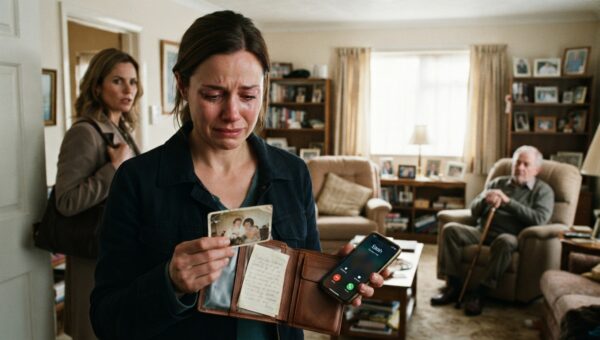
“I figured you would want your mother’s cooking cards since you are always messing around in the kitchen anyway.”
That was what Vivian said, and I remember the way she tilted her head when she said it. She was standing in the middle of our family’s living room in rural Virginia, the air still thick with the smell of lilies from the funeral we had finished three weeks prior.
She looked perfectly put together in her tailored black suit, holding a glass of chilled mimosa like she was at a country club brunch instead of settling an estate. My stepbrothers, Leo and Todd, were sprawled on the sofa behind her, already counting the digits on the checks she had handed them earlier that afternoon.
I stood there holding the box. It was heavy, made of solid cedar that had darkened to the color of strong coffee over the last thirty years. My mother had kept it on the kitchen counter for as long as I could remember. It was the place where she stored the secret to her peach cobbler, her sourdough starter adjustments, and every family memory that could be written down on a grease-stained index card. I didn’t want to be in the same room as Vivian for one more second, so I just nodded, took the box, and walked out the front door.
The drive back to my apartment was quiet. My hands felt strange on the steering wheel, as if I were holding a ghost. I had been living in a haze since my father passed away, a blur of lawyers, funeral arrangements, and Vivian’s constant, condescending reassurances that she was handling the “tedious logistics” of the homestead. I hadn’t been back to the house in weeks, and frankly, I didn’t want to go back again if she was going to be standing there, acting like the queen of a castle she had only lived in for five years.
I got home and set the box on my own kitchen counter. It felt like a small, solid piece of my childhood had finally returned to me. I sat down, opened the lid, and let the familiar smell of dried nutmeg and old paper fill the air. It was a comfort I didn’t know I needed until that moment.
I started flipping through the cards, looking for the peach cobbler recipe, wanting to bake something that tasted like home.
That was when I noticed the stack of cards didn’t sit right.
They were pushed against the back wall of the box, but there was a gap. I pulled the cards out and stacked them on the counter. Then I looked into the box. The bottom wasn’t flush. The right side sat about a quarter-inch higher than the left. I frowned, thinking maybe a piece of wood had warped over time, but when I pushed down on the right side, it didn’t budge. It felt solid, but it sounded hollow, like a drum.
I grabbed a paring knife from my drawer. I didn’t know why I was doing it, but something in my gut, that same feeling I get when a batch of dough doesn’t rise the way it should, told me to look closer.
I wedged the thin blade into the gap along the edge of the cedar base. It hit something hard, but it wasn’t wood. It was tape.
I moved the knife slowly, careful not to scratch the cedar. The wood gave way with a faint, dry snap. It was a false floor, taped in place with yellowed masking tape that had lost most of its stickiness. I pulled it up, and my breath caught in my throat.
Folded neatly underneath was a thick piece of parchment. It was a property assignment deed. I unfolded it on my counter, and my hands started to shake. It was a legal document transferring one hundred percent of the family’s acreage and the homestead to Vivian. It was dated three days before my father died.
The signature at the bottom was my father’s. But it wasn’t his. It was a jagged, distorted version of the handwriting I had seen on a thousand birthday cards. It looked like someone had guided his hand while he was deep in the fog of hospice medication.
I stared at that paper for a long time. The silence in my apartment felt heavy, like it was pressing in on my chest. I thought about the way Vivian had handed me that box. She hadn’t given it to me out of love or nostalgia. She had used it as a safe. She knew I cherished that box. She knew I would keep it close, keep it safe, and never dream of tearing it apart. She had used my own grief as a padlock.
I didn’t scream. I didn’t call her. I sat in the dark for a while, my brain racing through every conversation we’d had since the funeral. I realized then that I wasn’t just dealing with a grieving widow. I was dealing with a predator.
The next morning, I was at the office of a probate lawyer I had known since I was a kid. I didn’t tell him why I was there until I laid the deed on his desk. He looked at it, then at me, and his face went grave. He told me he couldn’t represent me in a criminal matter, but he pointed me to a forensic handwriting expert.
I spent the next three days in a blur of meetings. The expert was blunt. “This is a trace, Clara. Whoever did this had a template of his signature and a very steady, very cold hand.”
The notary seal on the deed was the final nail. It belonged to a shipping clerk whose license had been pulled months before my father even entered hospice. It was a sloppy job, probably done in a rush while she thought no one would ever look behind the pretty facade of the family estate.
I learned that Vivian was already moving to liquidate the land. She had a public auction scheduled at the county agricultural hall for that Saturday. She was planning to sell the family homestead to a regional developer who didn’t care about the history of the soil. She wanted the cash, and she wanted it gone before anyone could ask questions about the inheritance.
Saturday arrived with a cold, biting wind. I dressed in my best suit, the one I wore to the funeral, and put the forensic report and the original deed into a clean manila folder. I felt like I was walking to the gallows, but for the first time in months, I felt clear-headed.
The agricultural hall was crowded with people in expensive coats, developers, and local speculators looking for a deal. I saw Vivian standing near the front, looking radiant and busy, talking to a man in a navy suit who I recognized as the lead developer from the city. She was laughing, her head thrown back, probably talking about how much she hated to part with the “old property.”
I didn’t wait for her to see me. I walked straight up to the A/V console near the front of the room. A technician was there, looking bored. I didn’t give him a chance to ask questions. I plugged in my flash drive and hit the command to project the files.
The massive screen behind the podium flickered to life. A high-resolution scan of the forged deed appeared, massive and undeniable. Right next to it, I had the forensic report.
Vivian turned around, her smile frozen on her face. The room went dead silent. The only sound was the hum of the projector.
I stepped up to the microphone. My voice sounded steady, even to me. “My name is Clara Abbott. That document you see on the screen is a forgery. My father did not sign away the family land three days before he died. I have a court-ordered title freeze request here, and any developer who signs a contract today is participating in a felony land theft.”
I didn’t look at her at first. I looked at the developer. He was staring at the screen, his face turning a deep, angry red. He turned to Vivian, and I heard him say, “You told me the title was clean.”
“It is clean, it’s just a misunderstanding,” Vivian stammered, her voice thin and high. She looked like she wanted to disappear into the hardwood floor.
“It’s not a misunderstanding,” I said into the microphone. “It’s fraud.”
The room erupted. The murmurs were like a tide coming in. People started whispering, pointing, and reaching for their phones. I saw Leo and Todd, my stepbrothers, ducking their heads and trying to slip toward the exit. They didn’t even look back at their mother.
Vivian turned a color I hadn’t seen before. It was a mottled, sickly white. She dropped her portfolio, and it hit the floor with a loud slap. She tried to say something, but the developer wasn’t listening. He was already walking toward the door, snapping his phone shut.
“We’re done,” he said, not even looking at her. “Cancel the auction.”
The room started to clear out. People didn’t want to be anywhere near a fraud investigation. Within ten minutes, the hall was almost empty, except for me, Vivian, and a couple of security guards who looked like they weren’t sure what to do.
Vivian walked toward me. She wasn’t smiling anymore. She looked old, tired, and desperate. “You’ve ruined everything, Clara. Do you have any idea what you’ve done?”
I looked at her. I didn’t feel the rage I expected. I just felt a cold, hard sense of justice. “I did what you couldn’t do, Vivian. I protected what was mine.”
She tried to bluster, to threaten me with lawyers, but the fear in her eyes gave her away. She knew the fraud was documented. She knew the forensic report would hold up in any court in the state. Her legal counsel reached out to mine by Monday morning, begging for a quiet settlement.
The process took two weeks. It was exhausting. There were depositions, meetings with county officials, and endless paperwork. But in the end, the court annulled the forged deed. The property was returned to me. Vivian was forced to pay every cent of the legal and forensic fees, and she and her sons packed their bags and left the county within the month. They didn’t even say goodbye to the neighbors.
It’s been a few months now. The house is quiet, and the land is still mine. I spend my days in my bakery, and my nights back at the homestead, working on the garden. It’s a lot of work, but it’s the kind of work I don’t mind.
This afternoon, I was in the kitchen at the homestead. The light was coming in through the window, catching the dust motes in the air. I reached for the vintage cedar recipe box. I hadn’t opened it since the day I found the deed.
I sat down at the counter and ran my fingers over the brass handle. It was tarnished, just like it had been for years. I opened the lid. The cards were still there, stained with flour and history. I reached for the peach cobbler recipe, the one I had been looking for that night so long ago.
I slid the card back into its proper slot in the back of the box. I took a deep breath, the smell of nutmeg and cedar still clinging to the wood. I closed the latch, and the sound of it, a sharp, final snap, echoed in the empty kitchen.
I left the box on the counter. I didn’t lock it away. I just left it there, sitting in the light, waiting for the next thing I needed to remember. I stood up, walked to the window, and watched the sun start to dip below the horizon of the fields that were finally, once again, mine.
The house was perfectly silent, but for the first time in a long time, it didn’t feel like it was holding its breath. It just felt like a house.
I don’t know what I’ll do tomorrow. I suppose there’s always more work to be done. There’s the fence line to fix, and the orchard needs pruning before the first frost. But for tonight, that was enough.
I turned the light off, and the room went dark. I didn’t look back at the box as I walked out of the kitchen. I just closed the door behind me and stepped out into the cool, evening air, letting the silence settle over the land.