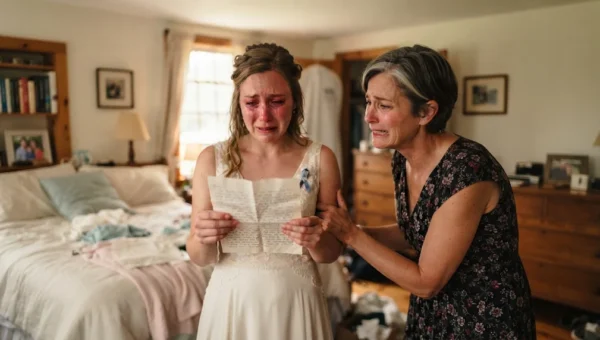
My daughter tried to take my $200,000 while I was in a hospital bed, and the house I thought I’d protected was already part of the plan.
Caroline had my purse turned inside out when the little black phone rang in her hand. She looked at the screen, then at me. I kept my eyes half closed and let my right hand rest on the blanket.
My heart monitor was making a steady little beep, and my mouth tasted like the paper cup they’d given me for pills.
The screen said Diane Foster. Before Caroline could answer, the door opened. Diane came in with a Seattle police officer and a hospital security guard right behind her.
“Put the phone down,” the officer said.
Caroline looked at me first. “Mom, I was just checking her bills.”
I didn’t say anything yet. I wanted to know what she’d do when she realized the room wasn’t hers to control.
Three weeks earlier, Diane had put a copy of my forged deed on her desk and told me someone had tried to take my house.
I’m 75. I owned a neighborhood diner in Seattle for 35 years, and I spent most of those years getting up before sunrise. I know how to keep a kitchen moving when somebody calls in sick and the coffee machine is acting up.
You make one thing at a time. You don’t waste your breath yelling at a jammed toaster.
My husband, William, died 22 years ago. Caroline was 16. I raised her by myself, and I loved her in the way a mother does, which is to say I kept making excuses for her long after the excuses stopped fitting.
I paid for college. I bought her first car. When she married Richard Vance, a financial consultant, I gave them $25,000 for the down payment on their first house. When the kids came, I watched them whenever Caroline needed me. I never kept a tally. That wasn’t how I thought being her mother worked.
Maybe I should have paid more attention when she started asking what I had saved. “How much is still in your account, Mom?” she asked one afternoon. A week later, she wanted to know why I hadn’t put her name on it.
Richard asked different questions. Was my mortgage paid off? Did I still have William’s old investment papers? Had I thought about putting my house in a family trust?
I told myself they were worried about me getting older. To be fair, I was getting older. I had started using a pill box, and I did once leave my reading glasses in the freezer. But I knew what I owned and what I wanted to do with it.
Caroline brought a folder to my house three weeks before my heart attack. She said it was medical and estate paperwork, “just so we can help if you get sick.” I made coffee while she spread the pages across my kitchen table.
Halfway through, I saw a document that would transfer my house to a company called Summit Peak Investments.
“What’s this?” I asked.
Caroline reached for the papers. “Richard must have included the wrong page.”
“Then I’m not signing anything.”
Her voice got sharp. “Mom, you make everything so difficult. What happens if you get confused and can’t manage your own affairs?”
“I’m reading what you brought me.”
She took the folder and left. I remember there was a little ring of coffee on the table where her glass had been. I wiped it up after she was gone. I don’t know why I remember that, except I was trying to keep my hands busy.
The next morning I took the papers to Diane Foster, my attorney. Diane had handled my will for years. She read every page without talking, then went back to one of them and read it again.
“Margaret, this is serious.”
She explained that the paperwork would transfer my house. Then she showed me a county filing that had already been submitted using a signature that looked like mine.
It wasn’t mine.
The county recorder had rejected it because the notarization was defective. I sat there looking at my name on the page. I’d signed it enough times in my life to know the difference. The capital M was too neat. The last stroke didn’t trail off the way mine did.
“Could Caroline have signed this?” I asked.
“I can’t tell you who signed it,” Diane said. “But someone tried to transfer your home.”
I was mad, but I was also embarrassed. I’d spent years telling people Caroline had a good heart. I said that even when she was being selfish, because admitting I’d raised a daughter who could use me felt like admitting I’d failed at the one job that mattered.
Diane told me to lock down my accounts. I went straight to the bank. They changed my passwords and set up an extra verbal check on transfers over $5,000. Anything that looked wrong would trigger a temporary hold.
Then I bought a cheap prepaid flip phone. Diane’s number went in the first speed-dial spot. I hid the phone in the bottom of my purse, under a folded grocery list and a packet of tissues.
I hoped I was being foolish. I really did.
Three weeks later, I woke with crushing pain in my chest. The ambulance ride is mostly a blur, except for the paramedic asking me to tell him my address twice. At Swedish Medical Center, the doctors said I’d had a moderate heart attack. Treatment stabilized me. They told me I was serious, but improving.
Caroline arrived later. I was relieved when I saw her. That’s the part I wish I could make sound smarter than it was. She kissed my forehead and said, “Mom, you really scared us.”
Then she looked at my smartphone on the tray.
“Can I borrow that for a minute?”
She picked it up before I could answer. She opened my banking app, took my weak hand and pressed my thumb against the fingerprint sensor.
“Caroline, what are you doing?”
“Mom, I’m transferring your $200,000. You probably won’t make it through the night anyway.”
I looked at her. I wasn’t confused. I wasn’t half asleep. I knew what she’d said.
“Who told you that?”
“Richard spoke to the doctor. He said your heart is failing.”
“But the doctor told me I was improving.”
“Mom, don’t start. We have massive debts. If you die, getting access to this money will be a legal nightmare.”
She started typing in the transfer details. I couldn’t move quickly, and I didn’t want to grab at her or make things worse. I watched the screen.
A red message appeared: Transfer declined. Additional authorization required.
She tried again. The next notice said the account was temporarily restricted and she needed to contact fraud prevention.
“What did you do?” she demanded.
“What do you mean?”
“Your bank account. Why can’t I move the money?”
“Maybe you should ask the bank.”
She leaned over the bed. “You’re lying in a hospital bed. Do you really want to spend your last day fighting with your own daughter?”
I closed my eyes. She thought I was scared and too weak to understand. Twenty-five minutes earlier, when she’d stepped into the hall to call Richard, I’d pulled the flip phone from my purse and called Diane.
“She’s trying to drain my money,” I whispered.
“Are you physically safe?” Diane asked.
“No.”
“Does she have your banking app open?”
“Yes.”
Diane told me not to argue with Caroline. She said to keep the other phone hidden and alert the nurse as soon as I could. Then she called hospital security and police.
So I lay still while Caroline went through my purse. She found my wallet, my keys, and a wad of tissues. Then she pulled out the flip phone.
“What is this?”
“An old phone.”
“Why do you have two phones?”
It rang in her hand.
Back in Room 412, Diane stepped beside my bed while Officer Bradley told Caroline to put the purse down. The security guard stood between Caroline and the door. Caroline held the flip phone out like it had appeared there by itself.
“Mom, what is this?” she said again.
Diane answered. “That’s my phone number. I’m the one calling.”
Caroline’s fingers loosened, and Diane took the phone from her. Officer Bradley asked Caroline to step away from the bed.
“I’m trying to help her,” Caroline said.
“Then put the phone and purse down,” he said.
“I was checking her bills.”
“You were transferring money?” Diane asked.
Caroline looked at the banking app still open on my phone. “She asked me to.”
“No, I didn’t,” I said.
It came out quiet. I had to say it again.
“No. I didn’t.”
Dr. Chen came in while Officer Bradley was asking Caroline to stay by the door. He had a chart in his hand and had probably been told there was trouble.
“Mrs. Sterling is stable,” he said. “Her heart is not failing. She is improving.”
Caroline’s mouth tightened. “Richard said you told him she might not make it.”
“I haven’t spoken to Richard,” Dr. Chen said. “I have not told anyone that.”
There it was. Not a mix-up. Not one bad guess. Caroline had told me my doctor said I was dying, and she had used that lie to rush me before I could stop her.
She sat in the chair by the wall. I could see her trying to arrange her face into a worried daughter’s face again. I knew that look. She used to make it when she’d missed curfew and wanted me to be mad at the curfew instead of her.
“Officer,” she said, “this is a family misunderstanding.”
He took her phone and asked her to wait in the hall while he got her account of what had happened. She turned to me as she stood.
“Mom, tell him I was helping.”
I didn’t.
Diane stayed by my bed. She looked tired, but not surprised. I asked how she knew to come in with police.
“I told them what you said on the phone,” she said. “They were already on the floor when the call rang.”
The banking system had put a time stamp on the failed transfer. The app showed the amount, the account, and the phone used. Hospital staff had seen Caroline take my thumb and heard her say she was moving the money. I didn’t know how much of that had been picked up by cameras, but there was enough to start with.
Then Caroline’s phone rang on the table. Richard’s name showed on the screen.
Officer Bradley was still in the corridor. Diane glanced at the phone, then at me.
“He’s calling her now,” I said.
Bradley picked it up and asked Caroline whether she wanted to answer. She shook her head. He took the phone with him as evidence and went out to speak with her.
I was shaking by then. Not from fear exactly. My body had been through a heart attack, and I’d run out of strength for pretending everything was fine.
Diane sat down. “I have something else you need to see.”
She had a folder with records from the Secretary of State’s office and the county. Summit Peak Investments wasn’t some outside company that had found my name in a list. Richard had registered it himself. The company records tied it to his personal tax number and his home address.
“Richard set it up six months ago,” Diane said. “The investigators believe he used it to move money and hide losses.”
“How much money?”
“I don’t have a final number. It’s millions.”
I looked down at the hospital blanket. My hand had a little adhesive mark from where they’d taken blood. I kept rubbing it with my thumb.
Diane explained that Richard’s unauthorized trades and missing client funds had started to catch up with him. He had taken money from older clients and used Summit Peak to shuffle assets around. He was facing an investigation and, according to the records Diane had seen, an imminent criminal indictment.
The forged deed was meant to move my paid-off house into that company. The $200,000 Caroline had tried to transfer was the liquid money Richard needed right away. He wanted it to cover losses and keep up the life they’d built. Diane believed he had also planned to use it for bail.
“So she knew?” I asked.
Diane didn’t answer too quickly. “The papers you showed me were clear. She brought them to you. She knew what the deed said.”
I kept thinking about the folder on my kitchen table. I’d wanted to believe Caroline hadn’t read the page. I’d wanted to believe Richard had slipped it in by mistake. But she’d reached for the papers before I finished asking. She knew.
Officer Bradley came back into the room with Caroline. Her eyes were wet, and she was breathing fast. She looked at Diane, then at me.
“Richard said they were going to take our house,” she said. “We’re behind on everything. He said this would keep the kids safe.”
“You told me I was dying,” I said.
“I thought you were. Richard said the doctor told him.”
“You could have asked me.”
“You were sick.”
“I was talking to you.”
She looked down at the floor. “I panicked.”
I can understand panic. I can understand fear of losing a house, or shame over debt, or believing someone who knows how to sound calm while lying. What I can’t make myself call a mistake is pressing my mother’s thumb onto a bank app while telling her she had hours to live.
“Did you know the deed was forged?” I asked.
Caroline rubbed her hands together. “Richard said it was temporary.”
“That’s not what I asked.”
She didn’t answer.
Officer Bradley told her she was being detained while they investigated attempted grand larceny, identity theft, and elder abuse. He said the bank records and phone would be preserved. She started crying harder.
“Mom, please. The kids need their grandmother.”
That got through to me. Of course it did. I had spent years being available whenever the children needed a ride, a meal, or somebody to sit with them after school. Caroline knew which part of me to reach for.
I looked at Diane. “What happens if I don’t press charges?”
“That decision doesn’t erase what happened,” she said. “The prosecutor will review the evidence.”
Caroline leaned forward. “Please don’t do this to us.”
I felt a sharp pain in my chest and pressed the call button. Dr. Chen came back in and checked me. He said it wasn’t another heart attack, but I needed to stop trying to sit up and let my body settle.
When he left, I looked at Caroline.
“William worked hard for this,” I said. “I worked 35 years for it. I’m not giving it to Richard to cover what he did.”
She cried into her hands. I didn’t reach for her.
Officer Bradley asked if I wanted to make a formal statement and cooperate with the investigation. I said yes. My voice sounded thin, but it was mine.
Caroline was taken out of the room. She asked me to call the kids. I said I would talk to Diane about what was best for them, but I wasn’t going to help her hide what she’d done.
Richard was arrested at his downtown Seattle office less than two hours later. Diane called me after the police confirmed it. They had the rejected deed filing, the Summit Peak records, and the banking attempt. His office records and client accounts were part of a much bigger investigation. Summit Peak was put into state receivership and dissolved.
Caroline faced charges tied to the attempted transfer and the forged deed. She also faced financial liability. I didn’t post bail or call anyone to make the case softer for her. I didn’t enjoy hearing what might happen to her. I just couldn’t keep treating every consequence as something I had to rescue her from.
I spent a week in the hospital. My heart settled, and the doctors let me go home with instructions I followed because, for once, I didn’t want to argue with anyone holding a clipboard.
Diane drove me back to my Seattle craftsman house. The first thing I did was stand in the kitchen and look at the table where Caroline had spread out the papers. The coffee ring was long gone. The table looked ordinary. That almost made me madder.
I changed the locks and put my house and savings into an independent trust. Diane became my power of attorney and sole executor. I revoked Caroline and Richard’s access to my accounts and added a no-contact order. My daughter would not be inheriting my home or diner savings.
I also changed my will. My money would help fund a community program for young people learning to cook and work in local kitchens. I wanted somebody who’d grown up without much to have a chance at that kind of work. I knew that part of the decision came from love for the diner, and part of it came from not wanting Richard’s company name anywhere near what I’d earned.
Caroline’s children are still my grandchildren. I didn’t ask them to pick sides, and I didn’t tell them details they were too young to carry. But I stopped using them as a reason to excuse their mother. That was hard. It was also necessary.
I signed the trust papers at my kitchen table on a clear morning. Diane had checked each page twice. I had my black coffee beside me, and William’s old diner mug in my hand. The handle had a small crack in it, so I kept my fingers around the thick part.
My daughter had chosen what to do with the life I gave her. I chose what to do with what I had left.
I sat by the bay window, holding William’s tarnished mug, and watched the sun come up over Puget Sound.