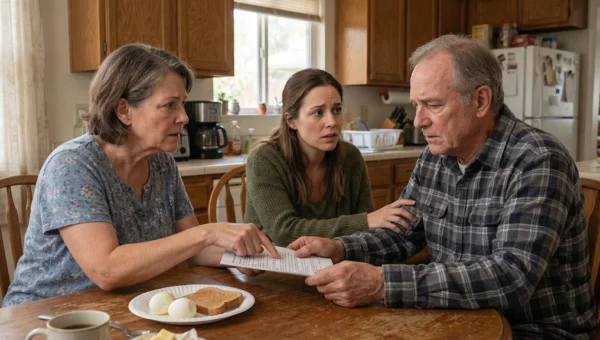
Robert had one hand on the kitchen door and the other braced on the counter when Madison asked me what I thought I was serving.
It was six in the morning. I had put out two boiled eggs, plain toast, and coffee. No butter. No jam. No bacon. The food sheet from the hospital said to keep his meals light for a while, and that was the part I could manage without calling the nurse.
Madison Clarke looked down at the plate like it had insulted her. She was still in her silk pajamas, phone in her hand. “Dad said you’d make protein pancakes.”
I looked at Robert. He was tightening the belt of his robe and studying the floor. I said the list on the fridge said no greasy food. Madison said pancakes weren’t greasy. Evan, her husband, stayed quiet by the doorway.
I’d thought the hardest part of Robert coming home after his heart scare would be helping him get up the stairs. I was wrong. The hardest part was watching my daughter speak for him while he let her.
I did not know then about the form.
We’d been married thirty-eight years. Robert had a way of saying “I’m fine” when he was tired, mad, hungry, or in pain. I used to think I could tell which one he meant by the way he set down his coffee cup.
Usually I could. Lately, I’d been guessing more than I wanted to admit.
Our cottage was in an independent-living community outside Tucson. We had a small kitchen, a little patio, and neighbors who knew when the mail came before I did. I’d been happy there. Robert liked the early walks and the old men who argued over baseball by the mailboxes.
Then, in April, he felt pressure in his chest while we were watching the evening news. He tried to call it heartburn. I told him to stop being stubborn and let me take him in. At the hospital, a doctor found a blockage and put in a stent. It wasn’t a heart attack, they said. It was still enough to make me watch the monitor whenever the nurse left the room.
I remember the nurse’s pen scratching across the food sheet. I remember the little smell of alcohol wipes on Robert’s hand.
I don’t remember most of what the doctor said. I was busy making a list in my head: pills, follow-up, rides, meals.
Robert came home after three nights. Madison and Evan drove down from Phoenix to help for a few days. I was glad. I was also embarrassed by how glad I was. I’d told people I had it handled, as if asking for help meant I’d failed at being his wife.
The first day went fine. Evan carried in the bags. Madison sorted Robert’s pills into a plastic box and asked me which ones he took at breakfast. She meant well. I know that now. At the time, I heard the question as a test.
She said she’d make meals while I got some rest. I said I was perfectly able to cook. Then I stayed up past midnight checking the discharge papers, which is not the same thing as being perfectly able.
The next morning, Madison took the food sheet off the fridge and read it aloud. She said protein was important and that she’d spoken with a dietitian at work. I said the nurse had told us low salt and easy on the fat. Madison said she knew, but Robert needed strength.
“Let me handle breakfast,” she said.
I should have let her. Instead, I told her I had breakfast handled.
By the third morning, Robert was tired of everyone asking how he felt. I get that. He was also tired of Madison telling him when to take his pills, though he never said so while she was in the room. When it was just us, he’d ask if I could bring his coffee to the patio and sit with him.
I did. I didn’t ask what he wanted to eat.
That’s the thing about taking care of someone. You can do ten kind things in a row and still get mean about the one thing you think you know best. I had a food sheet. I had a husband who’d nearly scared the life out of me. I also had a daughter who’d come to help, and I kept treating her help like an argument I had to win.
The morning of the eggs, Madison put her phone on the counter and said Dad had told her he needed protein pancakes.
Robert kept his eyes down. I could hear the coffee maker clicking as it cooled.
I said, “The hospital list says no greasy food.”
Madison said the pancakes were made with egg whites and oats. She’d brought the mix. She said they were easy, and that he’d eaten them before. I could have asked Robert. I didn’t. I looked at his face and waited for him to back me up.
He didn’t.
So I set the plates on the table. I used the cheap paper ones because I was annoyed and didn’t want to wash anything. That part was petty. I knew it then, and I know it now.
Madison didn’t eat. She said the eggs were overcooked. I said they were boiled, so she’d have to forgive me. Evan took a piece of toast and stayed out of it. Robert ate half an egg and pushed the rest around with his fork.
After breakfast, Madison showed me a text from him. It said he wanted the pancakes and asked her to bring the mix. She didn’t shove it in my face. She held it out, and I read it twice.
I said he could have told me. Robert said, “I didn’t want to get into it.”
That hurt more than it should have. Maybe more than the food deserved.
I told Madison she could make the pancakes the next morning, but I wasn’t going to guess at what the doctor meant. I wanted the nurse’s office to confirm it. Madison said she’d already checked. I said I still wanted to hear it myself.
She said, “Fine, Mom.”
I heard the fine as a door closing. It was probably just fine.
That afternoon, I called the nurse line. The nurse confirmed that Robert could have the pancakes as long as the mix wasn’t loaded with salt and he kept to the portion they’d discussed. She also said I could call anytime, which I knew, but I’d needed to hear it from someone who wasn’t my daughter.
When I told Madison, she nodded and put the mix on the counter. She didn’t say I’d been wrong. I wished she would. Then I could have been mad at her instead of myself.
The pancakes were good. Robert ate two. He said they were a little dry, which made Madison laugh. For a couple of hours we were the family we had been before. I watched her tuck a napkin under his plate, the way she used to do when she was little and dropped syrup everywhere.
In the afternoon, she asked if I wanted her to stay another week. I said no too quickly. She glanced at Robert. He said he’d be fine.
I should have caught the way she looked at him then. It wasn’t a look of someone who thought he was fine. It was a look of someone waiting for him to say what he had asked her to say.
Two days later, I went to the community office to get a second key made for Madison. She’d misplaced the one I gave her. The receptionist asked whether I wanted to add her to our emergency contact sheet. I said yes, because of course I did. Then she asked if I wanted to update the health care paperwork too.
I said we already had that.
I didn’t know what we had. That was the honest answer. Robert and I had made a will years earlier. We’d signed some forms when we moved into the community. I’d assumed the paperwork meant I could speak for him if he couldn’t.
I asked the receptionist to print whatever was on file. She did. There was an old form with both our names, but it had expired when we changed doctors. She said she couldn’t give me a new form to fill out for Robert. He had to sign it himself.
I brought the old copy home and put it on the counter beside the mail. I asked Robert whether he wanted to update it. He said he would.
I asked when. He said, “Soon.”
I didn’t push. I’d made a life out of knowing when to push and when to let things sit. The trouble was, I’d started treating that instinct like a fact.
Madison and Evan left the next day. The cottage felt too quiet, but not in a sweet way. There was a half-empty bag of pancake mix beside the toaster. I kept meaning to put it away. I didn’t.
For a week, I made Robert breakfast. He ate what I served him and said thank you. He also kept his phone close by. I noticed because it buzzed on the table while he was napping, and I carried it to him rather than letting it ring.
Madison called most evenings. Sometimes she talked to me. Mostly she asked Robert if he’d taken his pills, whether he’d walked, whether he’d eaten enough. He answered her in a gentler voice than he used with me. I could hear it from the sink.
I told myself she was worried. I told myself I was jealous. Both things were true.
One evening, I asked Robert why he’d texted Madison about the pancakes and not me. He said he knew I’d be worried about the food sheet. I asked why he’d let me look foolish in the kitchen. He said he hadn’t thought of it that way.
I said I had.
He looked tired. I was tired too. We let the talk go.
The next week, I found a folded envelope in the desk drawer while I was looking for the community directory. It had a copy of a medical form inside. Robert’s signature was at the bottom, dated the month before his procedure.
Madison was named as his health care agent. Evan was listed as the backup.
My name wasn’t on it.
I sat down on the edge of the bed with the paper in my hand. I read the names, then the date, then the names again. It was not a mistake or an old draft. Robert had signed it and kept the copy.
I put the form back. Then I took it out again. I was mad at myself for snooping, although I’d opened a drawer in my own house looking for a directory. I was mad at Robert. I was mad at Madison, even though I had no proof she knew.
Mostly, I felt foolish. I’d been making his meals and setting out his pills while assuming I was the person he trusted to make decisions if he couldn’t.
He was on the patio when I found him. He had his coffee and the sports page, though he wasn’t reading it. I set the form on the table.
He looked at it, then at me.
I asked him why he’d signed it without telling me.
He said he’d wanted to spare me. He said if he got worse, he didn’t want me having to make every decision alone. He thought Madison would be better at arguing with doctors. He said he knew I’d say I could manage.
I said, “You could have asked me.”
He nodded. Then he said he was sorry.
I wanted a better answer. I wanted him to say he’d forgotten to tell me, or that a nurse had rushed him, or that Madison had talked him into it. I wanted somebody else to blame. Instead, he said he’d made the choice because he thought it would be easier for me.
It wasn’t.
I asked if Madison knew. He said he’d told her before the procedure. She’d been scared and had agreed to be his agent. He said she’d never asked to be put ahead of me. That mattered, though I still hated seeing her name there.
“I didn’t want you to have to fight for me,” he said.
I told him I’d been fighting for him all week. I didn’t say it kindly.
He looked down at the paper. “I know.”
That was the first time he’d said it.
I called Madison the next morning. I didn’t tell her I was furious. I told her I’d found the form, and asked if she could come back for a talk. She said yes. Evan drove her down that afternoon.
I had set out coffee and the leftover pancake mix was still beside the toaster. I’d meant to move it before they arrived. I forgot.
Madison came into the kitchen, saw the form on the table, and stopped. She didn’t pretend she didn’t know what it was. She said Dad had asked her to take the role before his procedure, and she’d thought he’d told me.
I said he hadn’t. She said she was sorry. Her voice sounded small, not defensive.
I asked why she’d acted like she was in charge of his meals. She said she’d been scared and had grabbed onto every instruction she could find. At the hospital, she’d heard “recovery” and “risk” and “call if anything changes.” She said she was afraid we’d both act like nothing was wrong.
I wanted to tell her that I was his wife, not a child she could supervise. I did tell her that. I also told her she could have asked before taking over the kitchen.
She said, “I know, Mom.”
Evan said he’d stayed quiet because he didn’t want to make things worse. I told him his quiet had made it easier for me to be the only one who looked unreasonable. He nodded. He didn’t argue.
Robert came in from the patio and sat down. He said he wanted Madison to remain his health care agent. He also wanted me to have a copy and to be part of every conversation unless he couldn’t speak for himself. He said the form didn’t mean I mattered less.
I believed him. I didn’t like the form any better.
We called the doctor’s office together and asked what we needed to do to make the paperwork clear. The nurse explained the choices and said Robert could change it if he wanted. He said he didn’t. We agreed that Madison would keep the role, but the office would note that I should be contacted too. It wasn’t the answer I would have picked. It was his answer.
That cost me something. I’d been used to being the one who knew where his pills were, what he’d eaten, and which doctor to call. I’d thought being needed and being trusted were the same thing. They aren’t always.
Madison still came by once a week after that. She brought the protein pancake mix the first few times, though she stopped when Robert said he was tired of it. I stopped checking the ingredients like a school principal. I did call the nurse line when I had a question. I don’t feel bad about that.
I still make his coffee too strong. He still says it’s fine when it isn’t. Some mornings I catch myself waiting for him to look at me before he answers Madison. Sometimes he does. Sometimes he doesn’t, and I have to let him speak for himself.
Last month, he asked me to bring the medical form to the clinic. I took it out of the drawer, folded it along the old crease, and put it in my purse. On the way out, he asked if I had the pancake mix.
I said, “You said you were tired of it.”
He said, “I changed my mind.”
So I made it for him when we got home. He ate two, and I put the signed form back in the drawer where I could find it.