My son Amos asked if I wanted the last piece of blueberry buckle. I said no, then changed my mind, and he cut it in half so we could split it. That was the last ordinary thing he said before his wife started assigning bedrooms in my house.
I remember the little fork he used. One of the old ones with a bent tine.
I don’t know why I remember that and not what was on television. Anyway, I was standing by the sink when Patrice said her parents could move in with me.
Not asked. Told.
“Joan and Frank need somewhere with fewer stairs,” she said. “We’ve talked it over.”
Amos was ten feet away, stacking plates. He looked at the plate in his hand.
I was 68 then, retired from the hospital after 31 years of keeping track of beds, discharges, and whose family had been called. I had a pretty good sense of when someone was trying to make a decision sound like it had already been made.
Still, I didn’t answer right away.
I’d been widowed for four years. The house was too big for one person, I knew that. It was a big old place in a former paper-mill town on the river, and after my husband Wade died, a realtor told me it might be worth just over a million dollars.
I had laughed at her, then checked the number online after she left.
The house had three bedrooms upstairs and one downstairs. My grandkids, Eli and June, had slept in the upstairs rooms when they were little. I kept the old night-light in the hall because June had been afraid of the dark. I told myself keeping it was for the kids. If I’m honest, I liked knowing there was still a reason for it.
Patrice had been in my family for 12 years. She could be funny, and she was good with the kids. She was also used to making a plan and expecting the rest of us to get on board. I’d let that go on too long because disagreeing with her meant Amos got quiet, and I hated seeing my son caught in the middle.
So I said, “I need to think about it.”
Patrice smiled. Not a big smile. Just the one she used when she figured the hard part was over.
“Sure,” she said. “Take a day.”
The next morning she called to say her parents had been looking at the house online.
I was standing at my kitchen island with my tea, looking at the little blue circle where the realtor had marked the property line. I had not told anyone in the family that I was selling. I had only signed the papers twelve days earlier.
I didn’t say that to Patrice. I said, “Why are they looking at my house online?”
She gave a small laugh. “Because they’re excited.”
That was the first clue I should have taken seriously. I didn’t. I told myself she was being pushy because her parents were worried, and worrying can make people talk like everything is settled.
The second clue was a phone call from Amos. He asked whether I still had the old deed in the file cabinet.
“Why?”
“Just trying to get a few things organized.”
“Which things?”
He said Patrice was helping with some family paperwork. I could hear a television in the background.
He lowered his voice like that would make the question less strange.
“I thought you might have it handy.”
I did. The deed was in the blue folder in the bottom drawer, along with the discharge instructions from Wade’s last hospital stay and the papers for his funeral. I asked Amos what the paperwork was for.
“Nothing big, Mom.”
I said, “That’s not an answer.”
He got quiet, then said Patrice had been talking about helping Joan and Frank find a place where they could live without worrying about stairs. I told him I hadn’t agreed to anything. He said he knew.
I believed him, or wanted to.
Two days after that, Patrice brought her parents over for coffee. Joan had a tan coat with a missing button. Frank wore a paper-mill reunion sweatshirt, though he hadn’t worked at the mill in years. He was a quiet man, with a hearing aid he kept touching whenever the kitchen fan was on.
I set out coffee and the blueberry buckle I’d baked the night before. Joan praised it. Frank asked if I still made the dough by hand.
“Wade’s recipe,” I said.
Then Patrice got up and walked toward the stairs.
“Let’s take a look upstairs,” she said. “Just to see how things might work.”
I should have stopped her. I know that now. But I stayed by the coffee cups, and I heard her say the room at the front would be good for Joan because it got the morning sun. I heard Joan say Frank’s dresser would fit along the far wall. I heard Frank ask if there was a bathroom on that floor.
There was.
They came back down talking about where a chair might go.
Joan looked embarrassed when she saw me standing there with the pot in my hand. “I hope this isn’t rude,” she said.
I said it wasn’t. That was a lie.
Patrice’s father didn’t seem greedy or mean. He looked tired. Their old house had a steep set of stairs, and Joan had recently hurt her knee. I knew that much. I also knew that they had lived in the same place for 38 years. They weren’t people who wanted to pack up for fun.
Still, no one had asked me.
Amos came into the kitchen as Patrice was saying that they could use the lower bedroom for storage.
“Amos,” I said. “Did you know about this?”
He rubbed his thumb over the edge of the table. “We were just talking.”
“Who’s we?”
He looked at Patrice. “I didn’t say anything was decided.”
Patrice folded her arms. “You said it would make sense.”
“I said it might.”
There was a little pause after that. I was waiting for him to say, “Mom, it’s your house.” He didn’t.
That night I called the realtor, Denise, and asked how soon the buyers could close. She said they were ready to move quickly because they’d already sold their condo. The date was 11 days away. I had been planning to tell Amos after the inspection. I’d put it off because I didn’t want him to think I was leaving him or the kids.
I know how that sounds. I was selling the house where he grew up and somehow thought it would be easier if I didn’t tell him until everything was nearly done.
The next clue was the tape measure.
I found it on my kitchen island the following afternoon, beside a scrap of paper with a few numbers written on it. The paper had “Frank’s dresser” at the top. I recognized Patrice’s handwriting. She’d measured the downstairs room while I was at a doctor’s appointment.
I stood there looking at those numbers. Then I put the tape measure in the junk drawer. I didn’t call her. I didn’t call Amos. I told myself I would handle it at Sunday dinner.
I had been doing that for years. Telling myself I’d handle things later, when everyone was calm, when there weren’t children around, when nobody had a hard week. At the hospital I’d never waited to chart a fall just because the room was busy. At home, I could put off the thing that mattered until it grew legs and walked right through my front door.
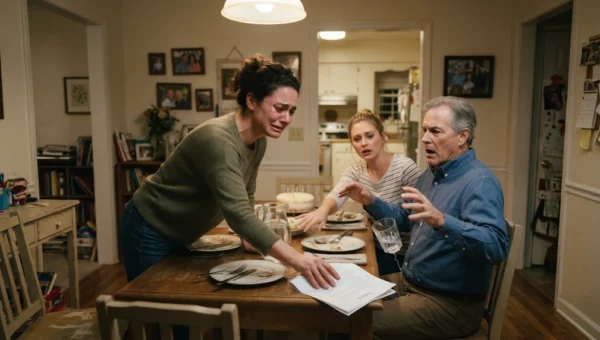
Sunday dinner was calm for about 20 minutes.
Eli was telling me about a school project, and June was dropping peas into her glass of water. Patrice got up to refill her drink, and I saw her look at the blue folder on the counter.
I had taken it out to check the closing date.
“Are those house papers?” she asked.
“Yes.”
She came closer. “We should talk about the room arrangements.”
“We should talk about you measuring my rooms without asking.”
“I was trying to help.”
“Help who?”
She pressed her lips together. “My parents are scared, Vickie.”
“I understand that.”
“They can’t stay in their house much longer.”
“Then we can talk about what they need. We have not talked about them moving in here.”
She looked past me toward Amos. He was helping June wipe up the water from the table.
“Amos said this would be a good fit,” she said.
Amos set down the dish towel. “I said we could discuss it.”
“You said, ‘Mom will come around.’”
“I didn’t say that.”
“You did.”
The kids stopped talking. I hated that. I hated how quickly the room had become something they would remember. I should have asked them to go watch television, but I was mad and wanted Patrice to stop making my son the only person who had to answer.
So I said, “You don’t get to decide what happens in my house because Amos is too uncomfortable to tell you no.”
Amos looked at me then. His face had that hurt look he used to get as a boy when I corrected him in front of other people.
I knew what I was doing. I kept going anyway.
Patrice said, “Fine. But don’t be surprised if it changes how much the kids are here.”
She didn’t shout. She said it in the same voice she’d used to ask for more coffee.
I could see June watching her. I should have said something softer. Instead I said, “That’s your choice.”
Patrice took her coat from the chair. Amos stayed where he was.
After they left, I washed the dishes too hard. I broke one of Wade’s old plates, the white one with a blue stripe. I scraped the pieces into the trash and then took them back out because it felt wrong to throw them away.
I called Denise and asked if I could move the closing date up. She said the buyers could manage it, but I needed to be ready. I told her I was.
I wasn’t.
The next three days were quiet in the way a hospital hallway gets quiet after someone has made a bad call and everybody is waiting to see what happens. Amos texted about the kids’ school schedule. Patrice sent a photo of June holding a spelling ribbon. I replied with a heart because I didn’t know what else to say.
I still had the blue folder on the island. I carried it to the bedroom at night and put it back in the morning. It was silly, but seeing it there reminded me I had a plan of my own. The closing was real. The buyers had signed. I had put down a deposit on a small condo near the hospital, with a laundry room down the hall and a grocery store across the street.
I had planned to tell my family over dinner. Then dinner went badly, and I waited again.
On Thursday morning, Patrice called at 8:17.
“Mom and Dad are coming over with their bags,” she said.
I was putting clean sheets in the downstairs bedroom.
“What bags?”
“Their suitcases. They’ve sold their house. They thought they could stay here while they figure out the next place.”
I sat down on the edge of the bed. The sheets were still in my lap.
“Who told them they could stay here?”
There was a pause.
“I said it would be fine.”
“You said it would be fine with me?”
“I said we’d work it out.”
That was not the same thing. We both knew it.
“Patrice, they can’t move in.”
“You’re going to tell them that after they sold their home?”
“I did not tell them to sell their home.”
She said nothing for a second.
Then she said, “They’ll be there in an hour.”
I asked to speak to Amos. She said he was driving and handed him the phone, or maybe she put it on speaker. I could hear the road noise.
“Amos, did you know they sold the house?”
He said, “I thought they were listing it.”
“Did you tell them they could move in with me?”
“No.”
“Did you tell Patrice I’d agree?”
He took too long to answer.
“I said you’d want to help.”
My mouth went dry. I said, “Wanting to help is not saying yes.”
He said, “I know.”
I asked him to come over before they got there. He said he was already on his way. I put the sheets in the closet and took the blue folder back to the kitchen.
I nearly called Denise and asked her to come over. I didn’t. I was not going to have a stranger tell my own family what I had to say.
At 9:06, a car pulled into the driveway.
Joan and Frank got out first. Patrice came around from the passenger side. Amos parked behind them a minute later. They had four suitcases and a box with a lamp sticking out of it. Frank was holding a grocery bag with what looked like his blood pressure pills and a loaf of bread.
I went to the front door.
Patrice stood there with her coat unbuttoned. “Can we come in?”
“No,” I said. Then, because it sounded cruel and I could see Joan’s hands shaking around the bag, I added, “Come in and sit down. But you’re not moving in.”
Frank looked at Patrice. “You said it was settled.”
Patrice’s mouth tightened. “I said we’d talk.”
“You said she was making room,” Joan said.
Amos carried one of the suitcases in. He set it by the wall and didn’t look at me.
I stepped back to let Joan and Frank come in. They left the bags by the door. Nobody took off a coat.
Patrice went straight to the kitchen island. “Mom, you don’t have to do this right now.”
“I do,” I said.
I opened the blue folder. I had the signed sale agreement in it, along with the inspection report and the closing schedule. My fingers were clumsy on the paper fastener. I wanted to hurry and couldn’t.
Joan sat down at the island. Frank stayed beside her, still holding the grocery bag.
“What’s that?” Patrice asked.
“My house-sale agreement.”
The room went still, but not in a dramatic way. It was just that everyone had stopped moving.
Amos looked at the page. “You sold the house?”
“I accepted the offer twelve days ago. We close next Friday.”
Joan looked at me, then at the bags by the door. “We didn’t know.”
“I know.”
Patrice reached for the papers. I put my hand on them.
“Don’t.”
Her hand stopped. “Why didn’t you tell us?”
“I was going to tell Amos. I should have done it sooner.”
“So you knew we were talking about my parents moving in and you said nothing?”
“I knew you were talking. I didn’t know you’d promised them.”
“You could have told me you were selling.”
“Yes. I could have.”
That was the part I couldn’t get away from. Patrice had acted like the house was hers to offer, but I had kept the sale from my son because I didn’t want a difficult conversation. Those were both wrong things. They weren’t the same wrong thing, but they were both mine.
Amos finally looked up. “Why didn’t you tell me?”
I said, “Because I was afraid you’d hear it as me leaving you.”
He frowned. “You’re not leaving me.”
“I know that now.”
He rubbed the bridge of his nose. He looked tired, not angry. I’d seen that same look when he worked doubles at the paper mill as a young man and came by to eat without wanting to talk.
“I thought you’d keep the house,” he said.
“I thought I would too.”
Patrice sat down hard in one of the chairs. “Mom and Dad gave notice. They’ve got nowhere to go.”
Frank turned toward her. “You said she was on board.”
“I thought she would be.”
“Did you tell them I agreed?” I asked.
She didn’t answer right away.
Then she said, “I told them you’d said you needed to think.”
“And you told them to sell their house?”
“I said you’d help us make it work.”
“That is not the same as asking me.”
“No, it isn’t.”
It was the first time that morning she’d said anything without trying to make it sound different.
Joan started folding the handle of the grocery bag in and out. I noticed the corner of a prescription bottle poking through. She looked embarrassed, and I felt bad for her. I didn’t feel bad enough to change my answer.
I said, “I can help you call a real estate agent. I can help look for a short-term rental. I can pay for a week at a motel if that’s what you need. But you can’t live here.”
Frank nodded once. “We can’t ask you to give up your house.”
Patrice turned to him. “Dad, please.”
He shook his head. “I thought we had a plan. We don’t.”
There it was. Not a fight, not a big family speech. Just a plan that Patrice had made using my home and Amos’s silence.
I asked Joan and Frank to sit and have coffee while I called a realtor I knew. Joan said she couldn’t. She said they’d been on the road since early morning and needed to go back to their place to pick up a few things.
I told her they could stay in the guest room for one night while we found somewhere. Then I stopped myself. The house was mine, yes, but the closing was in eight days. I couldn’t start making promises I hadn’t thought through all over again.
“I’m sorry,” I said. “I don’t think that would be fair to anyone.”
Joan nodded. “It’s all right.”
It wasn’t all right. I could tell from how she held her purse against her coat. But she didn’t blame me. That made it harder.
I called Denise, who gave me the number of a woman who managed furnished rentals. The first place was too far away. The second had stairs. The third was a small two-bedroom on the ground floor, available for a month, and the owner agreed to let Joan and Frank move in that afternoon.
The price was $2,460 for the month. I offered to pay it. Frank said no. I told him he could be mad at me later, but I wasn’t asking him to take money he didn’t want. We settled on me paying the deposit directly to the owner.
Amos took the bags back to the car. Patrice did not help him. She was still at the island, staring at the sale papers.
“You really signed it?” she asked.
“Yes.”
“You can’t change your mind?”
“I could. I won’t.”
She looked at me then. Her eyes were wet, though she was trying not to cry. “I thought we’d have more time.”
“So did I.”
She wiped under one eye with her thumb. “I was scared for them.”
“I know.”
“I didn’t want them to end up somewhere bad.”
“I know that too.”
“And I thought you’d say yes eventually.”
That was probably true. I had said yes to a lot of things by not saying no. I had let her mistake my silence for room to keep pushing.
I wanted to say that this was not all her fault. I also wanted to tell her she had done something selfish and dangerous. I said neither thing well.
“You don’t get to promise my house,” I said.
She nodded. “I know.”
Then she picked up the papers and set them back down in the folder, carefully, like they might tear.
By noon Joan and Frank were in the rental. Frank had put his pills on the counter beside a jar of instant coffee. He thanked me for the deposit. Joan hugged me at the door, but it was a quick hug with one arm.
“I’m sorry it got to this,” she said.
“Me too.”
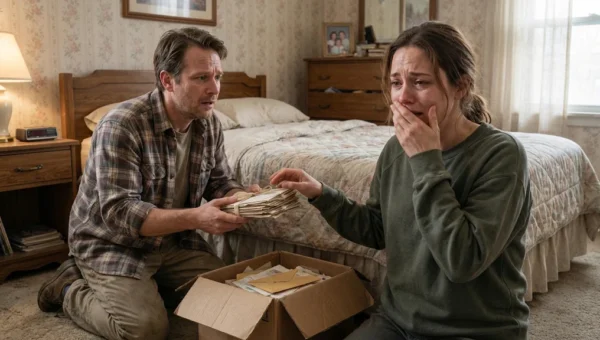
Patrice and Amos left with them. I watched the car back out, then went inside and shut the door. The suitcases had left a black mark on the floor by the entry. I rubbed it with a wet paper towel until it faded.
I didn’t hear from Amos for two days. Patrice sent one message asking whether I could take June to her dance class. I said yes. We talked about the class and nothing else.
On Friday, Amos came over alone. He stood in the kitchen while I was packing the mugs. He asked if I was really going through with the sale.
“Yes.”
He nodded. Then he said, “I should have told you no one could decide that for you.”
“Yes, you should have.”
“I’m sorry.”
I kept wrapping the mugs. “I’m sorry I didn’t tell you about the sale sooner.”
He looked down at the counter. “I thought you’d want me there when you decided.”
“I didn’t know I’d decided until I was signing the papers.”
He smiled a little at that, but it didn’t last. He asked if the buyers had kids. I said they had a little girl, maybe eight. She’d asked Denise if the night-light in the hall came with the house.
I had forgotten it was still plugged in.
Amos said, “You’re leaving it?”
“I guess I am.”
He reached for the mug I was holding. “You don’t have to pack all of these.”
“I have room for six.”
“You have two dozen.”
“Some of them are chipped.”
He didn’t argue. He wrapped three mugs in newspaper and set them in the box.
We did not talk about Patrice’s threat to keep the kids away. I didn’t want to make Amos choose sides again, and I didn’t want to pretend it hadn’t happened. I have spent a lot of years mistaking not making a scene for being kind.
The buyers took the house the following Friday. The sale went through at 11:02 in the morning. I signed the last page at Denise’s office, gave her the keys, and put the blue folder in a box with Wade’s old hospital papers.
My new place is small. The kitchen has one counter, and I can see the grocery store from the window. I’ve been there six weeks. Joan and Frank found an apartment they can afford, and Patrice said they’re getting used to the stairs. Amos brings the kids over on Wednesdays. Patrice comes sometimes. Sometimes she doesn’t.
The night-light came with the house. June told me the newgirl likes it. I said I was glad. June nodded, then asked if I still had the bent-tine fork.
I do. It’s in the drawer with the six mugs I kept.