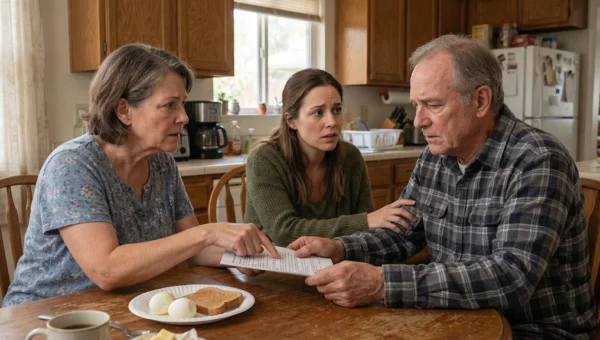
Why did I let Julian call it a payoff when I knew it wasn’t one?
I still ask myself that, though I know the answer has something to do with wanting him to understand what I’d done before I had to say it out loud. That was my mistake. The transfer was $150,000, approved at 9:02 on a Thursday morning.
Julian thought I’d paid off his business debt. I’d bought the debt itself.
I’m 49. I do payroll and books for a few small businesses around Beckley, and I was married to Julian for 17 years. I’m not a lawyer. I did know how to read the loan papers, which is different, and I knew exactly what my name meant on the page he eventually read. The part I can’t quite settle is why I let him believe the old version for one more day.
The debt came from Julian’s repair shop, not from some grand business scheme. He’d bought new equipment and expanded into a second bay, then lost a fleet account that had covered most of the payments. By the time I found the numbers, he owed $150,000 to Mountain Ridge Bank and had missed two payments.
He didn’t tell me at first. I found the envelopes in the bottom drawer of his desk because I was looking for the warranty on our dryer.
The bank’s name was printed on the front. I remember the dryer had started making a thump every time it spun, and I was mad about that too. I kept the envelopes in my tote bag for three days before I asked him.
“I was going to tell you,” he said.
“When?”
“When I had a plan.”
He had a plan, in the sense that he was hoping the next month would be better. I didn’t say that. I’d spent years sorting numbers for people who got offended when a number refused to change. So I asked how much he’d missed, and Julian gave me the amount without looking up from the kitchen table.
He looked tired. I wanted to be kind. I also wanted him to stop treating the bank’s letters like they’d come from a person he could avoid. Both things were true.
Our marriage hadn’t been awful. That matters to me. Julian could make my mother laugh when she was in one of her sour spells, and he knew how I liked my coffee, with a little milk and no sugar.
When my car died on Route 19, he came with a gallon can and drove me to the garage without making me feel foolish. I loved him. I also got used to stepping in whenever his plans came up short.
So when he said the bank was talking about calling the loan, I offered to help.
I had money from selling my mother’s small house after she died. It wasn’t a fortune, but it was mine, kept separate and set aside. Julian knew I had it. He didn’t know the exact amount because I never gave him the statement, and now I see that made him think he knew more than he did.
I called the bank myself. The loan officer, Mr. Harlan, said the bank was willing to sell the note and the security interest attached to it. He explained that it would not make the debt disappear. It would transfer the bank’s rights to whoever bought it.
He sent the papers to a lawyer I’d used for my mother’s estate.
I read every page twice. Then I called the lawyer and asked the same questions I’d asked Mr. Harlan, because I didn’t like how plain the answer was. If I bought the note, I’d become Julian’s creditor. The business equipment and his personal guarantee were part of the agreement. I couldn’t just take anything I wanted, and I couldn’t pretend he owed nothing. I could offer him time and a fair payment plan, or I could enforce the note if he refused to deal with me.
“Do you understand what that means for your marriage?” the lawyer asked.
“I understand what it means for the loan.”
That was not an answer. I knew it then.
Julian knew I was going to the bank. He even drove me there. The whole ride, he talked about getting through the next six months, keeping the shop open, and maybe selling one of the old lifts. He said, “Once it’s paid, we can breathe.”
I could’ve corrected him in the car. I didn’t. I told myself I would explain once the papers were finished. I told myself he needed to feel some relief first. Really, I wanted to see whether he’d be grateful. That part is not pretty, but it’s true.
At the bank, the loan officer slid the closing papers across the desk and pointed out the line where I’d sign as the buyer and new holder of the note. The amount was $150,000. I transferred the money from my separate account at 9:02 a.m. and signed the assignment.
The clerk handed me a copy in a long envelope with a blue corner. I tucked it into my tote, the same one I’d used for Julian’s overdue notices. He waited by the front doors and asked, “All set?”
“Everything’s signed,” I said.
He took that as good news. I let him.
We went to lunch at the little place beside the grocery store. Julian ordered a burger and talked about what the shop could do if the debt was behind him. He was relaxed for the first time in weeks. I remember him wiping ketchup off his thumb with a paper napkin, then reaching over to touch my wrist.
“I knew you’d come through,” he said.
It was a nice thing to hear. It was also the wrong thing to hear, and I let it sit between us.
That night, Julian came home late. I was in bed, not asleep. I could hear him move around downstairs, opening the fridge and shutting it again. When he came up, he said, “We’re okay now.”
I said, “We’ll talk tomorrow.”
He kissed the side of my head. I stayed still. I didn’t want to ruin the small calm I’d bought for the evening, even though I knew it wasn’t calm. It was a delay.
The next morning, I was rinsing my coffee cup when Julian laid divorce papers on the counter. He’d brought them from a lawyer. There were tabs on the pages, and the top sheet had my name typed neatly beside his.
I looked at the papers, then at him.
“You’re filing?”
“I’ve made up my mind.”
His mother, Eileen, was in the living room packing my things into boxes. I could hear tape tearing. Julian’s girlfriend, Tessa, stood by the refrigerator in my silk robe. I’d bought it on a weekend trip with my sister years earlier, and I still remembered the loose thread at the cuff.
I did not raise my voice. I said, “Take that off, please.”
Tessa looked at Julian. He nodded toward the stairs.
“She’s moving in,” he said.
Then he looked at me and added, “You’re no use to me anymore.”
It didn’t sound like the Julian I’d loved. It did sound like a sentence he’d been practicing.
I was very calm. More calmly than I felt. “You should read the blue-cornered copy in my tote before you move anything else.”
He glanced at the bag by the chair. “What are you talking about?”
“The transfer from yesterday.”
“I know about the transfer.”
“No. You know what you decided it meant.”
Eileen came to the kitchen doorway with a box against her hip. She looked at Julian, not me. Tessa was still holding the robe closed at her chest.
Julian gave a short laugh. “You paid off the loan.”
“I bought it.”
He stopped smiling. It wasn’t a dramatic change. His mouth just stayed open for a second, like he’d started a word and lost it.
I took the envelope from my tote and placed the assignment on the counter, beside his divorce papers. The top page showed the sale of the loan and the security interest. My name was typed under the words “new holder of note.”
“I didn’t pay the bank to forgive the debt,” I said. “I paid the bank to sell it to me.”
Julian picked up the paper. I watched his finger move down the page. He read the amount, then the date, then my name. He flipped it over and read the next page too.
“You’re the lender?”
“Yes.”
“You did this without telling me?”
“I told you I was going to talk to the bank.”
“That’s not the same thing.”
“No,” I said. “It isn’t.”
Eileen set down the box. The cardboard made a dull sound against the floor. Tessa pulled the robe tighter around herself and took one step back from the counter.
Julian looked at me. “You tricked me.”
I could have argued. I could have told him he’d been told what the bank was doing, or that I was trying to keep the shop from closing, or that he’d used my silence to fill in the version he wanted. All of that was true. None of it fixed the part I’d done on purpose.
“I should’ve explained it before I signed,” I said.
He looked back at the document. “So now you own everything?”
“No. I own the note. You still own the shop. The papers say what the papers say.”
That was when Eileen dropped the box. A roll of tape bounced out and skittered under the table. Tessa swore under her breath. Julian kept looking at the page as if the words might change if he read them again.
“You can’t do this,” he said.
“I already did.”
I didn’t say it sharply. I didn’t have to.
The bank had recorded the assignment the previous day. Julian had a personal guarantee on the loan, and the shop equipment secured it. That did not mean I could march in and take his tools. It meant he could not pretend the loan had vanished because I was his wife. It also meant he had a choice: pay under a plan we could both sign, refinance with another lender, or risk the legal steps set out in the note.
I’d had the lawyer prepare an option for a payment plan, but I didn’t put it in front of Julian that morning. I wanted him to read the first page. I wanted him to understand I wasn’t standing there with nothing but my feelings.
I was ashamed of that later. A little. I’d wanted him to feel the same fear I’d felt with those bank envelopes in my tote. That was not the same as being fair.
The first person to speak after that was Eileen.
“Julian, what did you tell me this money was?”
He didn’t answer. She looked at me then, and I saw that she hadn’t known about the assignment either. I don’t know if that made me feel better. It shouldn’t have.
Tessa took the robe off and folded it over the back of a chair. She put on her own sweater. Nobody asked her to leave right then, though I was hoping she would. Julian had told her she was moving in, but I was still in the house and the divorce wasn’t final. I had a lawyer too. I wasn’t going to have a kitchen argument about who got which room.
I picked up the divorce papers and set them on the far end of the counter.
“I’ll have my lawyer respond,” I said.
“You’re making this ugly,” Julian said.
“No. I’m making it clear.”
I don’t know if that was brave or just the only thing I could manage. My voice didn’t shake until I went into the bedroom and shut the door. I sat on the edge of the bed and looked at my hand. There was a small ink mark on my thumb from the signature page.
For years I’d kept things running by smoothing over the places where Julian’s choices and our money didn’t quite meet. I’d fixed payroll at the shop when he forgot a deadline. I’d called suppliers when he was embarrassed. I’d said “we’ll work it out” so often that I started hearing it as a promise instead of a way to get through the day.
He had not forced me to stay silent. He had not made me sign the assignment. I had chosen both. That made the morning harder to sort out, not easier.
The next few weeks were mostly calls, copies, and waiting. My lawyer filed a response to the divorce petition and sent Julian’s lawyer the full loan documents. I moved into my sister’s spare room with two boxes and a suitcase. Eileen called me once to say she was sorry about the way she’d packed my things.
“I thought you’d agreed to leave,” she said.
“I hadn’t.”
“I should have asked.”
“Yes,” I said. Then I told her I appreciated the call. I meant it, though I was still angry.
Julian’s lawyer argued that I’d misled him. My lawyer answered with the bank’s record and the signed assignment. The papers showed the debt had not been paid off. They also showed that I hadn’t hidden the transaction from Julian’s lawyer after he filed for divorce. I don’t know if that made me look better. I cared more about making sure the account stayed separate and the legal record stayed clean.
Julian called me twice about the loan. The first time, he was angry.
“You could’ve just paid it off,” he said.
“I could’ve. I didn’t.”
“You wanted to own me.”
“I wanted to keep the money from disappearing into a deal I didn’t understand.”
“That’s not what this is.”
“Then get your own lawyer to explain it.”
He went quiet. Then he said, “You were my wife.”
“I was.”
That was the call where I cried after we hung up. Not because I suddenly missed the life we had. I missed the old version of us, the one who would’ve sat across from me and asked what the papers meant instead of deciding I was an enemy.
The second call was different. He asked for a payment plan. He said the shop was getting by, but not well enough to refinance right away. I said my lawyer could send a draft. We settled on monthly payments, with the business equipment still listed as collateral and a clear date for review. He agreed to send the payment through a regular bank transfer.
I did not lower the amount because I felt sorry for him. I did not raise it because I was angry. I let the written terms do the work.
That sounds colder than it felt. I didn’t like being his creditor. I didn’t like opening an envelope with his name on it. But the first payment came on time, and so did the next one. The shop stayed open. The divorce went through six months later.
I signed the final papers at my lawyer’s office. Julian wasn’t there. His signature was already on the last page. I had thought I would feel something large when I signed mine, but all I felt was the edge of the paper against my finger.
Tessa didn’t move into the house after all. I heard that from Eileen, not Julian. I don’t know what happened between them, and I have tried not to make that my business. I still had to settle the loan, the house, and my own part in the marriage. There was enough to do without keeping score on their relationship.
A year later, Julian refinanced the shop debt with another lender and paid the note in full. The amount was slightly higher than the original principal because of the agreed interest. My lawyer sent me the final release to sign, and I signed it at my kitchen table, alone.
The transfer had not erased his debt. It had changed who he owed. That was the plain answer, and it was the answer I should have given him before I signed.
The first payment he sent me came in a plain envelope, though the agreement said he could transfer it electronically. He’d written my name in the careful block letters he used on parts orders. I set the check beside my coffee and kept it there for a few minutes before I put it in the bank.
I don’t know why I remember that better than the day the divorce was final. Maybe because the check meant the shop was still open, and I’d finally stopped being the person who had to make every problem disappear.