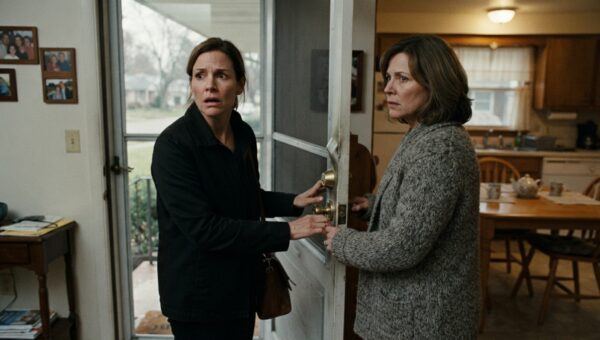
The dust in Aunt Eleanor’s old Victorian attic settled on my sleeves like gray flour, thick enough to taste whenever I took a deep breath. Downstairs, Mark was already shouting at his brother and sister about probate lawyers and injunctions, his boots heavy on the heart pine floorboards that Eleanor had polished every single Saturday for forty-three years. He was furious, and honestly, the whole family had been on edge ever since the attorney read the will aloud on Tuesday morning.
Eleanor had left the grand old house on Maple Street to the county historical society, lock, stock, and barrel, while her three biological children received a meager five hundred dollars apiece. Mark had called it a final, spiteful betrayal from a cold woman who never forgave anyone anything. He was ready to tear the courthouse apart to break the testament and get his hands on the deed. I had only agreed to help clear out the attic because someone needed to keep Mark from tossing out Eleanor’s good porcelain in his blind rage, but I never expected to find what was tucked away behind the wall.
The attic had always smelled of dried lavender and cedar shavings, a comforting sort of scent that made you forget how the winters howled through the eaves. I was working my way along the far eastern wall, dragging cardboard boxes filled with old tax forms and church bulletins toward the pull-down stair opening.
That was when my foot caught on a slight unevenness in the floor molding near the built-in bookcase that framed the chimney stack.
The shelf didn’t look like much at first glance, just heavy oak shelves sagging slightly under the weight of crumbling encyclopedias and old canning jars. But when I leaned my weight against the side panel to steady myself while reaching for a heavy bin, the whole wooden upright gave a soft, oiled click and drifted half an inch inward. It wasn’t a crack from settling timber or dry rot. It was a precise, deliberate seam cut into the cabinetry with a fine-toothed saw sometime back when woodworkers still cared about secrets.
My heart did a strange little flutter against my ribs, and I dropped to my knees right there on the rough floorboards. I poked my fingers into the gap, feeling the cool, dry air breathing out from the dead space behind the chimney flues.
With a gentle tug, the entire vertical shelf swung outward on concealed brass hinges, revealing a shallow alcock that had stayed completely hidden through decades of spring cleanings and roof repairs.
Inside sat a single leather bound journal, its cover dark and stiff with age, wrapped tightly in a thick rubber band that had long since rotted into a sticky, amber brittle mess. Tucked beneath the leather strap was a faded bank statement from November of 1984, showing numbers so deep in the red they looked like typographical errors. I pulled the items out into the meager daylight filtering through the gable window, my fingers leaving clean streaks in the gray film covering the paper.
The first page of the journal wasn’t filled with Eleanor’s neat, upright cursive. It was a chaotic scrawl of heavy ink, written by a hand that had clearly been shaking when the pen hit the page.
It was a handwritten promise, dated precisely four decades ago, signed by my cousin’s father, Arthur, just hours before he vanished from town and left his young family behind.
I remember the summer Arthur disappeared as if it were yesterday, though I was just a girl back then. One morning he was driving a shiny new station wagon and talking up a storm about an oil lease in Oklahoma, and by the next evening the car was abandoned at the Greyhound station three towns over and Arthur was gone like smoke in a gale. The townsfolk whispered about foul play, about mob debts, about runaways who just got tired of changing diapers and paying grocery bills. Eleanor never wept in public, never asked the sheriff for updates after the first week, and just went to work at the county recorder’s office by dawn every single day.
Now, sitting in the dusty quiet of that attic, I unfolded Arthur’s statement and read his exact words written in bold, terrified strokes. “I, Arthur Vance, hereby surrender all legal rights, title, and equity in the Maple Street property to Eleanor Vance, in consideration of her agreement not to press criminal charges regarding the missing funds from the ledger and the joint accounts.”
I swallowed hard, my throat feeling dry as sandpaper. I turned the page to Eleanor’s own cramped, careful handwriting that started on the very next line of that same ledger book. She hadn’t written poetry or prayers. She had written columns of numbers, tracking every single dollar of the missing escrow funds and business loans that Arthur had drained before he packed his single leather suitcase.
There were entries for the lumber yard, the feed store, the parish building fund, and the local bank where Arthur had forged her signature on second mortgages. Eleanor hadn’t just watched her husband walk out the door. She had caught him red-handed with the cash tin open on the dining room table, bags packed by the front door, and she had made a choice that nobody in this town ever knew about.
She didn’t call the police. She didn’t ruin her husband’s name or drag her children through a public scandal that would have followed them into every school desk and grocery aisle in the county. Instead, she traded her silence and her forgiveness for the deed to the house, and then she spent the next twenty-five years working two jobs to pay back every single cent of Arthur’s debts out of her own pocket.
The bank statements tucked into the back of the journal told the real story of her life. Receipt after receipt from local creditors, stamped paid in full, month after month, year after year, until the balance finally hit zero around the time Mark graduated from high school. She had sacrificed her youth, her savings, and her peace of mind so her children could grow up with their heads held high in a town that would have chewed them up if the truth about their father ever leaked out.
Footsteps creaked on the stairs below, heavy and uneven, and Mark’s voice cut through the floorboards, loud and bitter. “I’m telling you, we’re contesting the whole thing by Monday morning. She had no right giving this place away to a bunch of strangers.”
I didn’t answer right away. I sat there with the old leather book open in my lap, the faint smell of old ink and yellowed paper rising around me like smoke from a dying fire. I thought about the five hundred dollar bequests she left them, which I suddenly realized matched down to the penny what was left in the old tin box on the pantry shelf the morning Arthur walked out. It wasn’t spite. It was the exact remaining sum of what was left of their shared life, divided equally, while the house itself was the fortress she had bought twice over with her own sweat.
I gathered the papers, tucked the journal beneath my arm, and pushed myself up from the floor, my knees popping in the silence. I walked down the narrow attic stairs and stepped out into the wide second-floor hallway where Mark was pacing back and forth near the banister, his face red and stormy with anger.
“Look at this,” I said, holding out the open ledger and Arthur’s signed statement without any preamble.
Mark stopped pacing, scowling down at the weathered paper in my hands. “What is that? More of her rules?”
“Read it, Mark,” I told him, my voice shaking just a little bit despite myself. “Read who signed it, and read what she spent her whole life paying off so you could walk around this town like you were somebody.”
He snatched the papers from my hand, his eyes scanning the faded ink of his father’s signature at the bottom of the page. The color drained out of his face so fast it looked like someone had turned off a lamp behind his skin. He didn’t say a word for a long, heavy minute, his breathing coming short and shallow as his eyes moved down Eleanor’s neat columns of debt repayments and bank receipts.
“He didn’t run away,” Mark whispered, the anger instantly evaporating from his voice, leaving behind something hollow and bruised. “He stole from everyone.”
“And your mother covered for him,” I said softly, stepping closer. “She gave up everything she had so you kids never had to carry his shame. She left the house to the historical society because she knew if she left it to you three, the creditors or your father’s old shadows might have found a way to take it back. She wanted it locked down forever where nobody could touch it.”
Mark just stood there at the top of the stairs, staring at the signatures on the paper as the reality of forty years settled over him all at once. Downstairs, the grandfather clock in the front hallway chimed twice, its deep, resonant tone vibrating through the floorboards beneath our feet. He didn’t mention the probate court again. He folded the papers carefully, handed them back to me with trembling fingers, and walked slowly down the stairs without looking back.
The transfer of the property to the historical society went through without a hitch three weeks later, just as Eleanor had wanted. Mark and his siblings dropped the lawsuit quietly, telling the local paper that they were honoring their mother’s deep love for local heritage and community preservation. On a crisp Tuesday afternoon in October, the historical society placed a small bronze plaque on the granite post beside the front gate, noting the house’s historic significance and Eleanor’s decades of careful stewardship. Mark and I stood together on the wrap-around porch as the workmen drove the final screws into the metal sign, the autumn wind rustling through the dry maple leaves overhead. He held the closed leather journal in his hands, his thumb tracing the worn spine where his mother’s name was written in pencil on the inside flap, finally at peace with the quiet weight of what she left behind.