PART 1
Forty years is supposed to mean something. In my parents’ day, forty years was ruby. It meant family dinners, polished silver on the dining table, maybe a toast from the grown children, and a photograph framed on the sideboard.
When Arthur walked into the kitchen on our anniversary, he set a white envelope next to the salt shaker.
It was from the ShopRite two miles down the road. You could tell by the generic florist sticker still clinging to the cellophane wrap. The card itself had two pastel birds sitting on a fence and words printed inside that sounded like they had been written by someone who had never loved anyone in their life.
Arthur didn’t kiss my cheek. He poured his black coffee, stirred in half a packet of raw sugar, and leaned against the counter.
“I know it’s not much, Helen,” he said. He looked tired. He had looked tired for five years, ever since he sold his share of the auto parts warehouse and tried to pretend retirement suited him. “Things have been stacked up this week with the tax accountant. I got busy. But happy anniversary.”
“It’s fine, Artie,” I said.
I even smiled. After four decades, a woman learns when an argument is worth the breath and when silence is just cheaper. Our two kids, Greg and Sarah, lived three states away with their own busy lives and their own mortgages. They had sent a joint floral arrangement the day before. Lilies and white carnations that smelled faintly like a funeral home sitting on our hall table. So I told myself Arthur’s card was just another part of growing old together, where the sharp edges of romance had long since ground down into dull routine.
Arthur finished his coffee, rinsed the mug in the sink, grabbed his light canvas windbreaker, and said he had errands to run out past the interstate. He didn’t say what errands. I didn’t ask. That was the rhythm of our house.
Around three in the afternoon, after I had vacuumed the rugs and put away the clean laundry, I sat down at the kitchen table with a cup of tea. Arthur’s card was still sitting by the salt shaker. I picked it up, intending to file it away in the sideboard drawer where I kept old birthday greetings and funeral programs.
That was when I noticed the small stamp on the back corner.
It wasn’t the barcode. It was a faint, purple-inked price mark stamped by hand over the barcode: $1.99. Right below it was a tiny date stamp that cashiers used to press on cardstock back when the local store used manual return tracking: 04/18/14.
I frowned and adjusted my reading glasses.
Our anniversary was April 19th. But the date on that stamp wasn’t yesterday, and it wasn’t even this year. It was dated twelve years ago.
I stared at the numbers. Arthur was frugal, but he wasn’t insane. He didn’t keep a drawer of cards bought a decade in advance just to save two dollars. And our town’s ShopRite had stopped using those purple ink hand-stampers when they renovated the registers back in 2016.
My chest tightened with an odd, prickling feeling. It felt silly, but I couldn’t stop looking at it. I picked up the kitchen phone and dialed the store’s customer desk. A woman named Beverly answered. She had worked that customer service counter since my kids were in middle school.
“Beverly, this is Helen Miller,” I said, trying to keep my voice light and conversational. “This is going to sound strange, but I found an old register slip with a hand stamp from your store from April 2014. Did your registers keep archive logs that far back when you did the system upgrade?”
Beverly chuckled. “Well, Helen, we kept the digital transaction rolls on the back-office drive for audit purposes. We had an IRS audit in 2018, so Mr. Henderson made us back up everything from 2010 forward. What are you looking for?”
“April 18, 2014. Mid-afternoon, probably. Around two dollars for an anniversary card.”
“Hold on, let me pull up the legacy folder. Give me two minutes.”
I stood there by the refrigerator, the coiled receiver cord stretched tight in my fingers. I could hear the hum of the fluorescent lights in Beverly’s office over the line, the click of her keys.
“Here it is,” Beverly said, her tone shifting slightly from casual to curious. “April 18, 2014. 3:14 PM. Register four. One Hallmark card, $1.99. A roll of heavy brown parcel wrap, $3.49. And a receipt surcharge for a key cut from the hardware desk in aisle nine. A five-pin tumbler key. Paid in cash.”
My stomach dropped. “A key cut?”
“Yes. A duplicate silver brass cut. Total was nine dollars and twelve cents. Why, Helen? Did Artie lose his shed key back then?”
“No,” I whispered. “No, just organizing some old boxes. Thank you, Beverly.”
I hung up the receiver. My hands were cold.
Twelve years ago. In April of 2014, Arthur had taken a sudden medical leave from the warehouse for what he called nervous exhaustion. He had spent three weeks barely speaking, sleeping in the guest bedroom, coming and going at strange hours. Then, by May, he had returned to work, acted as if nothing had happened, and we had never spoken of those weeks again.
I looked at the kitchen table.
It was an oak table, heavy and dark, that we had bought when Greg was four. Beneath the tabletop, on the underside near the center pedestal, there was a crossbeam. When the children were little, they used to tape their plastic treasures up there so they wouldn’t have to share them. Arthur had always been the one to crawl under on his hands and knees to retrieve them when they got stuck.
I dropped to my knees on the linoleum.
My joints ached, but I crawled beneath the table, tilting my head back into the shadow under the crossbeam. I ran my fingers along the rough, unvarnished wood.
Near the joint, my fingertips hit a strip of brittle, dried duct tape.
I pulled. The tape gave way with a dry crackle.
In my palm lay a small, tarnished silver key. Attached to the head by a loop of faded twine was a yellow plastic tag with a stamped number: 47. Below the number was a single word stamped in black ink: UNION.
There was only one place in our county that used numbered lockers under that name: the old Union Depot station twenty miles west, where the commuter trains ran down into the city.
I sat on the kitchen floor for five minutes with that cold piece of metal pressed against my thumb. Arthur was supposed to be running errands until five o’clock.
I stood up, grabbed my purse, took Arthur’s car keys from the hook by the door, and drove west toward the station.
The depot was nearly empty in the middle of a Tuesday afternoon. The smell of diesel fuel and damp gravel hung in the air. I walked past the ticket counter to the row of tall, green metal lockers built into the brick alcove near the baggage platform.
Locker 47 sat at chest height.
The lock cylinder was stiff. I had to force the key and lean my weight against it until the tumblers gave an audible click. The door swung open with a screech of rusted hinges.
Inside sat a single navy blue canvas suitcase. It was clean, dusted over with only a thin layer of station grime.
I pulled it out onto the wooden bench. It wasn’t locked. I unzipped the main compartment.
Neatly folded inside were three pairs of women’s slacks, four cotton blouses, a warm cardigan, and walking shoes.
They were all in my size. Every single garment had been taken from my closet twelve years ago, items I had assumed were lost during our spring donation drive that year.
Tucked into the side pocket of the lid was a manila envelope. Inside was five thousand dollars in banded twenty-dollar bills, an uncashed cashier’s check made out to me from a bank that had closed four years ago, and a folded sheet of lined yellow legal paper.
The handwriting belonged to Arthur. The ink was faded, but the words were clear:
“If you are reading this before Friday, do not let him leave alone. He will not survive the trip, and neither will what he left behind.”
PART 2
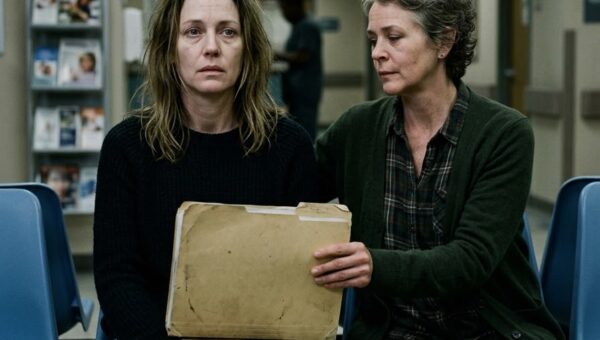
I sat on that cold bench in the Union Depot for twenty minutes, staring at Arthur’s handwriting until the yellow paper blurred.
The letter was written in the third person. He didn’t write “do not let me leave.” He wrote: “do not let him leave alone.”
My first instinct was panic. My second was an icy, steadying clarity that comes to women who have spent forty years managing a household through broken furnaces, sudden layoffs, and family sickness. You do not fall apart while there is still paperwork to read.
I put the letter back in the envelope, zipped the navy suitcase, and carried it out to the trunk of my sedan. It felt heavy, not just with the clothes and the cash, but with twelve years of silence.
When I drove back into our driveway at four-thirty, Arthur’s truck was not there. The house was quiet. The grocery-store card still sat on the kitchen counter like an innocent piece of trash.
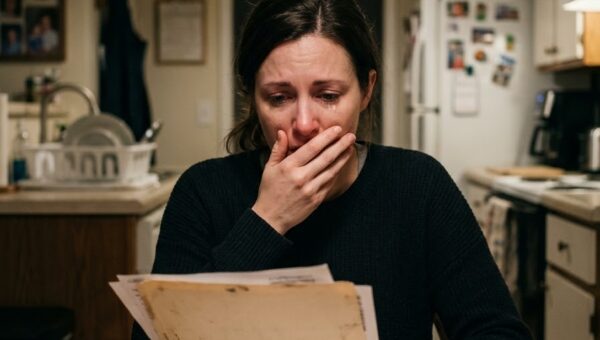
I took the envelope to the kitchen table, sat down, and read the rest of the letter.
Below the first two sentences, Arthur had written names, dates, and account numbers.
In 2014, his business partner at the warehouse, a man named Raymond Vance, had been laundering freight payments through an offshore holding company. Raymond was a smooth talker, the kind of man who joined the country club before he could afford the dues. Arthur had discovered the double invoices during the spring tax audit. But Raymond hadn’t threatened Arthur with violence. He had threatened him with ruin.
Raymond had taken out an unauthorized commercial bridge loan using our family home as collateral, forging Arthur’s signature on a power of attorney. Arthur had been terrified. He hadn’t told me because he thought he could settle it quietly. He had drawn five thousand dollars from his personal savings, packed a bag for me in case Raymond’s creditors came to our door, and planned to confront Raymond at a freight transfer office in Philadelphia on a Friday afternoon.
The letter ended with a sentence that stopped my breath:
“If Raymond leaves that office alone on Friday, he takes the second ledger with him. Without it, the house is gone, and the police will think I signed the notes.”
I looked at the date on the letter: April 18, 2014.
That Friday had come and gone twelve years ago.
I remembered that weekend vividly now. Arthur had come home on that Saturday morning in 2014 looking like a ghost. He had told me Raymond had suffered a sudden heart attack at a hotel in Philadelphia and died before the paramedics arrived. The warehouse business had dissolved within six months. Arthur had taken a modest payout from Raymond’s estate, paid off our mortgage completely, and retired early.
For twelve years, I had believed Raymond died of bad health and that Arthur had simply walked away from a failing business.
So why was this card on my counter today?
Why had Arthur picked up a card from 2014 that morning, handed it to me, and walked out the door?
A man who wants to keep a secret does not tape a key under a kitchen table and then deliver the map twelve years later by accident.
I got up and went down to the basement.
Arthur’s workbench was always immaculate. Small jars of nails were screwed to the underside of the shelves. His tools were hung by outline on pegboard. In the corner behind the water heater sat an old steel filing cabinet with a combination padlock.
I had never asked for the combination. I had never needed it.
I pulled out Arthur’s legal pad note from my purse. At the bottom of the second page, scribbled faintly in pencil, were four digits: 19-4-74.
The date of our wedding. April 19, 1974.
I turned the dial. It clicked open on the first try.
Inside the bottom drawer was a thick expanding file labeled “VANCE ESTATE / SETTLEMENT.”
I pulled it out and set it on the workbench under the bare bulb.
There were bank statements, death certificates, and transfer receipts. But beneath the official probate papers lay something else: a carbon copy of a police report from the Philadelphia Municipal Police, dated April 22, 2014.
Raymond Vance had not died of a heart attack in a hotel.
He had been found unconscious in his parked Lincoln Town Car behind an abandoned warehouse near the rail yards, suffering from acute carbon monoxide exposure. He had survived, barely, with severe cognitive impairment, and had been placed in a state-assisted care facility in Scranton under his sister’s guardianship.
And beside the police report was a cashier’s check stub dated three days ago.
Payee: Scranton Meadowview Care Home.
Amount: $4,200.
Memo line: “Final private settlement payment — Account Closed.”
The pieces hit me one by one, hard and cold.
Arthur hadn’t killed Raymond. But he had found him, or confronted him, and whatever happened in that rail yard had ended Raymond’s life as a free man. Arthur had been paying for Raymond’s care out of our retirement savings for twelve straight years.
The front door upstairs clicked open. Heavy footsteps crossed the kitchen linoleum above my head.
PART 3
I didn’t hide. I didn’t scramble to close the drawer or shove the papers back into the file.
I gathered the police report, the check stub, the yellow legal letter, and the silver locker key in my hand, walked up the basement stairs, and pushed open the door into the kitchen.
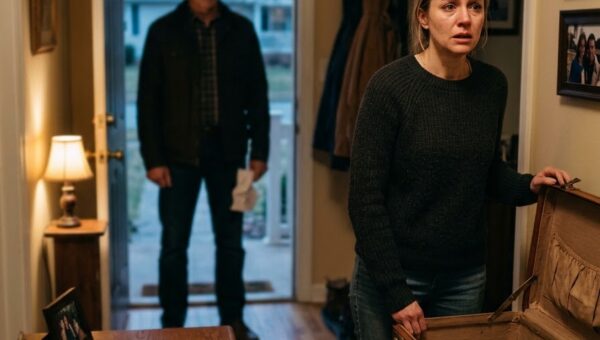
Arthur was standing by the stove, unzipping his windbreaker. He looked older than seventy-two. His shoulders sagged under his flannel shirt, and his hair was thin and white against the afternoon light.
When he saw me standing in the doorway with the papers in my hand, he didn’t jump. He didn’t gasp.
He just stopped. His hands stayed on the zipper of his jacket.
“You went to the depot,” he said. His voice was flat, dry, stripped of all pretense.
“Beverly remembered the receipt from 2014,” I said. “A five-pin tumbler key. You bought the card the same day you cut the key. You left it on the counter this morning, Artie. Why?”
Arthur lowered his hands. He walked over to the kitchen table, pulled out his regular chair, and sat down. He looked at the pastel birds on the cheap grocery-store card sitting next to the salt shaker.
“I didn’t leave it by accident, Helen,” he said quietly.
“Then talk to me. Forty years of marriage, and I find out you’ve been paying for Raymond Vance’s bed in a nursing home for over a decade. Did you put him in that car?”
Arthur closed his eyes. For a second, I thought he was going to cry, but his face remained dry, set like stone.
“No,” he said. “Raymond put himself in that car. When I got to the freight office that Friday, he was already gone. He had taken two bottles of sleeping pills and hooked a garden hose from the tailpipe through the trunk of his Lincoln behind the yard. He had left a note blaming me for the embezzlement. He was going to die and leave me holding the debt, the fraud charges, and the prison time.”
I leaned against the kitchen doorframe, my knees trembling. “What did you do, Arthur?”
“I pulled him out,” Arthur said. “He was still breathing. I dragged him out of that car, tore the hose off the pipe, and threw his note in the river. But his brain was starved for air, Helen. When the ambulance got there, he couldn’t speak. He couldn’t remember his own name.”
“Why didn’t you call the police right away? Why did you hide it?”
“Because the ledger was still in his trunk,” Arthur said, his voice rising slightly, tight with old terror. “If the police took that car into evidence, our house was seized within forty-eight hours. Raymond had signed our property deed over as collateral to loan sharks in Camden, not a legitimate bank. They would have thrown you out on the street while I sat in a county jail awaiting trial. I took the ledger. I took the notes. I burned them in our furnace.”
“And the money?” I asked, laying the $4,200 check stub on the table in front of him. “What is this?”
“His sister knew,” Arthur said. “She found a copy of the forged bridge loan in Raymond’s apartment after the hospital admitted him. She told me she wouldn’t go to the district attorney as long as Raymond was kept in a private facility and she didn’t have to pay a dime for his hospice care. She wanted three thousand a month. Then four.”
I stared at the man I had slept beside every night for forty years.
“Every vacation we canceled,” I said, the realization cutting deep into my chest. “Every time you told me the roof could wait another two years. The new car we never bought. The trip to Alaska we talked about for our thirty-fifth anniversary.”
“I was keeping the roof over our heads,” he said, looking up at me. His eyes were bloodshot. “I was keeping you safe.”
“You weren’t keeping me safe, Arthur! You were keeping yourself from being honest with me!”
“His sister died last month,” Arthur said abruptly.
The kitchen went dead silent.
“What?” I whispered.
“Raymond’s sister died of pneumonia three weeks ago,” Arthur repeated. “And Raymond passed away in his sleep on Sunday night. The nursing home called me Monday morning. The account is settled. The hospital bills are cleared. The releases are signed. There are no more checks to write. There’s no one left to blackmail me.”
He reached out his weathered hand and touched the edge of the grocery-store card.
“I found that card in my old briefcase this morning,” he said softly. “I bought it twelve years ago on the day I went to Philadelphia. I bought it because I thought that Friday was going to be the last anniversary I ever spent with you as a free man. I hid the suitcase at the train station so you’d have cash and warm clothes if the Camden men showed up at our door before I could fix it.”
He looked at me, his lip trembling for the first time.
“I put it on the counter this morning because I couldn’t carry it alone for another year, Helen. I knew if you looked at that date stamp, you’d pull the string. I was too much of a coward to tell you with my own mouth, but I wanted you to know. If you want to pack your bags and leave, the money in that locker is yours. The house is clear. There’s no debt left.”
ENDING
I stood in that kitchen for a long time, watching the late-afternoon sun stretch across the linoleum floor.
The anger was there, hot and heavy in my throat. He had lied to me for twelve years. He had made decisions about our lives, our finances, and our future without giving me a voice. He had let me believe we were struggling on a fixed pension while he wrote four-thousand-dollar checks every month to keep a ghost quiet in Scranton.
I could have walked out. I had five thousand dollars in cash sitting in the trunk of my car, and my daughter Sarah had an extra bedroom in North Carolina that she offered me every holiday.
I pulled out the chair opposite Arthur and sat down.
I slid the cheap card between us. Two pastel birds on a wooden fence.
“You should have told me twelve years ago,” I said. My voice was quiet, but it was hard as iron. “I would have stood beside you in that lawyer’s office. I would have fought Raymond’s sister in court. You treated me like a child who needed protecting instead of your partner.”
Arthur kept his head down. “I know.”
“We are not going to pretend this didn’t happen,” I told him. “Tomorrow morning, we are going to the bank. We are taking my name off the joint liability accounts, and you are putting every deed and title into a revocable trust in my name. You are going to show me every single bank statement from the last twelve years, down to the penny.”
Arthur nodded. He didn’t argue. “Whatever you want, Helen.”
“And on Friday,” I said, “we are taking that navy suitcase out of the trunk. We are giving those clothes to the church shelter, and we are using that five thousand dollars in cash to book two tickets to Alaska for August. You and me.”
Arthur raised his head. He looked at me with an expression that was half disbelief and half grief.
“You don’t have to stay,” he whispered.
“I’m not staying for the man who hid secrets in the basement,” I said, reaching across the table and picking up the silver key. “I’m staying for the man who dragged a crook out of a burning car so his wife wouldn’t lose her home. But don’t you ever buy me a two-dollar card again, Arthur Miller.”
Arthur took a deep, shuddering breath, reached across the table, and put his hand over mine.
Outside, the streetlights were turning on along the avenue. The house was quiet, old, and completely ours.